Politics
Part of: Regulatory CaptureDeath Dealers: How Social Media Became the Nation’s Biggest Drug Cartel
By Rob C.
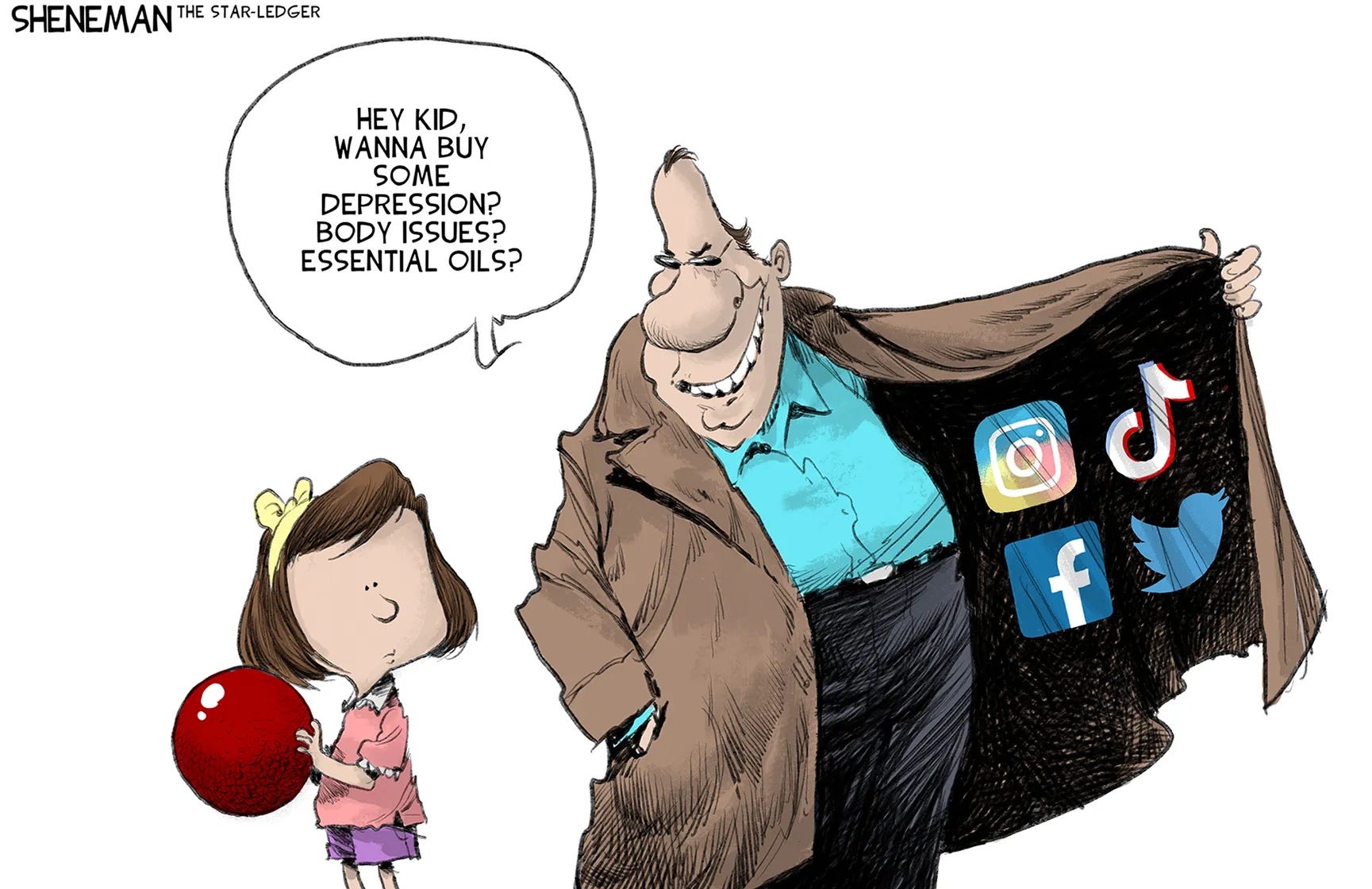
Art by Drew Sheneman
TL;DR: There’s a small, flickering ray of hope in our future. It isn’t just that Trump’s approval ratings have hit a record low, or that the political winds are finally shifting toward a more sane Democratic leadership after November. No, the real hope comes from a courtroom where Meta and other social media titans were finally found guilty. For the first time, a jury looked at the “Move fast and break things” mantra and realized that what they were actually breaking was our children.
But as a follow-up to my post “Toxic Relationships,” I have to tell you: The fight is not over.
Meta and the other tech giants have been held accountable for the first time, but the fight is far from over. From fentanyl-laced pills sold on Snapchat to the devastating “sextortion” rings that lead to child suicide, these companies have prioritized their “profit over lives” ideology for too long. People are waking up: if “We the People” don’t stop these techno-fascists, we’ll lose generations to depression, addiction, and suicide. Watch the film “Can’t Look Away,” then call your Congress member and demand they pass the Kids Online Safety Act (KOSA).
There’s a small ray of hope for our future.
Not because Trump’s approval rating is in the toilet—though it is, and Democrats will likely take power after November. Not because the American people suddenly woke up to the grift—though more are waking up every day.
The hope comes from something simpler and more powerful: Meta and other social media companies finally faced a jury, and they were found guilty.
Guilty of what they’ve been doing for years while lawyers and lobbyists protected them. Guilty of prioritizing profits over the safety of children. Guilty of knowingly operating platforms that harm, addict, exploit, and kill young people.
This is a follow-up to my earlier post “Toxic Relationships,” where I wrote about how social media companies function as digital drug dealers, engineering addiction by design. But I need to go deeper, because there’s another side to this story that’s even darker—and it’s finally getting the attention it deserves.
Social Media: The Largest Drug Dealer in America
Let me be blunt: Social media companies are the largest drug dealers in the country. Not metaphorically. Literally.
Yes, they deal in digital addiction—dopamine hits, infinite scroll, engineered engagement loops that keep kids glued to screens while their mental health deteriorates. But they’re also dealing in actual drugs. Fentanyl. Pills. Counterfeit prescription medications that kill teenagers in their bedrooms while their parents sleep downstairs, unaware their child just bought what they thought was Xanax from someone on Snapchat.
These companies have known for years that their platforms are used to sell illegal and often deadly drugs to children. They’ve known that drug dealers use their features—disappearing messages, location services, recommendation algorithms—to target young customers. And they’ve done nothing to stop it. Because stopping it would require investing in safety systems that cut into profit margins. And profit always wins over children’s lives when you’re a techno-fascist billionaire.
🎥 “Can’t Look Away”: A Documentary Every Parent Must See
If you haven’t seen the new film Can’t Look Away, you need to. It is a moving, heart-wrenching testament to the families who have lost everything to a screen. The movie exposes a side-effect of social media that is more than just “unhealthy”—it’s lethal.
Specifically, the film shines a spotlight on how Snapchat’s very architecture functions as a precision tool for the drug trade. While the company markets disappearing messages as “privacy for friends,” in reality, they provide a cloak of invisibility for dealers to erase evidence of a sale before parents or law enforcement ever see it. Their “Snap Map” feature, designed to help friends find each other, is effectively a geofencing tool that allows dealers to target local high schools and neighborhoods with terrifying accuracy. Most damning is the auto-recommend algorithm; it doesn’t just suggest new friends, it pushes “vendors” directly into the feeds of vulnerable teens, creating a frictionless pipeline for deadly, fentanyl-laced pills.
It is a story of tragedy, but also of a hard-won triumph over the insurmountable legal shield known as Section 230. For decades, these companies hid behind that “Get Out of Jail Free” card, claiming they weren’t responsible for the content on their sites. A jury finally disagreed, thanks to some very committed attorneys who care deeply for our children.
The Full Scope of Harm
Social media companies expose our children to multiple levels of harm, and they do nothing meaningful to stop any of it. Bullying is relentless, 24/7, inescapable. Kids used to get bullied at school and find refuge at home. Now bullying follows them everywhere, into their bedrooms, into their safe spaces, amplified by algorithms that boost cruel content because it drives engagement. Fentanyl-laced drugs kill kids who think they’re buying Adderall or Xanax. One pill kills. And Snapchat makes the transaction as easy as ordering pizza.
The harm doesn’t stop at fentanyl-laced pills. We are seeing a rise in Sexploitation—a predatory practice that is as efficient as it is evil. Predators pose as young girls to convince boys to send compromising photos. The moment the photo is sent, the trap snaps shut. The victims are blackmailed with threats that the photos will be blasted to their entire family, school, and social network. This has resulted in financial extortion—kids emptying their bank accounts, stealing money from parents, doing anything to make the blackmail stop. And it’s resulted in suicides—kids who couldn’t see a way out, who couldn’t tell their parents, who felt trapped by shame and fear, choosing death over exposure.
Suicide glorification videos on TikTok, Instagram, and YouTube romanticize death, provide methods, encourage vulnerable kids to see suicide as escape. The algorithms learn who’s vulnerable and feed them more of this content because it keeps them engaged.
These aren’t rare edge cases. These are systematic harms happening to thousands of kids, enabled by platforms designed to maximize engagement without regard for safety.
These tech giants have seen the data. They know this leads to financial extortion, and worse, it leads to suicide. Yet, they did nothing. They sat back and watched the “engagement” metrics rise while children were being bullied, groomed, and pushed to the edge by suicide-glorification videos.
“To these techno-fascists, your child’s mental health is just another data point to be sold to the highest bidder.”
Techno-Fascists: Profit Over Lives
The people running these companies aren’t ignorant. They’re not unaware of the harm. They know. Internal documents prove it. Whistleblowers confirm it. Research studies document it.
Meta’s own research showed that Instagram makes teen girls feel worse about their bodies, increases anxiety and depression, and contributes to suicidal ideation—and they buried those findings and kept pushing the platform to younger users. Snapchat knows drug dealers use their platform to target kids. They’ve been told repeatedly. They’ve been sued. They’ve faced congressional hearings. And they’ve done the bare minimum because meaningful safety measures would hurt growth. TikTok knows their algorithm pushes harmful content to vulnerable kids. They know the “For You” page learns what makes you depressed, anxious, insecure—and feeds you more of it to keep you scrolling.
This isn’t negligence. This is deliberate choice. This is techno-fascism—the ideology that says profits matter more than people, growth matters more than safety, and shareholders matter more than the children whose lives are destroyed. These billionaires have decided that your kids are acceptable collateral damage in their quest for market dominance and quarterly earnings growth.
🏛️ The Call to Action: We the People vs. The Machine
If “We the People” don’t put a stop to this “profit over lives” ideology, we will lose entire generations to depression, addiction, and the dark corners of the web. These companies have treated our children like lab rats in a digital cage, and the results are in: the rats are dying.
We have to be the adults in the room. We have to be the ones to say that a “Like” isn’t worth a life.
Here is what you need to do today:
See the film Can’t Look Away. Watch it with your kids. Use it to start the conversation they are terrified to have.
Call your Congress member. Don’t just email—call.
Demand they pass KOSA (Kids Online Safety Act). We need to strip away the digital immunity that allows these “Death Dealers” to operate without consequence.
Criminal activity should not be dismissed just because it happens behind a glass screen. Our children deserve a future where “online” doesn’t mean “in danger.”
F*CK ICE, RELEASE ALL THE FILES!
Please like, share, and subscribe—because the only thing more addictive than social media is the truth. a
Democray4sale.substack.com / Democracy4sale.com
— Robert Cain, author of Democracy for Sale: How Corporate Greed Is Corrupting Democracy and Endangering the Planet. Available at Amazon, Barnes & Noble, and Booksellers everywhere