Politics
Part of: Corporate InfluenceAmerica Rolls the Dice:
By Rob C.
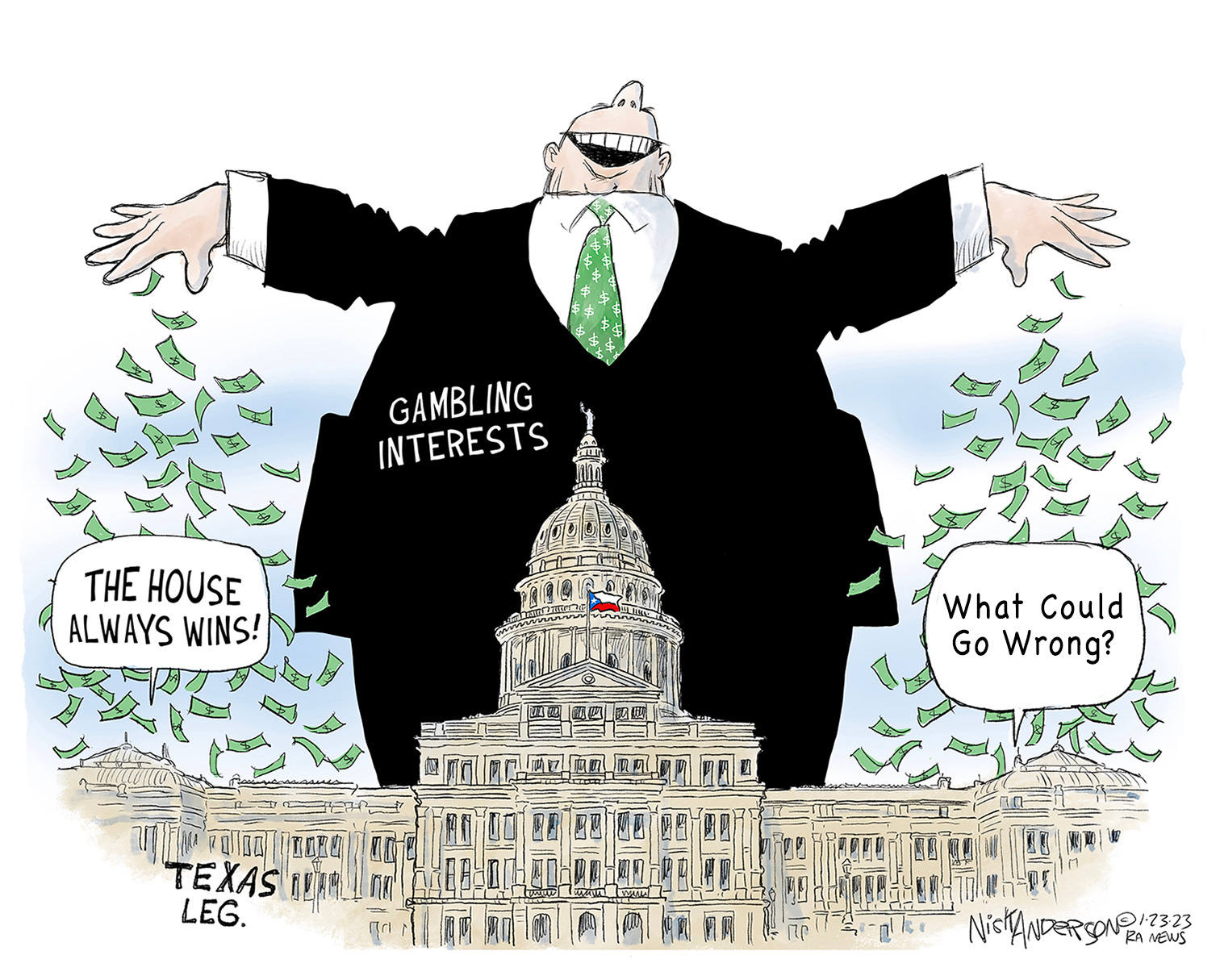
Art by Nick Anderson
TL;DR: America has become one giant casino where you can bet on literally anything—sports, elections, stock prices, whether it’ll rain next Tuesday. The Super Bowl alone saw $1.76 billion in legal bets, and total US sports betting hit $157 billion in 2025. But it’s not just sports. The stock market is operating as a rigged casino for the “Epstein class,” prediction markets let you gamble on elections, and social media platforms hook kids on dopamine-driven algorithms designed to be as addictive as slot machines. It’s “digital fentanyl” for our youth. Young people are 2-4 times more likely to develop gambling addictions than adults, yet “social conservatives” who lost their shit over rap music are totally cool with corporations poisoning kids for profit. Remember, the house always wins. Everyone else loses. Maybe it’s time we stopped letting them rig the game.
You could be forgiven for thinking this is just about sports betting—the apps that promise easy money, the celebrity endorsements, the constant ads during every game telling you to “bet responsibly” (wink wink). Sports gambling has exploded, snaring millions of young men who think they’re one good bet away from paying off their student loans.
But gambling has metastasized far beyond football pools and March Madness brackets. It’s infected every corner of American culture. We’re not just tolerating it anymore—we’re celebrating it, normalizing it, and building entire industries around convincing people to risk money they don’t have on outcomes they can’t control.
The numbers are staggering. The Super Bowl just set records with $1.76 billion in legal betting on a single game. Total sports betting in the US topped $157 billion for 2025. That’s not money being invested in businesses or infrastructure or education. That’s money being funneled into corporate gambling operations designed to extract wealth from regular people and concentrate it in the hands of casino executives and tech bros.
There was a time when gambling was viewed as a vice—something shameful, something you hid, something society discouraged. Now? We’re stewing in a pot of sin where you can bet on literally anything, and corporations are making billions by convincing you it’s entertainment.
Prediction Markets: Gambling on Democracy
Sports betting is at least honest about what it is. But now we have “prediction markets” where users buy binary “Yes” or “No” contracts on real-world events, treating outcomes as tradeable assets.
Think about that. You can now gamble on elections. On wars. On whether a politician will be indicted. On whether a company will go bankrupt. These platforms, like Kalshi and Polymarket, where users buy “Yes” or “No” contracts on real-world events. Will the war with Iran start by Friday? Bet on it. Will the Epstein files stay redacted? Buy the ‘Yes’ contract. These aren’t hypotheticals— these platforms are letting people bet real money on the outcomes of events that affect millions of lives.
It’s gambling dressed up as “information markets.” They’ll tell you it’s about “wisdom of crowds” and “price discovery,” but strip away the jargon and it’s just a casino where you’re betting on whether democracy survives or your neighbor loses their job.
Corporate America has, of course, embraced this with open arms. Why wouldn’t they? There’s money to be made, regulations to dodge, and a whole new generation of marks to exploit.
The Stock Market: The World’s Biggest Casino
But here’s the uncomfortable truth: we’ve been gambling for a long time. We just called it “investing” and pretended it was different.
Of course, the biggest casino in the world has always been Wall Street. People bet on the future of everything—corn prices, oil futures, whether a company will beat earnings projections by a few cents per share. We like to pretend the stock market is a rational reflection of value, but as I’ve documented in my work on the Panama and Paradise Papers, it’s mostly a playground for institutional manipulation. Stock prices exist almost entirely outside of a company’s control, driven by the whims of large investors who play by a different set of rules. They exist in their own reality, driven by speculation, manipulation, and the collective delusions of people who think they can time the market.
Sure, the markets are slightly more predictable than rolling dice—there are patterns, trends, fundamentals. But they’re also controlled and manipulated by large institutional investors who have information advantages, algorithmic trading systems, and the ability to move billions in seconds. For the average person? It’s a rigged game where you’re competing against people who see the cards before they’re dealt.
And let’s talk about insider trading. It’s supposedly illegal. But look at Congress. Look at the Trump administration. Politicians are making stock trades based on classified briefings and then pretending it’s just “good financial planning.” Members of Congress consistently outperform the market—not because they’re investing geniuses, but because they’re trading on information you and I don’t have access to.
The law doesn’t apply to them. It never has. The game is rigged, and they’re not even hiding it anymore.
The Dark Side: Preying on Young Minds
Here’s where this stops being about questionable life choices and becomes genuinely horrifying: gambling is destroying young people.
Studies show that adolescents are 2-4 times more likely to develop gambling problems than adults, with 10% of young men already showing signs of clinical addiction. Their brains aren’t fully developed. The prefrontal cortex—the part responsible for impulse control, risk assessment, and long-term planning—doesn’t finish developing until the mid-20s.
But gambling companies don’t care. They’re targeting kids through social media ads, celebrity endorsements, and gamified apps designed to feel like video games. They’re hooking developing brains on dopamine hits, teaching teenagers that money is something you win rather than earn, and creating a generation of gambling addicts before they’re old enough to rent a car.
The effects are devastating. Heightened anxiety. Depression. Academic decline. Financial debt before they even have a credit score. Social isolation as they chase losses and spiral deeper into addiction.
And it’s not just gambling apps. Social media platforms have designed their algorithms to function exactly like slot machines—unpredictable rewards, infinite scroll, dopamine-driven engagement loops that keep you coming back for one more hit. They knew what they were doing. The evidence is overwhelming. Internal documents prove these companies studied addiction, hired psychologists to maximize engagement, and deliberately targeted vulnerable populations including children.
They’re being sued now. Defending themselves in court. And their defense is essentially “we didn’t know getting kids addicted to our platforms would be harmful”—which is either a lie or an admission of criminal negligence.
Just like tobacco companies knew cigarettes caused cancer and sold them anyway. Just like opioid manufacturers knew OxyContin was highly addictive. These companies knew, and they did it anyway because profit mattered more than people.
The House Always Wins
There’s one rule in gambling that never changes: the house always wins.
That means everybody else loses. Maybe not today. Maybe not this bet. But over time, mathematically, inevitably, the house wins and you lose. That’s how the system works. That’s why casinos are profitable (except when Donald Trump runs one). That’s why gambling companies spend billions on advertising—because they know the odds are in their favor and volume is all that matters.
And yet we’ve built an entire culture around pretending this isn’t true. We celebrate the winners and ignore the thousands of losers. We promote “responsible gambling” while designing systems specifically to encourage irresponsible behavior. We let corporations target kids with addictive products and then act shocked when those kids develop addictions.
Where Are the “Social Conservatives”?
Here’s what I find fascinating: the same “social conservatives” who lost their absolute shit over rock music, rap lyrics, violent video games, and Janet Jackson’s nipple are completely silent about gambling destroying young lives.
They’ll scream about protecting children from drag queens reading books, but they’re totally cool with gambling apps targeting teenagers. They’ll organize boycotts over beer commercials featuring trans people, but won’t say a word about casinos advertising during family programming.
Why? Follow the money. Gambling corporations donate to politicians. They fund campaigns. They hire lobbyists. They’ve bought silence from the people who claim to care about “family values.”
Turns out “protecting children” only matters when it doesn’t interfere with corporate profits.
It’s Time to Demand Better
Maybe—and I’m just spitballing here—it’s time for citizens to demand that corporations stop poisoning our kids with toxic algorithms and predatory gambling apps.
Maybe we should regulate gambling advertising the way we regulate tobacco and alcohol. No ads during programming likely to reach children. No celebrity endorsements aimed at young people. No gambling apps designed to look like innocent games.
Maybe we should ban prediction markets on elections and political events because treating democracy like a casino game is fucking dystopian.
Maybe we should enforce insider trading laws against politicians and make Congressional stock trading illegal because if you have access to classified information, you shouldn’t be allowed to profit from it.
Maybe we should break up the social media platforms that are deliberately addicting kids and design their algorithms to maximize engagement at the expense of mental health.
Maybe we should stop pretending the stock market is “investing” when it’s really just legalized gambling for people with enough money to lose.
The house always wins. But only because we let them run the game. We don’t have to keep playing in a rigged casino. We could demand actual regulation. We could protect vulnerable people. We could prioritize human wellbeing over corporate profit.
Or we could keep rolling the dice and pretending we’re going to win.
Your call.
F*CK ICE. RELEASE ALL THE FILES!
Please like, share, and subscribe—because the house is counting on you not paying attention.
Robert Cain, author of “Democracy for Sale: How Corporate Greed Is Corrupting Democracy and Endangering the Planet”