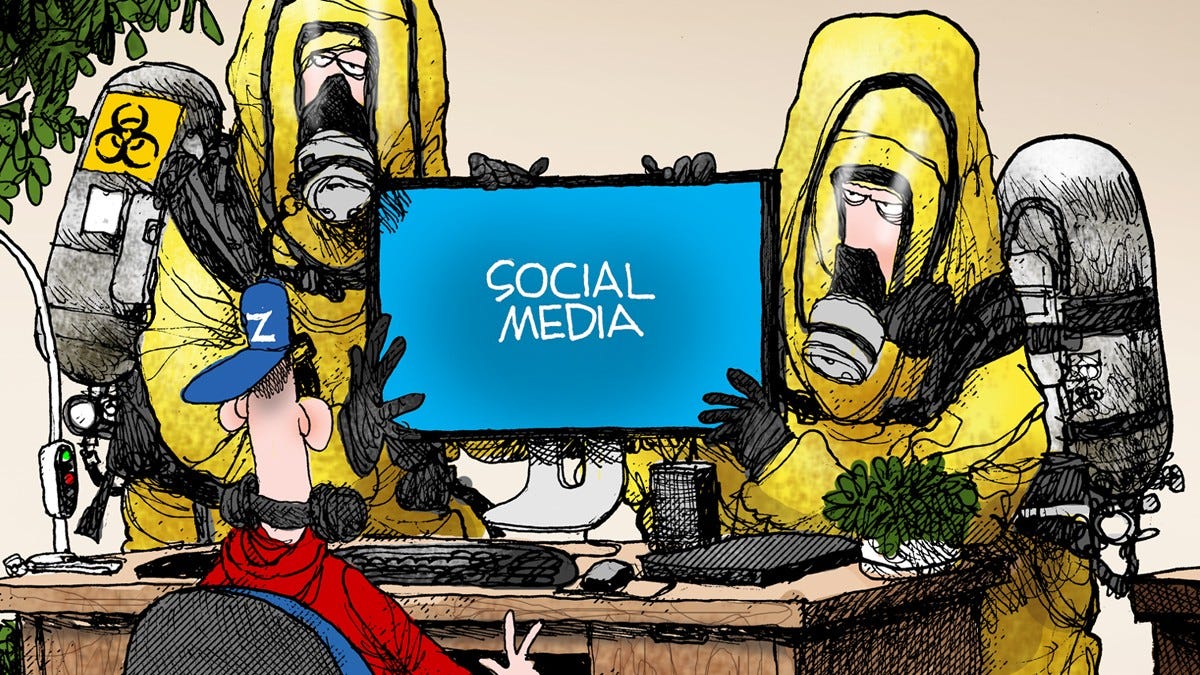
Art by Michael Ramirez
TL;DR: For decades, Silicon Valley has conducted an unconsented psychological experiment using algorithms as “digital fentanyl” to hook children for profit. Landmark court cases in New Mexico and California reveal that Meta, TikTok, and YouTube deliberately designed addictive platforms knowing they cause anxiety, depression, eating disorders, and suicide. New Mexico’s Attorney General sued Meta for creating “a breeding ground for predators” while suppressing research showing Instagram harms teen girls. California cases exposed companies studying addiction mechanics and deploying them on minors. These giants remain shielded by Section 230. Without stripping legal immunity from the “Epstein Class,” the next algorithm they write will not just harm a generation — it will delete democracy itself.
Good morning. If you’re reading this on a smartphone, you are currently holding a digital slot machine designed by expensive psychologists. Its only goal? To keep you scrolling until your thumb cramps and your dopamine receptors burn out.
Social media companies have spent decades claiming they connect the world and build communities. Instead, they’ve poisoned society — particularly children — with deliberately addictive algorithms designed to maximize engagement and profit regardless of psychological, social, and physical harm.
This isn’t conspiracy theory. This is documented fact, proven in internal company documents, confirmed by whistleblowers, and now being litigated in landmark court cases holding these corporations accountable.
The Social Dilemma: How We Got Here
As the 2020 documentary The Social Dilemma revealed, if you aren’t paying for the product, you are the product. These platforms were designed by brilliant minds to be maximally addictive. For the techno-fascists running them, “the product” isn’t just your data — it’s your children’s mental health. They’ve spent twenty years poisoning human interaction, creating a fragmented society of outrage and anxiety, because “engagement” keeps stock prices high enough to buy politicians.
Former executives and engineers from Facebook, Google, Twitter, and Pinterest confessed on camera that they built systems specifically designed to manipulate psychology and maximize user engagement. They hired behavioral psychologists. They studied slot machine mechanics and applied them to notifications and infinite scroll. They A/B tested every feature to maximize “time on platform.” They built algorithms that learned exactly what content triggers emotional responses — anger, fear, outrage, validation — and fed users more to keep them hooked.
People became addicted to their phones, scrolling feeds, seeking validation through likes. Children grew up with dopamine systems trained by algorithms exploiting their developing brains. The companies claimed they were neutral platforms — just technology, just connecting people. Any negative consequences were unintended side effects, not deliberate features. This was always a lie. Now we have proof.
Meta is a “Breeding Ground for Predators”
The legal “drug bust” of the century is underway, led by states tired of burying children who fell down algorithmic rabbit holes. In late 2023, New Mexico’s Attorney General sued Meta (Facebook and Instagram), pulling back the curtain on how knowingly harmful these platforms are. Based on internal Meta documents and undercover investigations, the lawsuit revealed that Meta deliberately designed Instagram to be addictive to children while creating “a breeding ground for predators.”
The evidence was devastating. Internal Meta research showed Instagram caused significant psychological harm to teenage girls. One study found that 32% of teen girls said Instagram made them feel worse about their bodies. Another found that among teens reporting suicidal thoughts, 13% of British users and 6% of American users traced the issue directly to Instagram. Meta knew this. They had the data. Their researchers warned executives that Instagram was toxic to young users’ mental health. Meta’s response? Suppress the research.
The lawsuit also detailed how Meta’s platforms facilitated child sexual exploitation. Predators used Instagram to find, groom, and abuse minors. Meta’s algorithms recommended child exploitation content to interested users. The company’s moderation systems were deliberately understaffed and ineffective because aggressive moderation would reduce engagement — and engagement drives ad revenue. Meta chose profit over children’s safety. Knowingly. Deliberately. With full awareness of the harm.
Addiction by Design
California has been ground zero for lawsuits against social media companies, revealing corporations’ deep knowledge about their products’ addictive nature and harm to minors. Court filings in cases against Meta, TikTok, YouTube, and Snapchat included internal documents showing these companies studied addiction mechanics and intentionally deployed them on young users. They analyzed how teenagers’ developing brains respond to social feedback. They measured dopamine responses to notifications. They optimized every aspect of user experience to maximize compulsive use.
One damning piece of evidence showed Facebook executives discussing whether to remove features they knew harmed teens but decided against it because those features drove engagement. Another showed TikTok engineers celebrating that their algorithm was so effective at keeping users scrolling that average session times kept increasing — even as mental health metrics for young users deteriorated.
The California lawsuits revealed these companies deliberately targeted children despite publicly claiming their platforms were for users 13 and older. They designed features specifically to appeal to younger demographics. They allowed children to create accounts with minimal verification. They ignored obvious underage users because more users meant more data, more engagement, and more ad revenue. These weren’t accidents. These were deliberate business decisions by executives who knew the harm and chose profit over safety.
Section 230: The Legal Shield That Enables Abuse
For decades, social media companies have hidden behind Section 230 of the Communications Decency Act — the legal provision shielding online platforms from liability for user-generated content. The original intent was reasonable: websites shouldn’t be held responsible for every comment or post, or they’d never operate. But Section 230 was written in 1996, before Facebook, YouTube, algorithmic feeds, and targeted content. It was designed for a different internet — where platforms were passive hosts, not active curators using AI to manipulate what users see.
Modern social media platforms aren’t passive hosts. They’re active participants shaping content exposure through algorithms designed to maximize engagement. When YouTube’s algorithm recommends increasingly extreme content to radicalize users, when Instagram’s algorithm promotes eating disorder content to vulnerable teens, when TikTok’s algorithm creates addictive feedback loops — these aren’t neutral platforms. These are editorial decisions made by AI trained to maximize profit.
Section 230 needs reform to reflect this reality. Platforms should retain protection for truly user-generated content hosted passively. But when they algorithmically amplify content, recommend content, or optimize content delivery to manipulate user behavior — especially when that manipulation harms minors — they should be liable. The tech industry will scream that any Section 230 reform will “destroy the internet.” This is Big Tobacco’s playbook: claim that oversight will destroy the industry and kill jobs. It’s a lie designed to protect profits, not people.
Tech-Bros Sacrificing Children on the Altar of Profit
Let’s be clear: billionaire tech executives have knowingly sacrificed children’s mental health, physical safety, and psychological development for obscene profit. They hired psychologists to study addiction. They deployed those findings to make products more addictive. They targeted children despite knowing their products were harmful. They suppressed research documenting harm. They lobbied against regulation. They lied to Congress. They lied to parents. They lied to the public.
Mark Zuckerberg knew Instagram was toxic to teenage girls and expanded it anyway. YouTube executives knew their recommendation algorithm radicalized users and optimized it for engagement anyway. TikTok leadership knew their platform was designed to be addictive and marketed it to children anyway. These aren’t entrepreneurs. These aren’t innovators. These are drug dealers who’ve figured out how to deliver their product through screens instead of street corners, and who’ve bought enough politicians to ensure minimal consequences.
The parallels to Big Tobacco are exact. Internal documents showing knowledge of harm. Deliberate targeting of young people. Suppression of research. Lobbying against regulation. Claims that products aren’t harmful despite overwhelming evidence. The playbook is identical because it works. Big Tobacco eventually faced accountability. Lawsuits. Settlements. Regulation. It took decades, but eventually harm became undeniable and the legal system caught up. We’re at the beginning of that process with social media. The question is how much more damage and how many more children die before accountability arrives.
The Techno-Fascists Don’t Care — And They’re Ending Democracy
Here’s what you need to understand about techno-fascists running these companies: they don’t care about the harm they cause. They’re not ignorant of damage. They’re not making honest mistakes. They know exactly what they’re doing. They have the research. They have the data. They have internal reports documenting anxiety, depression, eating disorders, self-harm, and suicide linked directly to their products. And they don’t care. Because caring means reducing engagement. Reducing engagement means lower ad revenue. Lower ad revenue means smaller stock prices. So they choose wealth over children’s lives. Explicitly. Knowingly. With full awareness.
This is the Epstein class in action. Billionaires and corporations believing laws don’t apply to them, using wealth to buy political protection, viewing other people — especially children — as resources to exploit for profit. Peter Thiel has stated openly that democracy and freedom are incompatible. Elon Musk uses Twitter/X as a propaganda tool spreading disinformation and radicalizing users. Mark Zuckerberg built an empire on addicting children to validation-seeking behavior that destroys mental health.
If we don’t take back the country from the Epstein class — if we don’t regulate these platforms, reform Section 230, hold executives accountable, and break up monopolies — they will create algorithms that end democracy itself. They’re already doing it. Facebook’s algorithm radicalizes users by feeding increasingly extreme content. YouTube’s recommendation engine creates conspiracy theorists. TikTok’s feed manipulates political opinions. Twitter/X under Musk actively promotes right-wing propaganda.
These aren’t bugs. These are features. Radicalized users are engaged users. Angry users share more content. Fearful users click more ads. Division drives engagement. Extremism drives time on platform. Algorithms optimized for engagement produce maximum engagement when people are angry, afraid, and divided. So the algorithms make people angry, afraid, and divided. Democracy requires informed citizens capable of rational discourse and compromise. The algorithms create the opposite: radicalized tribes incapable of finding common ground.
This is how democracy dies. Not through military coups or obvious tyranny, but through algorithmic manipulation making rational self-governance impossible. The techno-fascists know this. Some want it. They believe democracy is inefficient and should be replaced with corporate rule. They’re using their platforms to make that vision reality.
We can stop them. But only if we recognize what’s happening, demand accountability, support regulation, and refuse to let our children be sacrificed for billionaire profits. The toxic relationship between social media companies and society must end. These corporations have proven they cannot be trusted to self-regulate. They’ve chosen profit over safety at every turn.
It’s time to break the addiction. It’s time to break the “Shield.” And it’s time to remind the tech-bros that our children are not their “profit centers.”
F*CK ICE. RELEASE ALL THE FILES!
Please like, share, and subscribe — because social media is poisoning our kids by design, and only regulation can stop it.
Robert Cain is the author of Democracy for Sale: How Corporate Greed Is Corrupting Democracy and Endangering the Planet. Available at Amazon, Barnes & Noble, and booksellers everywhere.