Politics
Part of: Corporate InfluenceAmerican Backlash
By Rob C.
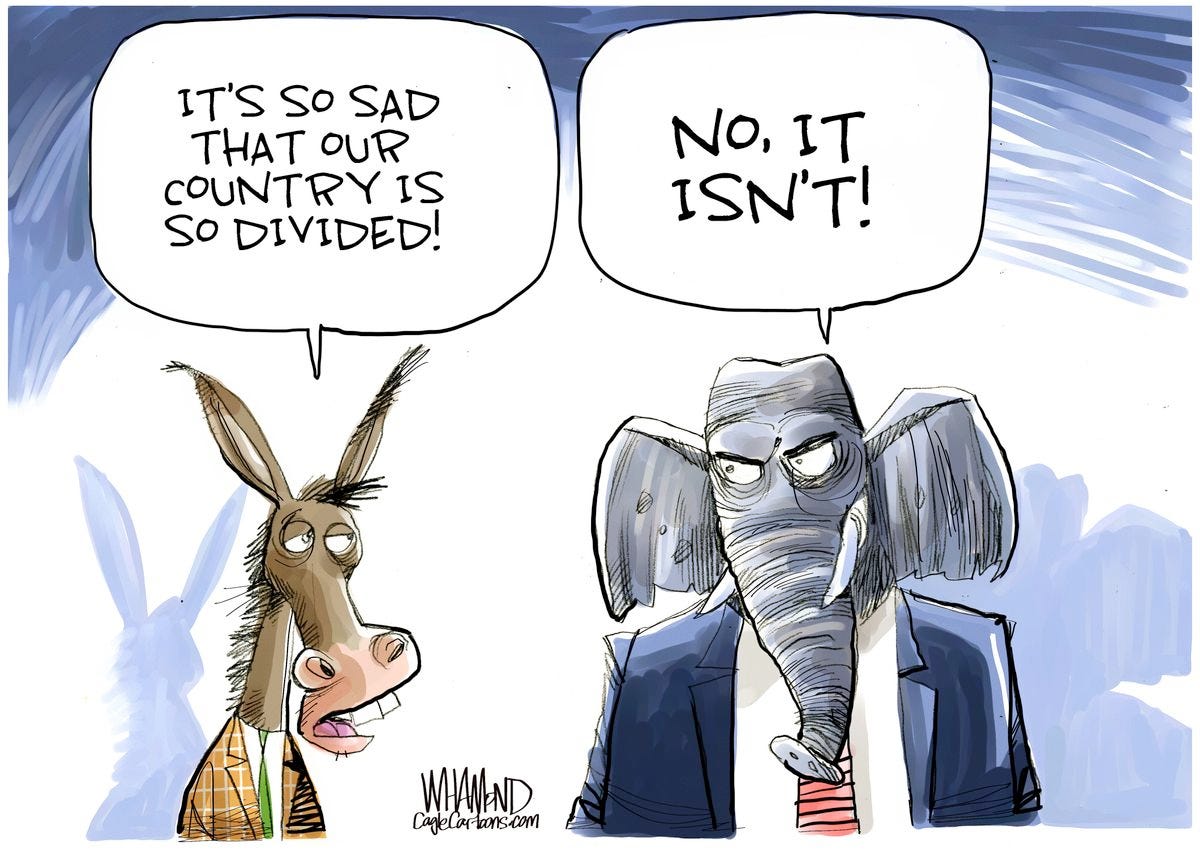
Art by Dave Whamond
Democrats send “thoughts and prayers,” Republicans send threats. Violence in America isn’t symmetrical — it overwhelmingly comes from the right. Online platforms radicalize isolated young men, algorithms accelerate the hate, and corporate media downplays it to protect advertising dollars. Unless we face reality, the backlash will keep spilling blood.
Too Much Prayer, Too Little Action
Democrats are basically the Hallmark Channel — kind words, soft piano music, and absolutely no confrontation. Republicans, on the other hand, skipped straight to Quentin Tarantino — blood, vengeance, and open threats. The right reacts with warnings about civil war and promises of retribution.
This is America’s divide in a nutshell. One party offers conciliation and candlelight vigils. The other offers armed militias and an open invitation to violence. It’s not just a difference in rhetoric — it’s a fundamental asymmetry in how the two parties view power, conflict, and democracy itself.
Radicalization by Algorithm: From Isolation to Insurrection
Mass violence in America isn’t born in a vacuum — it’s incubated online.
As Scott Galloway points out, millions of young American men are increasingly cut off from the anchors of life: fewer friends, less intimacy, lower educational achievement, and declining workforce opportunities.¹ In this vacuum, algorithms become the loudest voices. YouTube autoplay doesn’t serve connection — it serves escalation. Facebook doesn’t deliver facts — it delivers outrage. TikTok doesn’t cure loneliness — it feeds grievance.
This toxic brew of isolation and algorithm creates a feedback loop: loneliness turns to resentment, resentment turns to rage, and rage finds a home in extremist communities that promise purpose, brotherhood, and someone to blame.
Charlie Kirk – Promoter of the Extreme
Charlie Kirk, a family man in the business of selling grievance with a side of hate.
Kirk built his empire on Turning Point USA by turning college campuses into battlegrounds of grievance. He peddled conspiracy theories about “white replacement,” attacked LGBTQ rights, dismissed gun violence, and belittled women and people of color with statements so offensive they’d make even Alex Jones say, ‘Dude, tone it down’. He was less a thinker than a performance artist for rage politics — and the applause came in the form of donor checks and massive online followings.
Kirk didn’t just amplify extremism — he legitimized it. For thousands of young men already lost in online echo chambers, his voice became proof that their darkest thoughts weren’t just acceptable, they were patriotic.
Where Hate Thrives
Sites like Gab, Telegram, and Discord are like grim back alleys of the web: full of shadowy voices trading insults, ideology, and occasionally instructions. But the danger isn’t confined to those fringe spaces. Mainstream sites — Facebook, YouTube, “X” but even Steam and other gaming-adjacent platforms — are part of the pipeline. Users on Steam (profiles, community forums), Discord servers, or lesser moderated gaming adjacent forums are exposed to extremist content, coded symbols, memes celebrating school shootings, and white supremacist ideology.⁶
Recent reporting on the murder of Charlie Kirk revealed that some of the bullet casings and ammunition recovered bore cultural references and memes rather than explicit political ideology (earlier claims of “trans ideology” which later were retracted).⁷ One engraving reportedly read: “Hey, fascist! Catch!” Popular with the “Call of Duty” community, while others reflected gaming or meme culture.⁷
The Zadrozny Factor: Looking Down the Rabbit Hole
Brandy Zadrozny has spent years wading through the sewage of America’s online underbelly. She’s not just reporting from the sidelines — she’s embedded herself in QAnon forums, Facebook groups, and Telegram channels to show how conspiracy theories mutate and spread.
Her early reporting on QAnon traced how a vague internet riddle spiraled into a full-blown mass delusion, pulling in suburban moms, retired cops, and even elected officials. Zadrozny has shown how the movement morphed from “online game” into political organizing, complete with merch tables and rallies. She documented how “Stop the Steal” was seeded on Facebook, grew in Telegram channels, and eventually leapt into real-world violence on January 6th.¹
In her most recent work (All In with Chris Hayes, 9/12/25), she made the asymmetry unmistakable: left-wing extremism online exists but is scattered, disorganized, and usually self-limiting. Right-wing extremism, by contrast, is “everywhere.” It’s in your aunt’s Facebook feed. It’s in local Telegram groups recruiting angry dads. It’s on Discord servers where teens play games by day and trade memes about civil war by night.²
What Zadrozny’s reporting makes clear is that radicalization isn’t happening in secret anymore. It’s happening in plain sight, under the watch of tech companies and politicians who know better, but stay silent because they know which way the money flows.
Follow the Money, Ignore the Bullets
Corporate media loves “both sides” narratives because they’re cheap and non-confrontational. More importantly, they’re safe for advertisers. NBC doesn’t want to lose Ford’s ad dollars. CNN doesn’t want to scare off Pfizer. So instead of calling out the documented reality — that political violence in America overwhelmingly comes from the right⁵ — they frame it as symmetrical, leaving viewers with the impression that “everyone’s doing it.”
This isn’t just lazy journalism, it’s complicity. When corporate news outlets refuse to tell the truth about the asymmetry of political violence, they become part of the cycle — normalizing extremism to protect revenue streams. The bloodshed may be real, but so are the quarterly profits.
Backlash Nation
Backlash is now America’s default political mode. Republicans respond to setbacks with rage, threats, and violence. Democrats respond with prayers, speeches, and hopes for unity. The media responds with cowardly false equivalence.
Until this asymmetry is acknowledged and confronted — by politicians, by journalists, and by citizens — the cycle of backlash will continue to accelerate. Pretending “both sides” are the same is not neutrality. It is surrender.
Footnotes
Vox. Are Men Okay? Our Modern Masculinity Problem, Explained. Interview with Scott Galloway, 2023.
RAND Corporation. Online Extremist Ecosystem Report. 2023.
Wall Street Journal. Facebook Knows Instagram Is Toxic for Teen Girls, Company Documents Show. 2021.
Brandy Zadrozny, All In with Chris Hayes, MSNBC, September 12, 2025. - Brandy Zadrozny, NBC News. QAnon: From Obscure Online Movement to Political Force, 2020–2023 reporting.
Anti-Defamation League (ADL). Murder and Extremism in the United States. Annual reports, 2023–2024. NYU Stern Center for Business & Human Rights, Gaming the System: How Extremists Exploit Gaming Spaces, 2023. Finds extremists exploiting both traditional gaming and gaming-adjacent platforms (livestreams, chat, etc.) to network, spread hate, recruit vulnerable users. Also Frontiers in Psychology report: far-right extremists are increasingly using livestream gaming to radicalize teenagers.⁸
The Daily Beast, The Guardian, Wall Street Journal reports on Charlie Kirk assassination: early claims about bullet inscriptions referencing “transgender ideology” and “antifascist ideology” were later questioned/modified; verified engravings included meme- and gaming culture references, and one reading “Hey, fascist! Catch!” were reported by official sources.⁷
Politics
I’m Not Wrong About This!Politics
Political Violence in America