By Rob C.
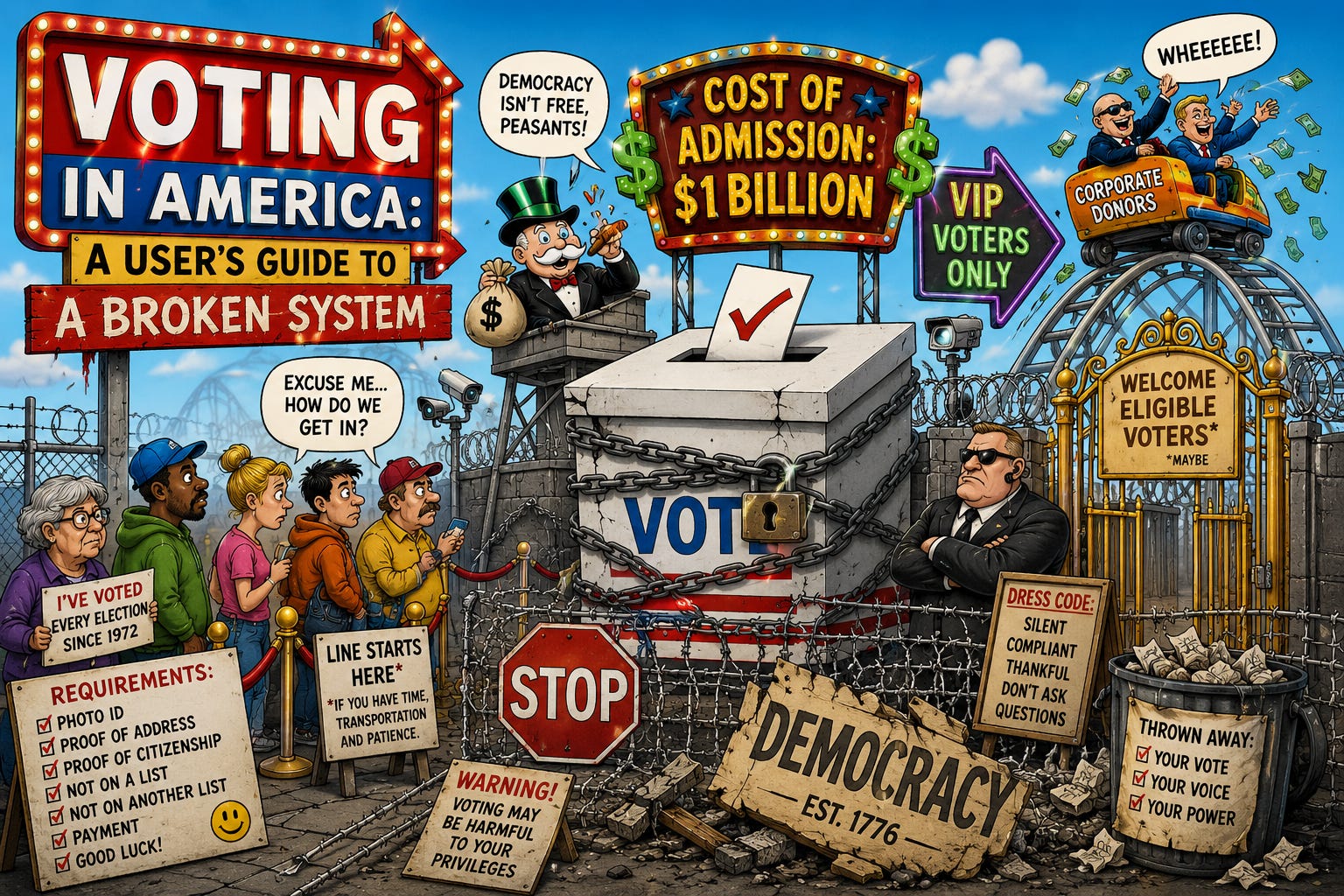
TL;DR: Congratulations, America! You’ve successfully turned the “sacred right to vote” into a high-stakes, corporate-funded circus where your actual influence on policy is statistically indistinguishable from zero. America doesn’t really have a voting problem. We have a democracy problem.
We have a patchwork of election systems that vary wildly from state to state, rampant gerrymandering, billionaire-funded campaigns, voter purges, and a political duopoly that leaves millions of Americans choosing between candidates they don’t actually like. Then we act surprised when turnout collapses and people lose faith in the system.
Good morning. If you’re currently standing in a line that wraps around a block to cast a vote for one of two candidates who seem to have been hand-picked by a corporate algorithm, do me a favor: take a deep breath and realize we’re all part of the greatest optical illusion on Earth.
The good news? None of this is inevitable. We know how to fix much of it: ban gerrymandering, establish a legal right to vote, adopt ranked-choice voting, eliminate dark money, and create a system where ordinary people matter more than billionaires.
The bad news? Most of the people who would have to pass those reforms are the same people benefiting from the current mess.
Voting in America: How Your Vote Became optional
As millions of Americans either cast their ballots or prepare to head to the polls, they are confronted with one of the strangest election systems in the developed world.
Not because it’s complicated.
Because it’s fifty different systems duct-taped together and called democracy.
Depending on where you live, you might vote in a closed primary, an open primary, a jungle primary, a ranked-choice election, a runoff election, or some bizarre hybrid that sounds like it was designed by a committee of lawyers locked in a room with a bottle of bourbon and a map of congressional districts.
And after all of that effort, many Americans have reached the same conclusion:
“Why bother?”
It’s a tragic reality. Millions of people died, marched, fought, and sacrificed so all Americans could vote. Yet today, many citizens are either too busy, too frustrated, or too cynical to participate.
Can you blame them?
We have transformed one of the most sacred rights in a democracy into a billion-dollar Super PAC spending contest where voters are often presented with two choices: a Republican who sounds increasingly comfortable with authoritarianism or a Democrat who spends most of their time dialing for dollars from wealthy donors.
Not exactly the stuff of civic inspiration.
The Right to Vote (That We Don’t Actually Have)
One of the strangest facts about American democracy is that there is no explicit constitutional right to vote. Most Americans assume there must be. After all, voting is the foundation of representative government. Yet the Constitution largely prohibits certain forms of discrimination in voting rather than affirmatively guaranteeing every citizen the right to cast a ballot and have that ballot counted.
The practical result is that states maintain enormous control over election administration, creating opportunities for manipulation.
The “Provisional” Mirage
One example is the widespread use of provisional ballots - a “maybe” ballot that gets shoved into a separate container and only counted if you can prove your eligibility to a bureaucrat’s satisfaction by a specific, often impossible, deadline. If you’re in the wrong precinct, didn’t bring the “right” ID, or if some poll worker just decides your signature looks “off,” your vote disappears into the ether. In theory, this serves as a safeguard. In practice, millions of provisional ballots are issued every election cycle, and many are ultimately rejected and never counted.
The “Purge”
And don’t get me started on the “Voter Roll Purges.” States love to conduct semi-annual reviews to “clean up” the rolls—a process that disproportionately targets minorities, the poor, and anyone who isn’t a guaranteed Republican voter. They claim they’re removing “dead people,” yet when you actually look at the cases of voter fraud, it’s almost exclusively Republicans pulling that stunt. It’s pure projection.
Florida’s infamous voter purge before the 2000 election remains one of the most notorious examples, but similar controversies continue today across the country. Voters routinely discover they have been removed from registration rolls only when they arrive at the polls.
The burden should not be on citizens to continually prove they deserve to participate in democracy. The burden should be on the state to demonstrate that someone is ineligible. Dead people don’t vote. Despite decades of political fearmongering, documented cases of voter fraud involving deceased voters remain extraordinarily rare. Yet millions of legitimate voters face barriers because politicians continue chasing a problem that largely exists on cable news rather than in reality.
A functioning democracy would establish a national right to vote, automatic voter registration, strong protections against improper voter-roll purges, and a clear requirement that every valid ballot be counted. Citizens who have completed criminal sentences should also have their voting rights automatically restored. Democracy should not be a privilege granted by politicians. It should be a right protected from them.
The Map-Rigging Apocalypse: Packing and Cracking
If the system is rigged, the architects use a tool called Gerrymandering to make sure it stays that way. This isn’t just “politics”—it’s a high-tech strategy to amplify a party’s power far beyond its actual support.
The two most popular tools in the fascist toolkit are “packing” and “cracking”:
Packing: Jamming as many opposition voters as possible into a few districts, giving them overwhelming wins in those spots, but ensuring they have zero impact on the rest of the map.
Cracking: Splitting up communities of opposition voters across several districts so they consistently fall just short of the 50% needed to win. (Alabama)
The result? Politicians get to choose their voters, rather than the other way around. It’s a “shit-storm of WTF” that keeps the same corrupt actors in power, regardless of how often their policies tank the economy.
A System of Confusion
Take California’s current gubernatorial race. Thanks to the state’s “top-two” jungle primary system, voters are sorting through a field of 61 candidates. Yes, sixty-one. That’s not an election. That’s an escape room. Under California’s system, all candidates appear on one ballot regardless of party affiliation, and the top two vote-getters advance to the general election, even if they’re from the same party. Supporters argue it encourages moderation. Critics argue it encourages confusion. Looking at a ballot with 61 names on it, I can see all 61 sides of the argument.
Escaping the Lesser-of-Two-Evils Trap
Perhaps the most important reform available today is Ranked Choice Voting, also known as Instant Runoff Voting.
We’re currently stuck in a “duopoly” that presents us with two options: a fascist-leaning Republican or a corporate-funded Democrat. It’s the “lesser of two evils” trap.
Ranked Choice Voting changes that equation. How it works: Instead of choosing one person, you rank your candidates by preference (1st, 2nd, 3rd).
Instead of selecting only one candidate, voters rank candidates in order of preference. If no candidate wins a majority of first-choice votes, the lowest-performing candidate is eliminated and those ballots are redistributed according to voters’ next preferences. The process continues until someone earns majority support.
The Benefit: If your favorite candidate loses, your vote isn’t “wasted.” It automatically transfers to your next choice. This eliminates the “spoiler effect” that lets third-party candidates be blamed for the wrong person winning.
This simple change dramatically alters political incentives. Voters can support candidates they genuinely like without worrying about wasting their vote. Independent candidates become viable. Third parties gain opportunities to compete. Candidates are encouraged to build broader coalitions rather than simply energizing the most extreme elements of their base.
Elsewhere, states are experimenting with alternatives. New York City uses ranked-choice voting in many local elections. Alaska adopted a top-four primary combined with ranked-choice voting. Maine has become one of the most prominent examples of statewide ranked-choice elections. While no voting system is perfect, Ranked Choice Voting represents one of the most promising ways to break the two-party stranglehold that has dominated American politics for generations.
These reforms are attempts to solve a very real problem: voters increasingly feel trapped by a two-party system that gives them limited choices and even fewer reasons to be enthusiastic. And that feeling isn’t irrational.
Why Universal Mail-In Voting is Non-Negotiable
If we are serious about fixing a democracy that currently treats your vote like a “suggestion,” we need to start with the most basic hurdle: actually getting people to the polls. The modern American voting experience is a deliberate gauntlet of long lines, broken machines, and restrictive hours, all designed to ensure that only the most dedicated (or the least busy) citizens get to participate.
Universal Mail-In Voting isn’t a radical partisan power grab; it is a basic infrastructure upgrade. When states mail a ballot to every registered voter, they effectively remove the “logistics tax” on democracy.
The Numbers Don’t Lie
One of the most important political science studies ever conducted came from researchers Martin Gilens of Princeton and Benjamin Page of Northwestern. They examined nearly 1,800 policy decisions over several decades and reached a conclusion that should have sparked a national crisis.
Average citizens have little to no independent influence on public policy outcomes.
Economic elites and organized business interests, however, have significant influence. In other words, if ordinary Americans overwhelmingly support a policy, that support alone does not meaningfully increase the likelihood it will become law. But if wealthy interests support it, suddenly the odds improve dramatically.
So when voters say, “My vote doesn’t matter,” they’re not entirely wrong.
They’re just describing the symptoms.
The disease is money.
The Real Problem: Money Owns the System
Ultimately, however, no voting reform will fully solve our democratic crisis unless we address the role of money.
The famous 2014 Princeton and Northwestern study by political scientists Martin Gilens and Benjamin Page examined nearly two thousand policy outcomes and reached a disturbing conclusion. Average citizens have little independent influence over public policy outcomes. Economic elites and organized business interests, on the other hand, possess substantial influence over what government actually does.
In other words, politicians often ask for our votes and then spend the next several years answering to their donors.
Skin in the Game: Hawaii’s Wake-Up Call
The biggest problem? The billionaire class has flooded the zone with so much dark money that your $20 donation feels like a spitball against a battleship. But Hawaii just dropped a bomb. In May 2026, they passed Act 11, effectively ending the idea that corporations are “people” with “free speech” rights.
The law removes the power of corporations to spend money on elections entirely. They’re not banning “speech”; they’re redefining the corporate charter to say, “Hey, your job is to make widgets, not to buy politicians”. It’s a genius workaround to Citizens United. Corporations are legal constructs, not citizens. They do not vote, breathe, raise families, or serve on juries. Yet they wield extraordinary influence over elections. We need to take it a step further: eliminate PACs, ban dark money, and give every citizen a $25 “Democracy Voucher” they can give to the candidate of their choice. Let the billionaire-class fight over their yachts, while the rest of us actually elect people who give a shit.
Imagine the difference. Instead of billionaires flooding the zone with unlimited money, every citizen would possess a small but meaningful stake in the political process. That creates accountability. It creates engagement. Most importantly, it creates ownership.
Because if democracy belongs to everyone, then everyone should have some skin in the game.
Once elected, many politicians quickly discover that their political survival depends less on the people who voted for them than on the donors who fund them. Washington has become a place where campaign contributions often speak louder than constituents.
The truth is that fixing America’s election system would require reforms many mainstream politicians consider radical.
The Bottom Line
Unless we do something “radical”—like banning gerrymandering, mandating non-partisan map-drawing, and stripping corporations of their “personhood”—we will continue to be ruled by the techno-fascists who think we’re just another asset to be extracted.
Stop expecting “moral purity” while your house is burning down. Wake up, rank your ballot, and start demanding that your state follows the Hawaii model. Because if democracy belongs to everyone, then everyone should have some skin in the game.
Stay informed, stay angry.
F*CK ICE. RELEASE ALL THE FILES!
Please like, share, and subscribe—because democracy isn’t dying from voter apathy. It’s dying from billionaires, gerrymanders, dark money, and a political class that thinks voters are an obstacle rather than the source of their authority.
— Robert Cain, author of Democracy for Sale: How Corporate Greed Is Corrupting Democracy and Endangering the Planet.
Follow my work: Substack: democracy4sale.substack.com / Website: democracy4sale.com