Politics
Part of: Corporate InfluenceThe Supreme Agenda
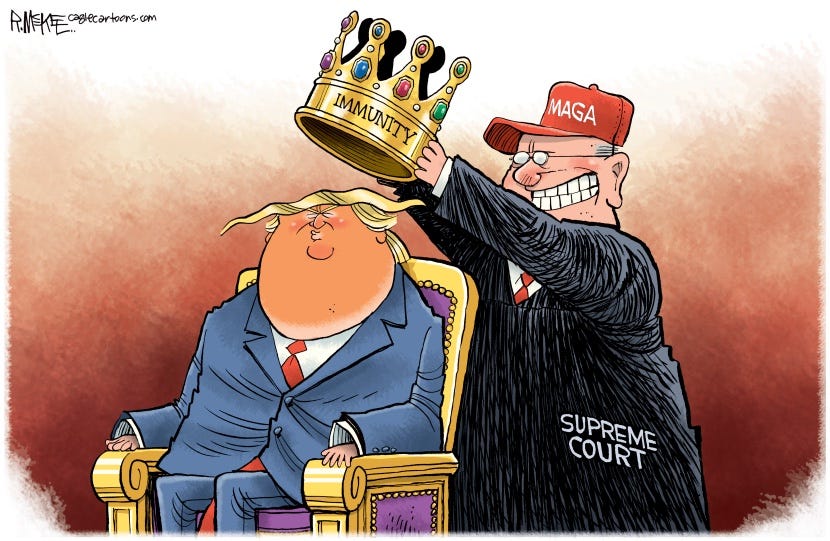
TL;DR: The Supreme Court has stopped being a neutral referee and is actively remaking the Constitution into a tool for a right-wing political project. Recent rulings and emergency orders have expanded presidential power (including broad immunity and the ability to oust officials at will), fast-tracked cases that reshape agency independence, and repeatedly favored the executive with emergency stays. This Court’s actions aren’t accidental — they’re the product of a decades-long Federalist Society strategy. If we don’t act, we’re handing an Imperial Presidency the legal cover to rule unchecked.
A Kings Court, Not of Laws
The Supreme Court was supposed to be the neutral arbiter between the branches of government. Lately it looks more like a branch of the executive. Consider three recent doctrinal shifts and the way the Court has rushed or shielded them:
First, last year the Court handed presidents unusually broad immunity for official acts — a decision that carved out wide swaths of protection for a sitting or former president from ordinary criminal prosecution for actions claimed to be within the “core” of presidential authority. That ruling dramatically raised the legal bar for holding a president accountable for official misconduct.
Second, the Court has cleared the way for presidents to remove members of independent agencies, sidestepping nearly a century of precedent. This summer the justices allowed President Trump to remove an FTC commissioner and agreed to decide whether longstanding protection for agency independence should be reversed. The court’s conservative majority repeatedly used emergency stays and the shadow docket to enable these removals while bypassing the normal, slower process of appeals — effectively taking immediate political power while postponing full, reasoned explanation.
Third, this isn’t the first time the Court has chipped away at agency insulation. The Seila Law decision (2020) already made a major change by allowing the CFPB director to be removable at will — a ruling that weakened independence tools Congress used to protect regulatory agencies from raw partisan control. Taken together with the Court’s new willingness to fast-track cases and issue emergency stays, the result is a court that not only rules for expanded executive authority but also accelerates the timetable for political change.
Originalism as a Weapon
“Originalism” is supposed to be an interpretive theory. But the current Court’s invocation of originalist rhetoric has become a cover for immediate partisan outcomes. When a result favors rolling back agency independence, stripping civil rights, or expanding presidential prerogative, the Court’s conservative majority waves the originalist banner — then uses emergency procedural devices to make that banner a functioning power grab.
That procedural behavior matters. The Court’s recent reliance on the so-called “shadow docket” — issuing emergency orders, stays, and fast-track scheduling without full briefing or oral argument — is how doctrinal coups are launched with minimal explanation. Fast tracks and emergency stays let the Court achieve political effects immediately, while the full reasoning (if it comes at all) dribbles out later. That’s not sober judicial review. It’s governance by ambush.
King Trump: Unlimited Executive Power
The legal architecture the Court is assembling has practical consequences. If the president can (a) claim broad immunity for “official” acts and (b) remove independent regulators at will, then the last structural checks on raw executive policymaking are gone. Imagine rule-making, enforcement, and regulatory investigations reflecting only electoral whim rather than statutory expertise. Imagine agency heads who answer first to the White House instead of the law. That is precisely what recent rulings and emergency orders are moving us toward.
The Court’s apparent unwillingness to draw bright lines — for example, Trump’s lawyer suggested a president could order Seal Team 6 to assassinate a political rival and be shielded from prosecution. Instead of rejecting the claim outright, the Court’s conservative justices hedged, signaling that presidential power may indeed stretch into authoritarian fantasy.
Civil Rights & Democratic Safeguards Under Attack
This judicial migration also maps onto the Court’s civil rights decisions: voting rules, reproductive rights, and administrative safeguards have all been weakened in ways that dovetail with the project to consolidate power. The effect is cumulative: weakening institutions that protect civic participation and then placing the executive above ordinary accountability undermines the republic’s core checks and balances. The Federalist Society’s decades of judicial vetting and Leonard Leo’s patronage have ensured both the ideological alignment and the procedural willingness to move quickly when a political opening appears. (See Democracy for Sale for deeper analysis of this capture.)
The Court Changes Policy Quickly, Explains Later
A few procedural tactics the Court has used to accelerate ideological change:
Emergency stays / Shadow docket: The Court repeatedly issues emergency stays that alter the status quo immediately (e.g., allowing firings to proceed) while reserving a full merits hearing months later. That grants near-instant political power with no explanation.
Fast-tracking high-stakes cases: The high court has compressed timelines, moving cases from the lower courts to December oral arguments or emergency review — a way to leapfrog ordinary appellate development and secure outcomes before public debate matures.
Narrow, outcome-driven emergency orders: The Court uses tight remedial language that helps one side now while postponing doctrinal justification — effectively governing by temporary order that becomes precedent once the full opinion follows.
Immunity for presidents: In Trump v. United States (2024), the Court granted broad immunity for “official acts,” making it very hard to hold a president accountable for misconduct if he claims it was part of his official function. 1
These procedural choices aren’t neutral; they’re an acceleration strategy that turns legal change into political advantage.
This is where the rubber meets the tyranny.
What Can Be Done — Realistic Reforms
If the Court is functioning as a partisan instrument rather than a neutral arbiter, reform isn’t optional. We can push for concrete changes that restore a judiciary that constrains, not enables, executive power:
Congressional limits on the shadow docket: Require full briefing and a minimum deliberation period for emergency orders in non-time-sensitive cases.
Statutory protections for independent agencies: Reinforce Humphrey’s Executor-style protections in statute so agency independence is not subject to judicial reinterpretation on an emergency basis.
Supreme Court ethics code: Enforce disclosure, recusal rules, and outside-income/benefit restrictions for justices.
Term limits / staggered terms for justices: Limit each justice to a single 18-year term, rotating appointments to reduce partisan stacking.
Congressional jurisdictional checks: Use Congress’s Article III powers to regulate appellate jurisdiction where necessary to prevent the Court from fast-tracking politically charged cases in ways that preempt democratic responses.
These are not radical ideas; they are reasonable reforms to restore a balance of power. The Framers never intended the bench to be a super-legislature. We need to act now before the precedent hardens further.
Final Warning
The Supreme Court has morphed from a guardian of rights into a political weapon. Left unchecked, its rulings could turn the presidency into an elected dictatorship while erasing hard-won civil liberties. Democracy will not survive if nine unelected ideologues are allowed to crown kings.
Read more: For a deeper dive into how corporate money, ideological networks like the Federalist Society, and the billionaire legal influence machine have transformed American institutions — including the courts — see my book Democracy for Sale: How Corporate Greed is Corrupting Democracy and Endangering the Planet.
Footnotes
Trump v. United States, Supreme Court opinion, July 1, 2024. ↩
Reuters, Supreme Court lets Trump fire FTC member, takes up arguments, Sept. 22, 2025. ↩
Seila Law v. Consumer Financial Protection Bureau, 591 U.S. ___ (2020). ↩
SCOTUSblog, Analysis of Court’s increased use of emergency stays and shadow docket fast-track cases, 2025. ↩
Democracy
The King’s CourtPolitics
The Bench Warmers: