By Rob C.
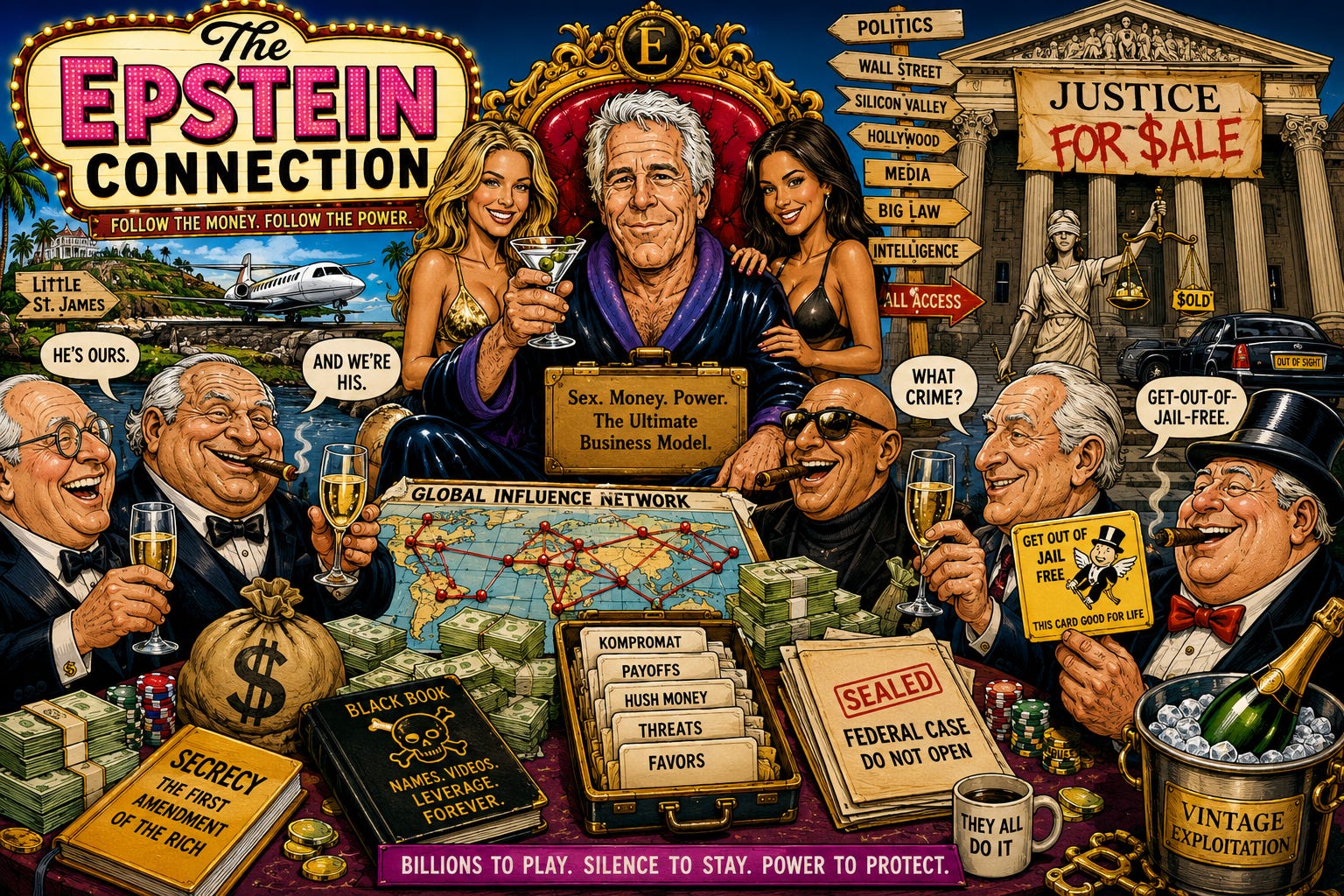
TL;DR: One of the greatest scams in modern American history didn’t happen in a dark alley, a back room casino, or on some shadowy corner of the internet. It happened in plain sight, in the offices and boardrooms of the American elite. The official story goes something like this: Jeffrey Epstein, a man with no obvious source of wealth, no major company, no revolutionary invention, and no verifiable record of successfully managing billions, somehow conned one of the richest men in America out of more than a billion dollars. If that explanation sounds ridiculous, that’s because it is. The more interesting question isn’t how Epstein fooled Les Wexner. The real question is why we’re expected to believe Wexner was fooled at all.
While the public story paints Wexner as an innocent victim of a master manipulator, the reality of the 1.3 billion-dollar heist reveals something far more sinister: a mutually beneficial partnership between two men who figured out how to use the legal system as a playground for theft. This wasn’t a con of a dupe; it was a conspiracy between two sharks.
Good morning, America. We are often told that the wealthy are just like us, only better at business. But every once in a while, a story comes along that exposes the billionaire class for exactly what it is: a private club where the rules are suggestions, and “misappropriation” is just a fancy word for “we split the loot and someone else pays.”
Today, we’re unpacking the Les Wexner-Jeffrey Epstein partnership. By the early 1990s, Les Wexner wasn’t some lonely retiree getting talked into a questionable investment scheme. He was one of the most successful businessmen in America. The mastermind behind The Limited, Victoria’s Secret, Bath & Body Works, Abercrombie & Fitch, and a growing retail empire, Wexner had amassed a fortune estimated at between one and two billion dollars. He was a titan of industry, a man known for ruthless efficiency and an eye for the bottom line. He didn’t build a global empire by being “gullible.” He built it by being sharper than everyone else in the room. He wasn’t naive. He wasn’t inexperienced. He certainly wasn’t incapable of recognizing a bad deal. Yet we’re asked to believe that this sophisticated billionaire somehow handed extraordinary power to Jeffrey Epstein and then spent years failing to notice what happened next.
The Billionaire “Advisor”
Even before Epstein became a household name, there were warning signs. His background was murky. His credentials were surprisingly thin for someone moving in elite financial circles. He seemed to possess an uncanny ability to convince powerful people that normal rules didn’t apply to him. Like many successful confidence men, Epstein didn’t sell a product so much as he sold an image. He sold access. He sold exclusivity. He sold the idea that he belonged in rooms full of billionaires, and once enough billionaires accepted that premise, it became self-reinforcing. Wealth attracts wealth. Power attracts power. Soon people stopped asking how Epstein got there and simply assumed he deserved to be.
Not everyone was convinced. One of those people was Harold Levin, a longtime Wexner financial advisor, who reportedly looked at Epstein and immediately saw trouble. According to accounts that emerged later, Levin warned Wexner directly. “I smell a rat. I don’t trust him.” That’s not a subtle concern. That’s not corporate-speak for “let’s monitor the situation.” That’s a flashing red warning light. Yet instead of investigating Epstein more carefully, Wexner appears to have done the opposite. Levin was pushed out, and the lone voice raising questions conveniently disappeared from the picture.
Ignoring the Rat
That decision deserves far more scrutiny than it receives. Most people, upon being warned that their financial adviser appears suspicious, would increase oversight. They would hire auditors. They would demand transparency. They would ask more questions. Wexner’s response appears to have been the exact opposite. The skeptic was removed, the warning ignored, and Epstein’s influence expanded. That’s not proof of criminal conduct, but it is difficult to reconcile with the image of a cautious billionaire victimized by a master con artist. It looks less like negligence and more like a deliberate decision to remove the one person asking uncomfortable questions.
Then came the deal that changed everything. In the summer of 1991, Wexner granted Epstein power of attorney. Let that sink in for a moment. A billionaire voluntarily handed sweeping authority over his affairs to a man whom trusted associates had already warned him about. Nobody forced him to sign those papers. Nobody tricked him. Nobody put a gun to his head. He made the decision willingly. Power of attorney isn’t something you give to the guy who fixed your printer or sold you a promising stock tip. It represents profound trust and extraordinary access. Wexner knowingly handed Epstein the keys to the kingdom.
This wasn’t a moment of weakness; it was the formalization of a partnership. Wexner wanted a money manager who wouldn’t ask questions about the tax strategies, the off-shore shuffling, or the creative accounting. Epstein provided exactly that.
And for a while, the arrangement appears to have worked exactly as intended. Wexner became wealthier. Epstein became more connected. The relationship flourished. Nobody publicly complained. Nobody reported being victimized. Nobody sounded alarms. In hindsight, we’re told that Epstein was secretly looting vast amounts of wealth while Wexner remained oblivious. But that’s where the story begins to strain under its own weight. Between 1991 and 2006, Epstein exercised enormous influence over assets connected to Wexner. Public reporting has documented transactions involving more than a billion dollars worth of stock and related assets. Meanwhile, Epstein’s lifestyle exploded into the realm of cartoonish excess. Mansions. Private aircraft. Luxury properties. Little Saint James Island. A social circle packed with billionaires, politicians, and celebrities.
$1.3 Billion of “Disappeared” Assets
The mystery isn’t simply where the money went. The mystery is how nobody noticed. More specifically, how Les Wexner supposedly didn’t notice. The average American notices when twenty dollars disappears from a checking account. Most people become concerned when a credit card charge appears that they don’t recognize. Yet we’re expected to believe that one of the sharpest businessmen in America somehow overlooked transactions involving more than a billion dollars over the course of years. Apparently, in billionaire math, a missing billion dollars is the equivalent of losing your car keys.
Maybe that’s true. Or maybe something else was happening.
One possibility is that the arrangement benefited both men. Epstein gained wealth, status, and legitimacy. More importantly, he gained a credential no amount of self-promotion could buy. He became the trusted adviser to one of America’s richest men, and the political influence that would later make him untouchable. It transformed him from an obscure financial operator into someone whom other billionaires, politicians, and financiers were willing to meet. Wexner, meanwhile, gained something valuable as well: a money manager who operated with extraordinary flexibility, extraordinary secrecy, and apparently very few questions.
That’s where the story becomes uncomfortable. Because if the relationship was producing favorable outcomes for both parties, the incentive to look too closely would have been limited. As long as the money flowed, as long as fortunes grew, and as long as everyone involved benefited, why rock the boat? The arrangement appears to have functioned for years with remarkably little scrutiny. That’s not evidence of innocence. If anything, it’s evidence that both parties had reasons to keep the machine running.
Then, eventually, the story changed.
The Victimhood Grift
Years later, after the relationship had ended and Epstein’s criminal conduct became impossible to ignore, Wexner began describing himself as a victim. He stated publicly that Epstein had misappropriated funds and betrayed his trust. Perhaps that’s true. Perhaps Epstein eventually crossed lines that even Wexner found unacceptable. But the timing raises obvious questions. Where did that money go? Why did it take so long? Why were the concerns raised only after the relationship collapsed? Why did the narrative of victimhood emerge after years of apparent satisfaction with the arrangement? But ask yourself: what did Wexner get? Given what we now know about Epstein, maybe there was something else happening.
The $47 million that was later “donated” to the Wexner Foundation isn’t restitution. It’s a rebate. It’s Wexner’s own money being returned to his own foundation to paper over the cracks when the relationship finally soured.
The broader lesson here has less to do with Jeffrey Epstein than with the system that allowed him to thrive. America has constructed an elite class that often operates under a different set of rules. When ordinary people lose money, investigators ask questions. When billionaires lose money, public relations teams issue statements. When ordinary people ignore warnings, they are called reckless. When billionaires ignore warnings, they are described as naive. Somehow the richer the person becomes, the more eagerly society accepts explanations that would sound absurd coming from anyone else.
The Springboard to Infamy
Whether Wexner was a victim, a willing participant, or something in between may never be fully answered. But one thing is certain: Jeffrey Epstein did not build his empire alone. He required access. He required protection. He required credibility. Most importantly, he required powerful people willing to open doors for him. Les Wexner opened the biggest door of all.
And once Epstein walked through it, the rest of the world followed.
The billion dollars was never the end of the story. It was the beginning. The wealth, influence, and legitimacy Epstein acquired through his relationship with Wexner became the foundation for everything that followed: the island, the international connections, the political relationships, and the vast network of powerful individuals that would surround him for decades.
In this three part series, we’ll follow that money even further, into the world of offshore finance, elite institutions, and the billionaire networks that helped protect one of the most notorious criminals of our time.
If you’re still waiting for the “Free Market” to hold these guys accountable, you’re going to be waiting until the fiery death of the universe—so like, share, and subscribe. Because apparently accountability, like everything else in America, is reserved for people who can’t afford it.
F*CK ICE. RELEASE ALL THE FILES!
Follow my work: Substack: democracy4sale.substack.com / Website: democracy4sale.com
Robert Cain, author of “Democracy for Sale: How Corporate Greed Is Corrupting Democracy and Endangering the Planet.” Available at Amazon, Barnes & Noble, and booksellers everywhere.