Politics
Part of: Billionaire ClassThe Battle for Equity and the New Gilded Age
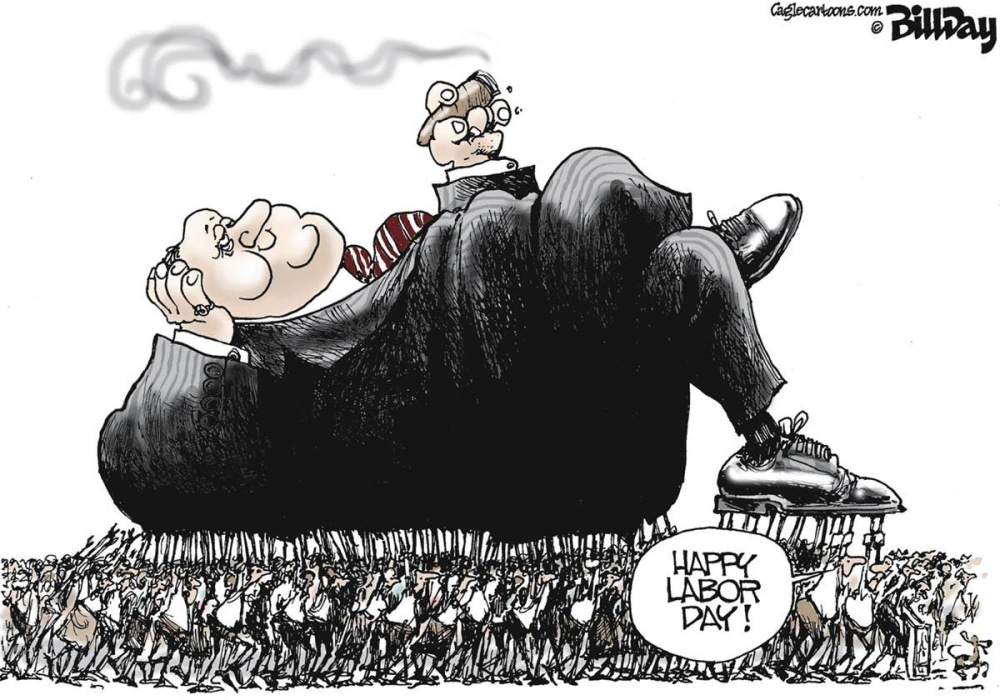
by Rob C.
Art by Bill Day
Labor Day was never meant to be about mattress sales or cookouts—it was born out of struggle. It’s a reminder that the working class, including the working poor, has always had to fight for dignity, safety, and a fair share of the wealth they create. And it’s also a reminder that the billionaire class—the robber barons of yesterday and the tech moguls of today—have always sought more power, more wealth, and more control, no matter the cost to democracy, the planet, or the people who make their fortunes possible.
From Howard Zinn’s “Voices of a People’s History of the United States”.
Howard Zinn: My viewpoint, in telling the history of the United States, is that we must not accept the memory of states as our own. Nations are not communities and never have been. The history of any country, presented as the history of a family, conceals a fierce conflict of interest. And in such a world of conflict, a world of victims and executioners, the job of thinking people, as Albert Camus suggested, is not to be on the side of the executioners.
Thus, in that inevitable taking of sides which comes from selection and emphasis in history, I prefer to tell the story of the discovery of America from the viewpoint of the Arawaks, of the Constitution from the standpoint of the slaves, of the rise of industrialism as seen by the young women in the Lowell textile mills, the conquest of the Philippines as seen by Black soldiers on Luzon, the postwar American empire as seen by peons in Latin America. And so on, to the limited extent that any one person, however he or she strains, can “see” history from the standpoint of others.
My point is not to grieve for the victims and denounce the executioners. Those tears, that anger, cast into the past, deplete our moral energy for the present. And the lines are not always clear. In the long run, the oppressor is also a victim. In the short run, the victims, themselves desperate and tainted with the culture that oppresses them, turn on other victims.
Still, understanding the complexities, this book will be skeptical of governments and their attempts, through politics and culture, to ensnare ordinary people in a giant web of nationhood pretending to a common interest. I will try not to overlook the cruelties that victims inflict on one another as they are jammed together in the boxcars of the system. I don’t want to romanticize them. But I do remember (in rough paraphrase) a statement I once heard: “The cry of the poor is not always just, but if you don’t listen to it, you will never know what justice is. -
The lesson from Howard Zinn—and of Labor Day itself—is that history is not neutral. It is a battlefield of class struggle. The Gilded Age gave us grotesque inequality, child labor, and corporate monopolies so powerful they nearly crushed democracy. Sound familiar? We’re standing at the edge of a second Gilded Age—where billionaires bankroll politics, rewrite labor laws, and sell us the lie that their wealth is somehow our salvation.
These men don’t build—they extract. They don’t innovate—they dominate. And they are more than happy to burn democracy to the ground if it means adding one more zero to their net worth.
If we don’t resist—if we don’t organize, vote, and overcome this tyranny - we will find ourselves reliving the worst of history. But if we remember Zinn’s warning, if we listen to the cry of the poor, then maybe we can finally write a different chapter: one where the working class doesn’t just survive the new Gilded Age, but defeats it.