Politics
Part of: Billionaire ClassThe New Dark Ages: 3 - Workers’ Rights How workers bled for the rights billionaires now call “too expensive”
By Rob C.
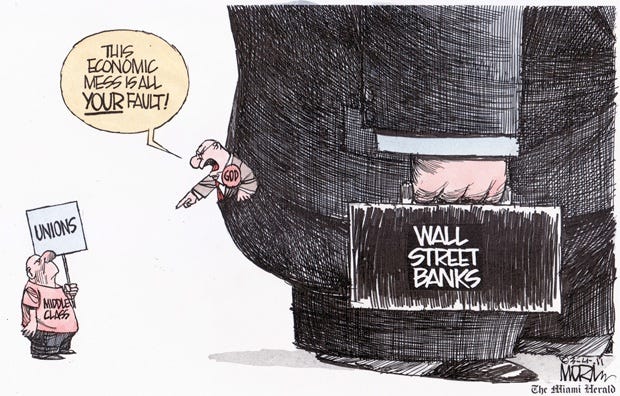
Art by Jim Morin
TL;DR: Happy May Day! If you enjoy your two-day weekend, your 8-hour workday, and the fact that your boss can’t legally feed you into a coal thresher, thank the “radical” socialists from 1886. Meanwhile, the modern billionaire class is working overtime to make the Gilded Age look like a hippie commune.
Good morning, fellow cogs in the corporate machine. Today is May Day. In most of the civilized world, this is a day to celebrate the worker. In America, we’ve mostly replaced it with “Labor Day”—a sanitized, government-approved Monday in September designed to make you forget that the rights you currently enjoy were paid for in the blood of people the state once labeled as “terrorists.”
Oh, The Irony!
It’s a delicious irony, isn’t it? We watch “conservatives” today rail against the “woke agenda” of unions and fair wages while they sit in their air-conditioned offices, enjoying a forty-hour work week and a lunch break that wouldn’t exist if it weren’t for the very progressives they claim to despise. They are the ultimate “nepo babies” of the labor movement, inheriting a suite of rights they didn’t fight for and are now actively trying to auction off to the highest donor.
Every right American workers enjoy—weekends, fair wages, safe conditions—was fought for by labor movements conservatives now mock. The same forces that created the Gilded Age are back, wealth inequality is worse than ever, and the people benefiting most from past victories are trying to erase them. May Day isn’t history—it’s a warning.
May Day should be one of the most celebrated holidays in the United States. It should sit right alongside the Fourth of July as a reminder of what collective action can achieve when ordinary people decide they’ve had enough. But instead, it’s been quietly sidelined, treated like an awkward historical footnote, or worse—dismissed as some kind of radical relic best left in the past.
Which is ironic, because the same people who scoff at labor movements are currently enjoying the fruits of those movements every single day. The weekend. Overtime pay. Workplace safety standards. The basic expectation that you shouldn’t die or lose a limb just to earn a paycheck. These weren’t gifts handed down by generous employers or enlightened billionaires. They were won—painfully, violently, and at great personal cost—by workers who were told, just like today, that what they were asking for was unreasonable.
To understand May Day, you have to go back to a time when the idea of an eight-hour workday was considered radical. In the late 19th century, American workers routinely labored twelve to sixteen hours a day, six days a week, in conditions that would make modern safety inspectors faint on sight. There were no meaningful protections, no safety nets, and certainly no employer-sponsored healthcare or retirement plans. If you were injured on the job, you were simply replaced. If you couldn’t work, you didn’t eat. It was a system that worked beautifully—if you were at the top.
The Haymarket “Thank You” Note
In 1886, workers across the country began to push back. They organized strikes demanding something that now seems almost laughably modest: eight hours for work, eight hours for rest, and eight hours for what we might generously call a life. This movement culminated in Chicago’s Haymarket Square, where a peaceful protest in support of striking workers took a tragic turn after a bomb was thrown into a crowd of police officers. What followed was chaos, gunfire, and a wave of repression that targeted labor leaders, many of whom were arrested and executed on questionable evidence.
Before the Haymarket Affair, the American workplace was essentially a voluntary labor camp. If you’re a fan of the “good old days,” let me describe the “freedom” workers had back then. You had the freedom to work 12 to 16 hours a day, six days a week. You had the freedom to earn wages that wouldn’t buy a loaf of bread, let alone a roof over your head. You had the freedom to work in “toxic” conditions—and I don’t mean a mean boss on Slack; I mean literal lung-rotting soot and finger-severing machinery with zero health care or retirement security.
The Haymarket Affair became a flashpoint. It exposed the lengths to which those in power would go to maintain control, but it also galvanized the labor movement. It turned a local protest into an international symbol. And over time, it helped build the momentum that would lead to real change—shorter workdays, safer conditions, and the slow recognition that workers were not disposable parts in an industrial machine.
The Gilded Age: When Criminals Wore Top Hats
We often talk about the Gilded Age like it was a period of quaint Victorian charm, but it was actually the first time the “Epstein Class” truly perfected the art of the grift. This was the era of the true Royal Class—the Rockefellers, the Carnegies, the Vanderbilts—men who didn’t just compete in the economy; they owned the economy.
Wealth inequality reached such dizzying heights that the top 1% controlled more than the bottom 99% combined. Worker abuse wasn’t just common; it was the standard operating procedure. If a worker died on the job, they were simply swept aside like a broken gear. There were no safety nets, no minimum wages, and certainly no “Human Resources” department to hear your grievances. The only HR back then was a Pinkerton detective with a club.
These “Robber Barons” viewed the working class as a renewable resource to be burned for fuel. They bought politicians like they bought railroad ties, ensuring that the law always favored the man with the gold watch over the man with the soot-stained hands.
The New Dark Ages: 1885 with Better Propaganda
The term “gilded” was chosen deliberately: a thin layer of gold covering something much more foul. What has changed is not the structure of inequality, but the sophistication with which it is maintained. The language is different. Instead of “robber barons,” we have “innovators” and “disruptors.” Instead of open hostility to labor, we have carefully crafted narratives about flexibility, efficiency, and the dangers of regulation. But the underlying dynamic remains the same: a system that rewards those at the top disproportionately while asking everyone else to make do with less.
Fast forward to 2026. If you feel like your paycheck is evaporating before it even hits your bank account, congratulations—your intuition is better than the “economic indicators” on CNBC. We are currently living through a wealth gap that doesn’t just rival the Gilded Age; it surpasses it.
The “affordability crisis” isn’t a mystery; it’s a math problem. For the last forty years, productivity has soared while wages have flatlined like a heart monitor in a morgue. We are producing more wealth than ever before in human history, yet it’s all being vacuumed up by a handful of dragon-hoarding billionaires who spend their time flying phallic rockets into sub-orbit while their warehouse employees are timed on their bathroom breaks.
Inflation is just the polite word for “corporate price gouging.” The elite class has realized they can just keep raising the price of eggs and rent because, what are you going to do? Stop eating? Stop living indoors? They have decoupled the cost of survival from the value of labor, turning the American Dream into a subscription service that most of us can no longer afford.
Our economy may look strong on paper—rising stock markets, growing GDP—but feels increasingly fragile to the people living in it. Housing costs have soared, making homeownership unattainable for many. Healthcare remains expensive and often inaccessible. Education, once seen as a pathway to opportunity, now comes with a price tag that can take decades to pay off. The concept of “affordability” has become a central concern, not because people suddenly forgot how to budget, but because the system itself has shifted.
This is where the irony of modern political rhetoric becomes most apparent. Many of the voices that argue most strongly against labor protections are the same ones benefiting from the protections secured by earlier movements. The eight-hour workday, workplace safety regulations, and labor rights are so deeply embedded in the fabric of modern life that they are often taken for granted. It is easy to forget that they were once fiercely contested, that they were labeled impractical or dangerous, and that they were achieved only through sustained pressure.
May Day serves as a reminder of that history, but also as a lens through which to view the present. It challenges the idea that progress is inevitable or permanent. It highlights the role of collective action in shaping economic and social systems. And it raises an uncomfortable question: if these rights were not given freely, what happens when the forces that opposed them begin to regain influence?
The Call to Rise Up
We are at a similar crossroads. We are being told that this is “normal.” We are told that “the market” has decided you should work three jobs just to afford a studio apartment. But “the market” is just a euphemism for the collective whims of the donor class.
The Supreme Corrupt Court is busy dismantling the last of our protections, gutting voting rights, and ensuring that “money is speech”—which is just a fancy way of saying “if you’re poor, shut up.” They want to roll us back to the 1880s, where the rich were kings and the rest of us were property.
But here’s the thing they forget: the rights we have weren’t “given” by the benevolence of the elite. They were taken. They were demanded. And on this May Day, as the “New Dark Ages” settle in, it’s time we remember how to demand them again. We need a fair, democratic economic system—one where the people who actually build the world get to live in it.
Rise up. Organize. Remind the “Epstein Class” that while they might own the judges, they don’t own the future.
F*CK ICE. RELEASE ALL THE FILES!
Please like, share, and subscribe—because billionaires have lobbyists, and the rest of us have each other.
Follow my work: Substack: democracy4sale.substack.com Website: democracy4sale.com
Robert Cain, author of Democracy for Sale: How Corporate Greed Is Corrupting Democracy and Endangering the Planet.
Available at Amazon, Barnes & Noble, and booksellers everywhere.