Politics
Part of: Corporate InfluenceWhen Markets Fail: The Free Market Fairy Tale
By Rob C.
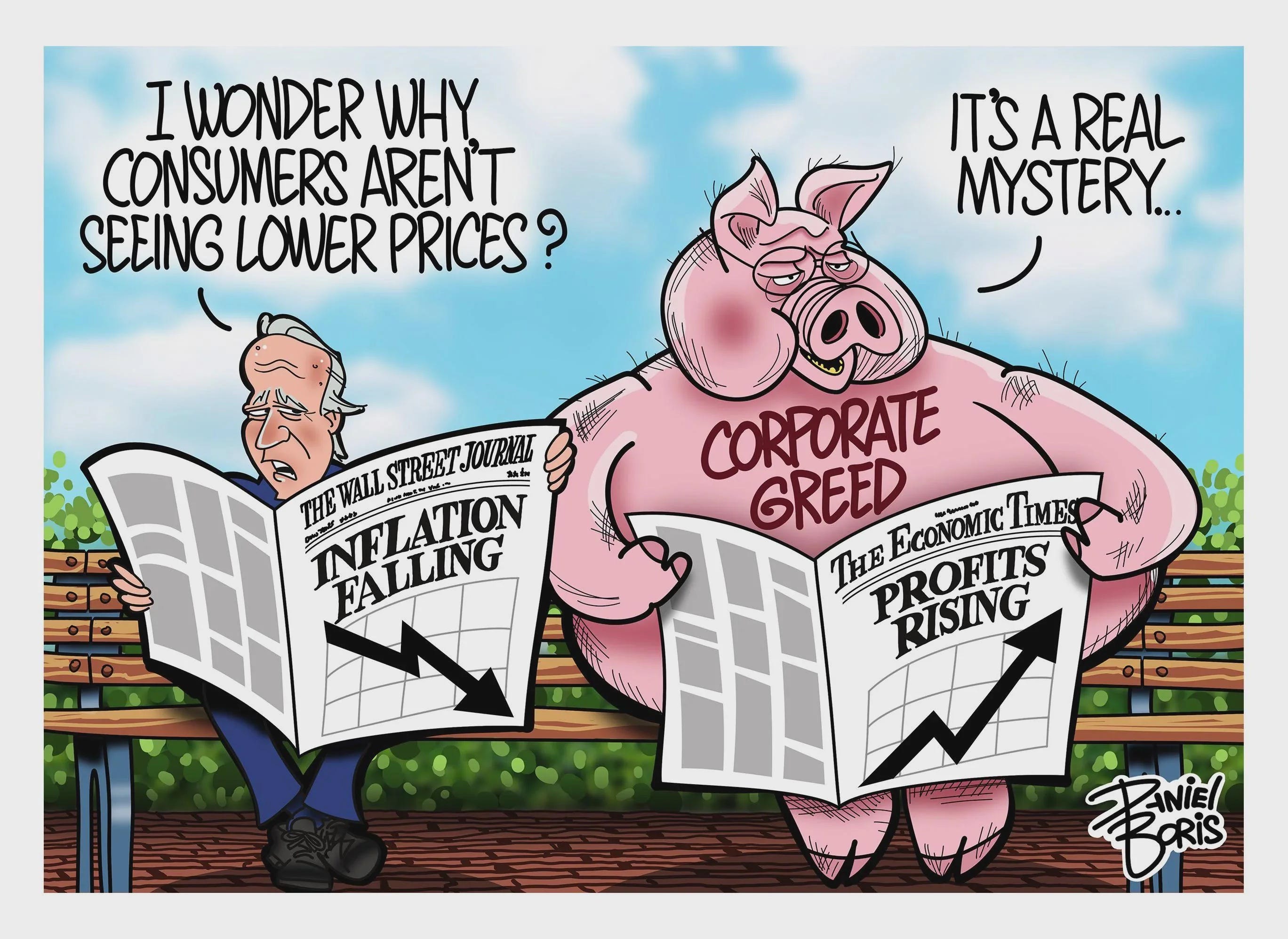
Art by Daniel Boris
TL;DR:
The “free market” isn’t broken—it’s doing exactly what it was designed to do: maximize profit, not meet human needs. That’s why it fails at healthcare, housing, and basic services. If you can’t pay, you don’t matter. Markets are a tool, not a solution—and when we treat them like a god, regular people get sacrificed.
For decades, we’ve been sold a comforting bedtime story: the free market is the most efficient way to allocate resources. Just let supply and demand do their thing, and voilà—prosperity for all.
It’s a lovely theory. Elegant. Clean. Almost poetic.
It’s also complete bullshit.
Because anyone who has tried to find an affordable apartment, pay a medical bill, or buy groceries without flinching knows the truth: the “free market” doesn’t solve our most basic problems—it exploits them.
Markets are great at producing luxury goods. You want 37 brands of sparkling water infused with Himalayan moon dust? The market has you covered. But when it comes to healthcare, housing, food, and infrastructure—the things people actually need to survive—the market doesn’t just stumble. It faceplants.
For years, the mantra has been “markets are the best way to provide services.” It’s the religion of American capitalism. The invisible hand. The efficient allocation of resources. The magic of supply and demand.
But anyone who’s shopped for housing on a limited budget, buy insulin without insurance, or figure out why an ambulance ride costs $3,000 quickly realizes this is a complete fantasy.
The reality is that markets do not solve our most basic problems. The “free market” doesn’t allocate resources efficiently. It allocates them profitably. And those two things are not the same.
The Free-Rider Problem: Why No One Wants to Pay for What Everyone Needs
Some things are essential precisely because everyone uses them. Street lighting. Clean water systems. National defense. Basic sanitation. Economists call these public goods—they’re non-excludable (you can’t easily stop people from benefiting) and non-rival (one person’s use doesn’t reduce availability for others).
Translation: they’re terrible business opportunities.
Because if you can’t charge everyone, you can’t maximize profit. And if you can’t maximize profit, the private market suddenly develops amnesia about how important the service is.
So what happens? Underinvestment. Neglect. Decay.
Imagine a privatized fire department that only shows up if your subscription is paid (They do exist). “Sorry about your house, sir, but you’re on the basic plan.” That’s not a dystopian thought experiment—that’s the logical endpoint of applying market logic to public goods.
(They still exist today. In 2010, firefighters in rural Tennessee watched a house burn to the ground because the owner hadn’t paid the $75 annual fee. During the 1880’s these were the only fire response teams. Then came the “Great Chicago Fire” and it destroyed much of the city. Private fire crews sat and watched as the fire spread because those buildings were not on their list. This gave rise to the first Municipal Fire Departments).
That’s why we have government-funded street lights, fire departments, and sewage systems. Because the market won’t do it.
Positive Externalities: When Doing the Right Thing Isn’t Profitable Enough
This is the high-brow way of saying “things that benefit everyone even if they don’t pay for them.” Things like education and vaccines—services that don’t just benefit the individual, but society as a whole.
An educated population drives innovation, stability, and economic growth. Vaccinated communities prevent disease outbreaks. These are called positive externalities—benefits that spill over to others.
But here’s the problem: markets only reward the individual transaction, not the broader societal benefit.
So what do we get?
Too few people vaccinated.
Underfunded schools. - A population that’s just educated enough to work, but not enough to question why they’re underpaid.
Because from a purely market perspective, why invest more when the return isn’t immediate and measurable?
The market doesn’t care. It produces less than the socially optimal amount because it can’t capture the full value of the externality.
The result is chronic underinvestment in the very systems that make a society functional.
The private market will provide education only to people who can pay for the individual benefit. But society needs universal education for a functioning democracy and economy.
Natural Monopolies: When “Competition” Is a Fantasy
Some industries are so infrastructure-heavy that competition isn’t just unlikely—it’s absurd.
Think water systems, electricity grids, rail networks. You’re not going to have five competing sets of pipes running into your house so you can shop around for “the best deal” on tap water.
These are called natural monopolies—markets where a single provider is the most efficient structure. Some essential services require massive infrastructure investments that only one entity can efficiently operate.
But here’s the catch: without competition, prices go up and service quality goes down. Because what are you going to do? Switch to a different water company? Drill your own well in a studio apartment?
This is where the “free market” quietly exits the chat and leaves you alone with a corporation that knows you have no alternatives.
For a deeper dive, check out my book chapter “Public Money, Private Profit”.
Information Asymmetry: When the Seller Knows Everything and You Know Nothing
In a functioning market, both parties are supposed to have enough information to make rational decisions.
Now let’s all laugh together.
Because in industries like healthcare, the imbalance is staggering. Doctors, hospitals, and insurance companies know exponentially more than patients. Providers can manipulate demand. They can order tests you don’t need, prescribe brand-name drugs when generics exist, and recommend expensive procedures when cheaper options would work fine. And you have no way to know if they’re right. You don’t “shop” for emergency surgery the way you shop for sneakers. What’s a “fair” price for an MRI? For cancer treatment?
You don’t compare prices mid-ambulance ride.
This is called information asymmetry, and it turns markets into a game where one side has all the cards and the other side is guessing.
Which is how you end up with a $12,000 bill for a procedure you didn’t fully understand, didn’t choose under normal conditions, and definitely didn’t budget for.
Efficient? Sure—if your goal is maximizing profit, not health.
That’s why every other developed country has government-regulated or government-run healthcare. Because letting the market decide means people die or go bankrupt.
But in America? We’ve decided that healthcare is a commodity, not a right. And the market has responded by making it unaffordable for millions.
Inequality: When the Market Decides You’re Not Worth Serving
Here’s the part no one says out loud:
Markets serve demand. Not need. If you can’t pay, you don’t count.
That’s why in the wealthiest country on Earth, millions of people struggle to access basic healthcare, affordable housing, and nutritious food. Not because we lack resources—but because serving them isn’t profitable enough.
The market doesn’t care if you’re sick.
It cares if you’re solvent.
And when a system ties survival to purchasing power, the outcome isn’t efficiency—it’s exclusion.
Can’t afford rent? The market builds luxury condos for rich people instead of affordable housing for you.
Can’t afford healthcare? The market offers you nothing. Go to the emergency room and declare bankruptcy.
Can’t afford food? The market sells organic kale to wealthy people while you choose between rent and groceries. In the U.S., 45 million people are food insecure. 580,000 people are homeless. 27 million people have no health insurance. The market could provide for them. But it won’t, because they can’t pay enough to make it profitable.
And here’s the kicker: Making these services profitable requires making them unaffordable for the people who need them most.
So… What Is the Market Actually Good For?
Let’s be fair. Markets are useful tools. They’re great at distributing consumer goods, encouraging innovation, and responding to trends.
But they are not moral systems. They are not designed to ensure fairness, equity, or universal access.
The invisible hand is giving us the finger while the Epstein class gets richer by privatizing essential services, jacking up prices, and telling us we should be grateful for the privilege of going bankrupt to not die.
The market has failed. It is failing. And it will continue to fail to provide what humans need to survive—until we stop treating survival as a commodity and start treating it as a right.
Final Thought: Stop Worshipping the Tool
The “free market” isn’t a god. It’s a tool. And like any tool, it works well in some situations and fails catastrophically in others.
So maybe it’s time we stop asking markets to solve problems they were never designed to fix—and start building systems that actually prioritize human needs over profit margins.
Because if your economic system can deliver same-day shipping on luxury goods but can’t guarantee healthcare, housing, or food, that’s not efficiency.
That’s failure.
F*CK ICE. RELEASE ALL THE FILES!
Please like, share, and subscribe—because the “free market” has failed to provide the things we literally can’t live without it.
Follow my work: Substack: democracy4sale.substack.com / Website: democracy4sale.com
Robert Cain, author of “Democracy for Sale: How Corporate Greed Is Corrupting Democracy and Endangering the Planet.”
Available at Amazon, Barnes & Noble, and booksellers everywhere.