By Rob C.
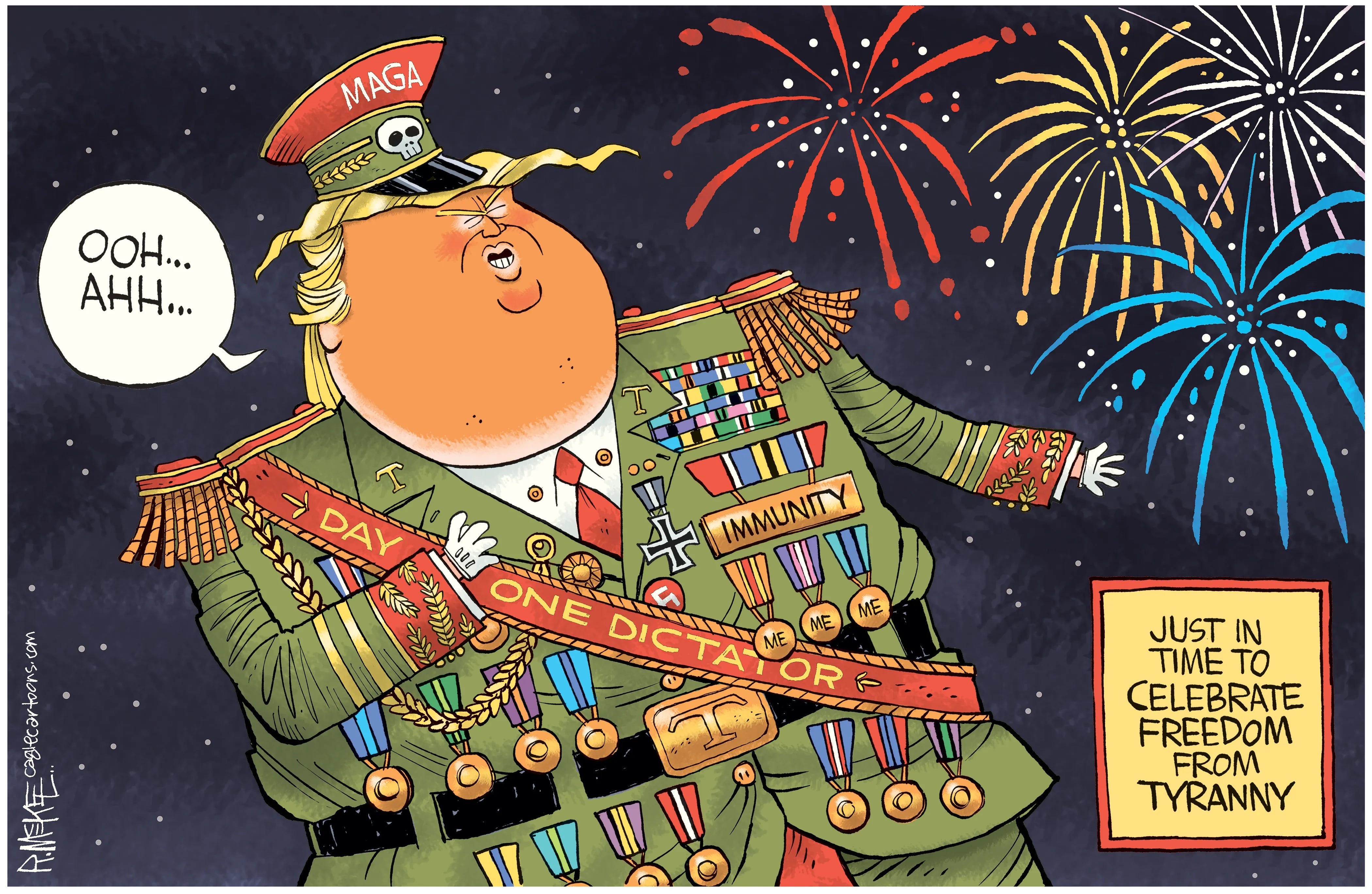
Art by Rick McKee
TL;DR: Authoritarians don’t all wear the same uniform, but they use the same toolbox: attack voting rights, demonize the press, weaponize the courts, flood the public with lies, and convince people democracy is “too messy” to bother with. From Putin’s oligarch-funded iron fist to Trump’s $1 billion taxpayer-funded ballroom, the playbook is the same: lie, loot, and dismantle democracy while pretending you’re “making America great again”. Trump didn’t invent the playbook—he borrowed it from world class strongmen and adapted it for America, with help from the Supreme Court and a Republican Party that traded democracy for power.
Today we’re dissecting the “Epstein Class” and their global authoritarian bromance.
For most of modern history, putting the United States and Russia in the same sentence as examples of creeping authoritarianism would have sounded insane. One was supposedly the beacon of democracy; the other was a corrupt oligarchic state run by a former KGB officer who treats political opponents like expired yogurt.
And then came Donald Trump.
Until Donald Trump occupied the Oval Office, no one in their right mind would have put the United States and Russia in the same boat. Now the comparison doesn’t feel outrageous at all. It feels uncomfortable because it’s increasingly accurate.
Trump’s relationship with Vladimir Putin has always carried the smell of cheap cologne and expensive kompromat. For decades, as American banks became wary of Trump’s financial disasters, Russian oligarchs and foreign money drifted into his orbit like moths to a gold-plated bankruptcy sign. His business empire survived on smoke, mirrors, licensing deals, and increasingly questionable financing while he publicly praised strongmen who viewed democracy as an annoying obstacle between themselves and unlimited power.
But it’s bigger than money.
Trump isn’t just financially linked to authoritarian networks—he’s following their playbook.
And once you understand the playbook, you start seeing the pattern everywhere.
Historian Timothy Snyder has spent years warning about exactly this kind of democratic backsliding in his book On Tyranny. Snyder’s central point is painfully simple: democracies rarely collapse overnight. They erode piece by piece while citizens normalize behavior that would have once shocked them.
That’s the trick.
Authoritarianism doesn’t usually arrive wearing jackboots and kicking down the front door. It arrives wrapped in patriotism, screaming about “security,” “tradition,” and “saving the nation” from whatever vulnerable group has been selected as the enemy of the week.
The Authoritarian All-Stars
The major players on the global stage all understand this game. Putin perfected the modern oligarchic dictatorship. Xi Jinping turned China into a high-tech surveillance state where dissent disappears faster than criticism on Truth Social. Narendra Modi has increasingly fused nationalism, religion, and state power in ways critics warn threaten India’s secular democracy.
And then there’s Benjamin Netanyahu, the sleeper contestant in the global authoritarian Olympics. Netanyahu’s political survival strategy increasingly depends on permanent conflict, expanding settlements, and weakening judicial constraints while corruption cases hover over him like a dark cloud wearing an expensive suit.
Different countries. Different histories. Same instinct: consolidate power, weaken accountability, control the narrative.
Trump is simply the American version.
Not because the United States was ever some flawless democratic paradise—we’ve spent plenty of time overthrowing governments abroad while lecturing the world about freedom—but because until recently, American leaders at least pretended the Constitution mattered.
Trump and his Republican co-conspirators have disposed of that pretext like a wrapper on a McDonald’s Filet-O-Fish.
One of the first tools in the authoritarian starter pack is restricting voting access. Because if your policies are wildly unpopular outside your shrinking base of angry Facebook uncles, it’s easier to limit voters than improve policies.
Putin effectively neutered meaningful opposition elections in Russia years ago. Modi’s critics accuse his government of using nationalism and bureaucratic pressure to marginalize opposition voices. Netanyahu’s allies have pushed judicial “reforms” critics say would weaken democratic oversight. And here in the United States, Republicans have spent years perfecting voter suppression with the precision of a corporate tax accountant finding offshore loopholes.
Gerrymandering. Voter roll purges. Restrictive ID laws. Reduced polling locations. Endless attacks on mail voting. The Supreme Court’s gutting of the Voting Rights Act opened the floodgates, because apparently racism ended sometime around the invention of Applebee’s. Suddenly states rushed to redraw maps that just coincidentally diluted minority voting power.
Totally normal democracy stuff.
Another essential authoritarian tool is prosecuting political enemies while protecting loyalists. Putin imprisons opponents. Xi disappears critics. Modi’s opponents complain of selective enforcement and pressure campaigns. Netanyahu’s government has faced accusations of politicizing state power while he fights corruption charges of his own.
And Trump? Trump spent years openly threatening prosecutors, judges, journalists, and political rivals while demanding personal loyalty from law enforcement agencies like he was casting a mafia reboot. He talks about the Department of Justice the way a king talks about the royal guard. Not as an independent institution, but as a weapon that should serve him personally.
That’s not democratic leadership. That’s gangster politics wrapped in an American flag.
Thought Control: Media Consolidation
Authoritarians hate independent journalism because facts are deeply inconvenient when your movement runs on grievance, conspiracy theories, and emotionally charged nonsense. Putin crushed independent Russian media. Xi built a censorship apparatus so vast it makes Orwell look lazy. Modi’s government has intimidated journalists and has consolidated media influence.
Trump took a more American approach: flood the zone with bullshit.
Attack every source of independent information. Label critical journalism “fake news.” Build a propaganda ecosystem where followers exist inside a sealed reality bubble reinforced by partisan media, influencers, and algorithms designed to monetize outrage.
The goal isn’t necessarily to convince everyone of one truth. It’s to destroy the idea of objective truth altogether. Because when people stop believing anything, they become easier to manipulate. Authoritarians rely on citizens becoming numb, cynical, and exhausted. Keep people overwhelmed. Flood them with scandals. Turn politics into constant chaos. Make accountability impossible because there’s always another outrage crashing into the timeline before the previous one finishes burning.
Trump didn’t invent that tactic. He industrialized it.
Netanyahu operates a slightly different version of the authoritarian model because his political survival is intertwined with permanent regional conflict and territorial expansion. Illegal settlements in Palestinian territories are often sanitized in Western media with bureaucratic language like “disputed territories,” but let’s translate honestly: armed settlers, backed by state power, expanding into occupied land while Palestinian communities face harassment, displacement, and violence.
This hypocrisy was brilliantly dissected decades ago in The Washington Connection and Third World Fascism, where the authors described how powerful nations classify atrocities into convenient political categories. There are the “benign bloodbaths” — massacres committed by friendly dictators and allied regimes that barely register in Western media because the victims are inconvenient and the killers buy our weapons. Then there are the “constructive bloodbaths,” the truly grotesque category, where mass violence is not merely tolerated but quietly supported because it serves strategic or economic interests. And finally, the “nefarious bloodbaths” — the crimes committed by official enemies, endlessly condemned and broadcast because outrage is useful when directed at the designated villains. The bodies are equally dead in all three cases, but the political value of those bodies changes dramatically depending on who profits. That same cynical framework still dominates modern geopolitics, where authoritarian allies are excused as “security partners” while rival nations are condemned as existential threats. The lesson is ugly but simple: for the powerful, morality is often just branding with a flag attached.
Critics argue Netanyahu’s political coalition increasingly depends on extremist factions that openly advocate annexation and permanent domination. And like all leaders flirting with authoritarianism, fear becomes the fuel. A population under constant fear is easier to control, easier to radicalize, and more willing to surrender democratic norms in exchange for promises of security.
Sound familiar? Because fear is Trump’s favorite drug.
Immigrants. Protesters. Journalists. LGBTQ people. Muslims. Teachers. “Radical leftists.” Every authoritarian movement requires enemies. Without enemies, the movement collapses under the weight of its own corruption and incompetence.
And now the Supreme Court has effectively joined the project.
The Supreme Wrecking Crew
Five or six unelected lawyers in robes are steadily rewriting the rules of American governance while pretending they’re neutral referees. Presidential immunity? Expanded. Voting protections? Gutted. Regulatory agencies? Handcuffed. Corruption standards? Practically decorative at this point. The Court didn’t invent authoritarianism in America, but it’s become the constitutional delivery system for it.
That’s what makes this moment dangerous.
People keep waiting for authoritarianism to look dramatic and obvious. They expect tanks in the streets and giant banners hanging from government buildings, although, Trump has that going too. But modern authoritarianism often arrives through court rulings, executive orders, captured institutions, propaganda networks, and exhausted citizens slowly adapting to behavior that once seemed unthinkable.
“Do not obey in advance,” Snyder warns.
Authoritarian systems rely on people normalizing corruption and surrendering piece after piece of democratic life until there’s almost nothing left to defend.
And make no mistake: the Epstein Class—the billionaire oligarchs, techno-fascists, fossil fuel barons, private equity vultures, and media manipulators funding this movement—understand exactly what they’re doing. Democracy is inconvenient when you’re trying to consolidate wealth and power indefinitely.
They don’t want citizens. They want subjects.
And we only get one real chance to stop it before the damage becomes permanent.
F*CK ICE. RELEASE ALL THE FILES!
Please like, share, and subscribe—because democracy doesn’t die all at once; it dies when exhausted people convince themselves someone else will save it.
Follow my work:
📧 Substack: democracy4sale.substack.com
🌐 Website: democracy4sale.com
Robert Cain, author of Democracy for Sale: How Corporate Greed Is Corrupting Democracy and Endangering the Planet. Available at Amazon, Barnes & Noble, and booksellers everywhere.