By Rob C.
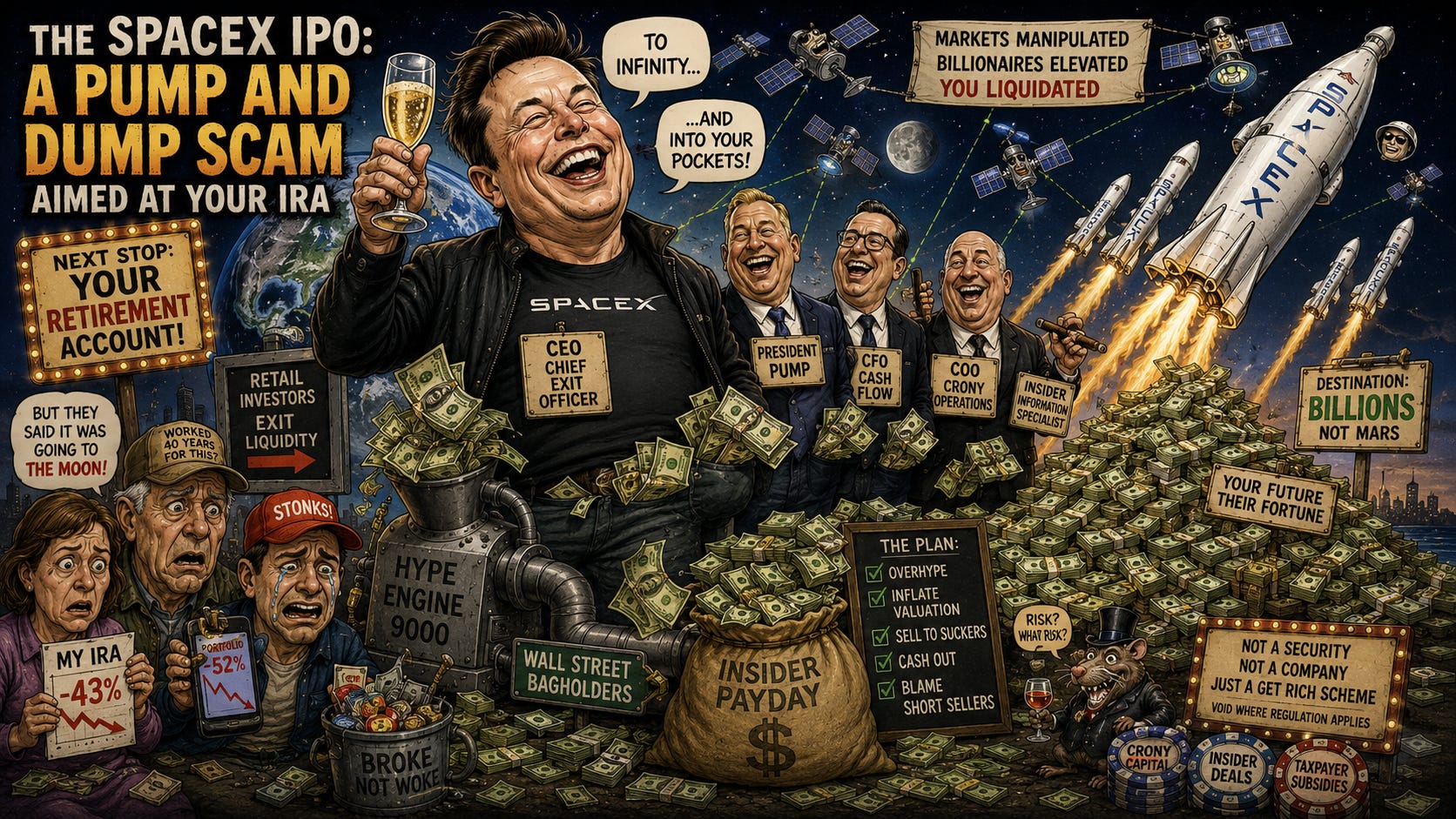
TL;DR: Millions of Americans may soon become investors in SpaceX whether they want to or not. Not because they carefully analyzed the company. Not because they chose to buy the stock. But because index funds, retirement accounts, and passive investment vehicles could be required to purchase shares if SpaceX is rapidly added to major indexes.
The larger issue isn’t Elon Musk, although he’s one of the villains of the story, it’s a system that increasingly appears designed to protect billionaire investors from losses while transferring risk onto ordinary people. When exchanges change rules, regulators look the other way, and retirement savings become mandatory buyers of overpriced assets, the question isn’t whether the system is broken. The question is whether it’s functioning exactly as intended. But don’t worry, your retirement savings will be funneled directly into the pockets of billionaires cashing out.
For decades, Americans were told that if they worked hard, contributed to their 401(k), and invested responsibly, the market would help them build wealth. It wasn’t a perfect system, but at least there was an understanding that markets were supposed to reward productive investment and punish bad decisions.
That fairy tale is getting harder to sell.
Good morning. If you have a 401(k), you might want to sit down. You are about to become “exit liquidity.”
That’s the technical term for the person who holds the bag when the billionaires run for the door. Right now, a massive financial machine is being engineered to turn your hard-earned retirement savings into the cash-out prize for Elon Musk and his inner circle. They didn’t break the rules to do it; they simply rewrote them. As one frustrated investor recently put it, “I hoped we’d go to Mars. Instead, I’m watching wealth transfer from ordinary people saving for retirement to Elon Musk.”
What we’re watching unfold around the proposed SpaceX IPO looks less like capitalism and more like a masterclass in financial engineering. The concern isn’t that SpaceX is a bad company. SpaceX has accomplished remarkable things. The concern is that the financial structure surrounding its public debut appears designed to protect wealthy insiders while leaving ordinary investors holding the bag if reality fails to match the hype.
And that’s becoming a familiar pattern.
The Twitter Disaster & The Merger Trap
To understand the SpaceX IPO, you have to look at the tombstone of the Twitter deal. In 2022, Musk bought Twitter for $44 billion, backed by a rogue’s gallery of tech billionaires, Saudi princes, and venture capitalists. Then reality arrived. Within a year, that investment was worth less than half. They were underwater by $20+ billion.
Advertising revenue collapsed. Users left. The platform struggled. Independent estimates suggested the company’s value had fallen dramatically below its purchase price. The investors who backed the deal weren’t looking at paper gains. They were staring at potentially enormous losses.
Normally that’s called investing. Sometimes you win. Sometimes you lose.
But billionaires don’t take losses—they just shuffle the deck. In March 2025, they merged the failing Twitter into xAI in an all-stock transaction. No cash changed hands, no taxes were triggered, and their worthless Twitter stake was magically rebranded as a “hot AI company.” Then came another all-stock merger, by February 2026, they merged that xAI money furnace into SpaceX.
Three companies. Two mergers. Zero dollars exchanged. They couldn’t admit Twitter was a disaster, so they buried the corpse inside a rocket. This wasn’t financial “innovation”; it was a multi-billion-dollar shell game designed to convert bad bets into a “hot” IPO.
Again, no cash. Again, no public reckoning.
It’s a bit like buying a rusted-out Pinto, painting flames on the side, attaching it to a Ferrari, and hoping nobody notices the difference.
The Nasdaq Rule Change: Regulatory Capture
The next piece of the puzzle is where things get especially interesting.
How do you sell a loss-making, debt-ridden, 94x-revenue-multiple company to the public? You don’t ask for permission; you demand it.
Historically, the “seasoning” rule protected investors by requiring companies to trade for a year before entering major indexes. The logic was simple. Allow markets time to determine a reasonable valuation. Let investors evaluate the business. See whether the initial excitement survives contact with reality. It was a speed bump to prevent financial castration. But SpaceX demanded—and Nasdaq granted—a fast-track entry to the Nasdaq-100 in just 15 trading days. Nasdaq changed the rules because they profit from the listing fees, the trading volume, and the data subscriptions.
They didn’t consult the SEC; they didn’t need to. Because index providers are self-regulated, they essentially turned the Nasdaq-100 into a private club where they can change the bylaws to profit from their biggest clients. And just like that, $30 trillion in passive retirement savings was forced to buy a company the market hadn’t even “reality-tested” yet. Imagine a giant financial vacuum cleaner.
Once the switch gets flipped, money starts flowing automatically.
Your retirement account, your pension, your index fund, and your IRA. All buying, All at once, regardless of price.
Early investors can potentially sell into a wave of mandatory demand created not by market enthusiasm but by index mechanics.
The average retiree in Ohio isn’t making an informed decision about SpaceX’s valuation. They’re simply becoming part of a process they don’t control.
And that’s the heart of the issue.
This isn’t really about rockets.
It’s about money, greed, and power.
The Four-Step Scheme: How to Trap Retail
Here is the blueprint for the greatest wealth extraction in history:
Create Artificial Scarcity: While normal IPOs offer 15–20% of shares to the public, SpaceX is offering less than 5%. They know the professionals won’t touch it at $1.75 trillion, so they keep the supply tight to pump the price.
Flood Retail with “Populism”: They market this as “democratizing space” with a 30% retail allocation. When a company gives a far larger allocation to retail than to Wall Street, it’s not generosity; it’s a red flag that the smart money is refusing to buy at that price.
Force Index Buying: Once they hit the Nasdaq-100, index funds have no choice. They are rule-based, mindless machines. They must buy. They provide a massive, mandatory “wall of money” that inflates the price.
Early Investors Exit: As the index funds rush to buy, the insiders start selling into that wall. By the time the stock inevitably crashes from its IPO hype back to fair value, the billionaires have already cashed out. You, the retiree, are left holding the bag at 50% losses.
Perhaps all of the hype will prove justified. Perhaps SpaceX really is worth every penny.
The Math Doesn’t Lie—The Valuation is a Scam
Let’s look at the numbers. SpaceX is being priced at a 94x sales multiple. For comparison, Apple is at 8.9x and Tesla is at 14x. SpaceX posted a $4.94 billion loss in 2025, yet they are asking for a trillion-dollar valuation.
Independent analysts like Morningstar peg fair value at closer to $63 a share—less than half the IPO price. The company is saddled with $29 billion in debt, much of it a bridge loan used to fund the xAI money furnace. They aren’t going public to “fund the mission to Mars”; they are going public to pay off the debts they accrued building an unprofitable AI data center, and to pocket billions for themselves.
This is the Template for Everything
SpaceX isn’t the end; it’s the beta test. Bloomberg reports the S&P 500 is considering similar “fast-entry” rules for OpenAI and Anthropic. Once the precedent is set, the index funds—your retirement accounts—become the permanent piggy bank for every failing tech giant looking to offload their losses onto the public.
This isn’t a glitch in capitalism; it is a feature of a system where private companies can direct $30 trillion in retirement savings without a single ounce of public oversight.
The Moral Reality: Elon Musk is a genius at one thing: corruption. He took a dying Twitter, rebranded it as an AI miracle, bundled it into a rocket company, and changed market rules to force the world to buy his exit liquidity. That’s not innovation—that’s theft with a law degree.
If you’re still clinging to the fairy tale that your index fund is managed by some neutral, benevolent guardian of market integrity, it’s time to wake up and smell the corruption. Today it’s SpaceX, but tomorrow it’ll be OpenAI or Anthropic, all following the same “innovation” blueprint: write your own rules, force-feed your overvalued trash into passive retirement accounts, and collect the cash while the insiders make their quick exit. It’s a beautiful, bloodless heist—none of it is technically illegal, because when you’re rich enough, you don’t have to break the law; you just pay for the privilege of rewriting it.
The system isn’t “broken”; it’s functioning exactly as designed to treat your 401(k) like a personal piggy bank for venture capitalists who need a soft landing for their failed bets. We’ve seen this movie before—from the dot-com bubble to the crypto grift—and the ending is always the same: a small circle of billionaires walks away with their pockets lined, while the rest of us get a condescending lecture on “personal responsibility” for being dumb enough to trust the process. This isn’t capitalism; it’s a sophisticated wealth-transfer scheme wrapped in a flag, and if you aren’t paying attention, you’re not an investor—you’re just the designated exit liquidity for people who already won the game.
F*CK ICE. RELEASE ALL THE FILES!
Go deeper – check out Patrick Boyle’s – SpaceX IPO: Nice Try Though on YouTube.
Please like, share, and subscribe. Because, if you’re waiting for the SEC to protect your pension, you’re betting on a referee who’s already been bought.
Follow my work: Substack: democracy4sale.substack.com - Web: democracy4sale.com
Robert Cain, author of Democracy for Sale: How Corporate Greed Is Corrupting Democracy and Endangering the Planet. Available at Amazon, Barnes & Noble, and booksellers everywhere.