By Rob C.
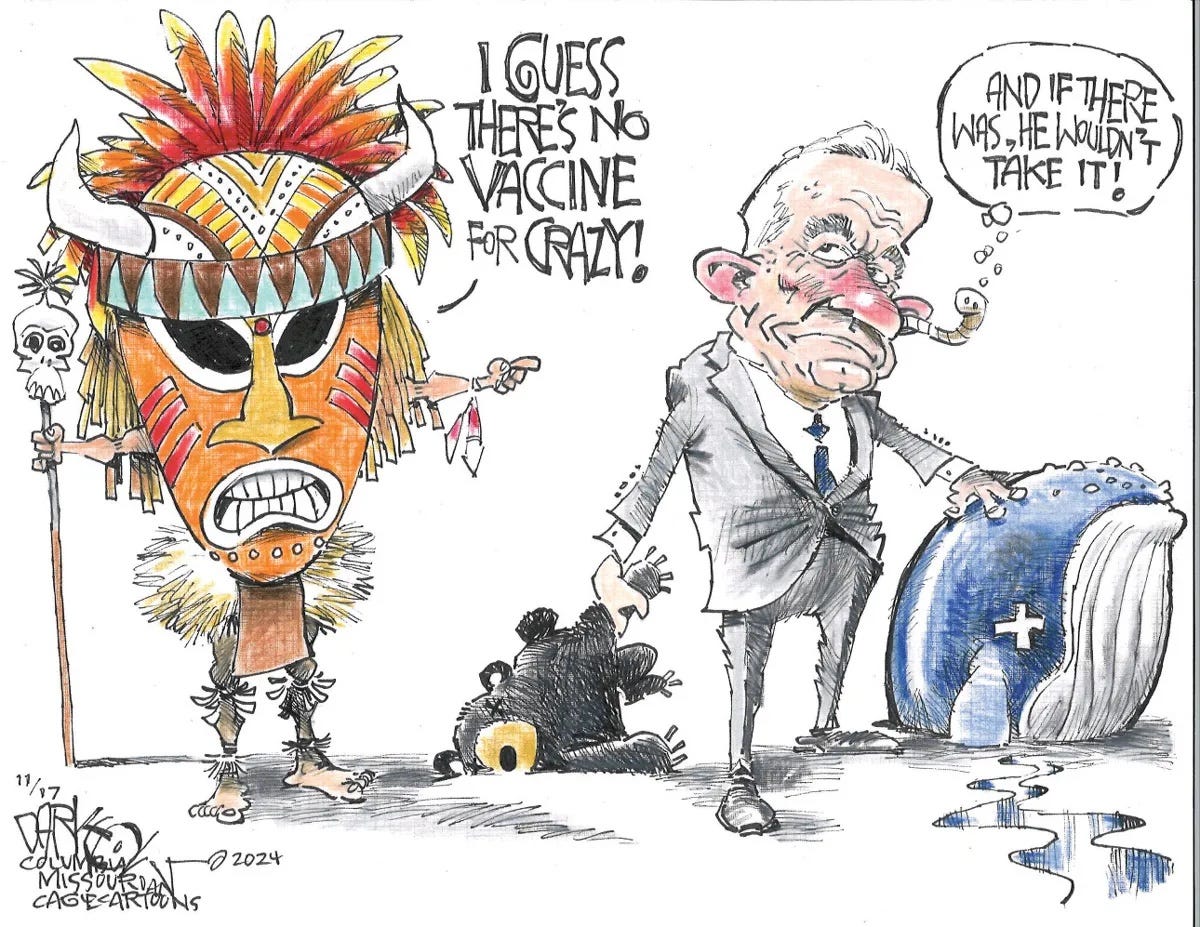
Art by John Darkow
TL;DR: After surviving one of the deadliest pandemics in modern history, America apparently decided the real problem was “too much science.” Trump’s second administration has turned public health into a conspiracy podcast with federal funding, putting anti-vaccine activists and internet cranks in charge while preventable diseases make a comeback tour. Nothing says “Make America Great Again” quite like measles, conspiracy theories, and a government response that sounds like it was brainstormed in a Facebook comment section.
In a stunning “I told you so” to basic biology, Trump 2.0 is meeting a looming Hantavirus outbreak with a health cabinet composed of anti-vax grifters and roadkill enthusiasts. While the nation’s top medical agencies are dismantled and replaced by internet skeptics, and the FBI Director hands out branded bourbon like it’s a Vegas convention, the administration’s strategy for the next pandemic remains unchanged: deny, delay, and shine a light into your own orifices.
Good morning, fellow survivors of the enlightenment. If you thought the last global pandemic was a bit too “science-heavy” for your liking, I have some excellent news. We are officially entering the “Choose Your Own Adventure” phase of public health, where the “adventure” usually ends with a ventilator and the “choices” are made by a man who once performed a roadside autopsy on a raccoon.
The world just crawled out of a pandemic that killed millions of people, shattered economies, overwhelmed hospitals, and permanently altered daily life. Most sane people would look at that experience and conclude that maybe—just maybe—we should invest more in science, public health infrastructure, and emergency preparedness.
Donald Trump looked at the same catastrophe and apparently concluded that the real problem was that doctors had become too arrogant.
Because if there’s one thing Trump learned from COVID, it’s absolutely nothing.
Let’s rewind for a moment and remember how America handled the first truly global pandemic to hit the United States in the modern social media era. While scientists scrambled to understand a rapidly spreading virus, Trump treated the crisis like a branding inconvenience. First came denial. Then delay. Then magical thinking. Then the now-legendary medical symposium where America’s commander-in-chief appeared to freestyle ideas involving bleach and “light inside the body,” as if the CDC had been replaced by a late-night infomercial for kitchen disinfectants.
More than a million Americans died. Hospitals overflowed. Nurses wore garbage bags because protective equipment ran short. Families said goodbye to loved ones through iPads while Trump obsessed over television ratings and stock prices.
A serious country would have treated that moment as a warning. Instead, America elected the sequel.
Trump 2.0 has somehow managed to take a catastrophic public health response and ask, “What if we made it weirder?”
The Secretary of Roadkill and the Anti-Vax Grift
Trump, staying true to form, has appointed Robert F. Kennedy Jr., as the nation’s top health official and living proof that having the Kennedy name is apparently enough to survive saying almost anything out loud. This is a man whose relationship with the natural world is, to put it mildly, “extracurricular,” allegedly using a chainsaw to behead a dead whale or dumping a bear cub in Central Park to frame a bicyclist.
Kennedy has spent years cultivating a reputation as America’s most famous vaccine skeptic, promoting claims repeatedly rejected by scientists and public health experts. During the 2025 measles outbreaks, experts criticized him for minimizing risks, sending mixed messages about vaccines, and promoting questionable alternatives while cases climbed.
Because in a functioning country, “the Health Secretary telling bizarre stories involving dead animals” would be disqualifying. Instead, it became one more strange footnote in America’s long national breakdown. Kennedy has publicly described his roadkill fascination and has made erratic statements and conspiracy-driven rhetoric that would normally get someone muted at Thanksgiving dinner.
But as amusing as his “Naturalist-meets-Texas-Chainsaw-Massacre” hobbies are, his day job is a serious danger to your health. The problem is that anti-vaccine ideology stops being funny when it collides with public policy.
Measles—an illness that was effectively eliminated in the United States decades ago thanks to vaccines—is back because enough people were convinced that medical science was part of a sinister global plot cooked up by Bill Gates, Dr. Fauci, and apparently the ghost of Anthony Bourdain. Public health experts have repeatedly warned that declining vaccination rates are driving outbreaks, especially among unvaccinated communities.
And while outbreaks spread, Congress remains laser-focused on the important stuff. Tax cuts for billionaires. Gutting regulations. Funding giant gold-plated ballrooms for Orange Julius Cesar. You know—priorities.
To be fair, I understand why some people became skeptical. The pharmaceutical industry is hardly a sacred institution. Corporate profit motives in healthcare are real, and Americans have every reason to distrust industries that charge $900 for medications that cost twelve cents to manufacture. Skepticism isn’t the problem.
The problem is when skepticism mutates into full-blown internet-brain poisoning.
A Clown Car of Skeptics
There’s a difference between questioning pharmaceutical profiteering and deciding measles can be defeated with vitamin supplements, positive vibes, and a podcast hosted by a guy selling tactical beef jerky.
Unfortunately, Trump’s administration assembled what can only be described as a clown car of “skeptics” and dropped them directly into the machinery of public health.
Kennedy isn’t alone. Across federal agencies, experienced scientists and career experts have been pushed aside in favor of ideological loyalists, wellness influencers, conspiracy-adjacent personalities, and culture-war crusaders who seem deeply offended by peer review. Critics and former officials have warned that the administration’s actions—including replacing vaccine advisory committees, cutting research funding, and sidelining experts—have weakened trust in public health institutions.
Meanwhile, the people actually qualified to manage public health emergencies keep resigning, getting purged, or quietly fleeing the building before the next press conference begins. Even top communications officials reportedly quit amid disagreements over the administration’s handling of disease outbreaks.
And now comes the newest nightmare fuel: hantavirus.
The Cruise Ship Crisis:
To be clear, hantavirus is still considered relatively rare, and health officials continue to monitor outbreaks carefully. But reports of evolving strains and public anxiety surrounding potential transmission are exactly the sort of thing that should trigger a calm, competent, science-driven response.
Instead, we’re living under a government where the national emergency strategy appears to be “wait for Joe Rogan to weigh in.”
Where are the emergency responders? Hard to say. Maybe they’re busy attending another congressional hearing about Hunter Biden’s laptop. Maybe they’re sampling Kash Patel-branded bourbon while tweeting about the Deep State. Maybe they’re stuck in an HR seminar titled How to Replace Scientists with Influencers.
What we do know is that public confidence in health institutions has cratered right when competent institutions matter most. And that’s the real danger here.
Pandemics don’t care about ideology. Viruses are famously uninterested in your political identity. They don’t stop spreading because someone posted a meme about “medical freedom” next to a shirtless eagle carrying an AR-15.
Nature does not negotiate with conspiracy theories.
But modern authoritarian politics depends on destroying trust in expertise because expertise creates accountability. Scientists can tell you when leaders are lying. Researchers can produce inconvenient data. Doctors can explain why injecting disinfectant into your bloodstream is less “innovative treatment” and more “FastTrack to organ failure.”
So expertise itself becomes the enemy.
The Politics of Disease:
That’s why modern reactionary politics increasingly attacks universities, scientists, researchers, teachers, journalists, and doctors. An informed population is harder to manipulate. A society grounded in evidence becomes resistant to propaganda.
And propaganda is all these people have.
Trump’s movement thrives on the performance of certainty. Complex problems always have simple villains. Climate change? Hoax. Vaccines? Conspiracy. Public health agencies? Tyranny. Disease outbreaks? Probably immigrants or librarians or drag queens somehow.
Anything except the actual causes.
Meanwhile, billionaires continue hoarding wealth at historic levels while public infrastructure decays around us. Hospitals are understaffed. Rural healthcare systems collapse. Research funding gets slashed. Scientists are demonized. And the same politicians screaming about “freedom” somehow never mention your freedom to afford insulin or survive a preventable disease.
Funny how that works.
The truly dark part of all this is that we already know what happens when societies abandon science for ideology. History is filled with regimes that replaced expertise with loyalty and turned reality into a political inconvenience.
It never ends well.
You cannot meme your way out of epidemiology. You cannot podcast your way out of virology. And you definitely cannot “alpha male” your immune system into defeating airborne disease because some supplement salesman on YouTube told you zinc and patriotism are basically the same thing.
But this is America now: a nation where public health policy increasingly sounds like it was drafted during a mushroom microdosing retreat hosted by InfoWars.
And looming over all of it is Trump himself—the man who once suggested sunlight and disinfectant as medical interventions—still standing there like America’s senile game-show emperor, promising strength while surrounding himself with conspiracy theorists, grifters, and anti-science ideologues.
But not to worry.
If the next pandemic arrives, Trump probably has a very powerful flashlight ready to shine into your orifices.
F*CK ICE. RELEASE ALL THE FILES!
Please like, share, and subscribe—because the people dismantling public health infrastructure won’t stop until expertise itself becomes illegal.
Follow my work: @ Substack: democracy4sale.substack.com / Website: democracy4sale.com
Robert Cain, author of Democracy for Sale: How Corporate Greed Is Corrupting Democracy and Endangering the Planet. Available at Amazon, Barnes & Noble, and booksellers everywhere.