By Rob C.
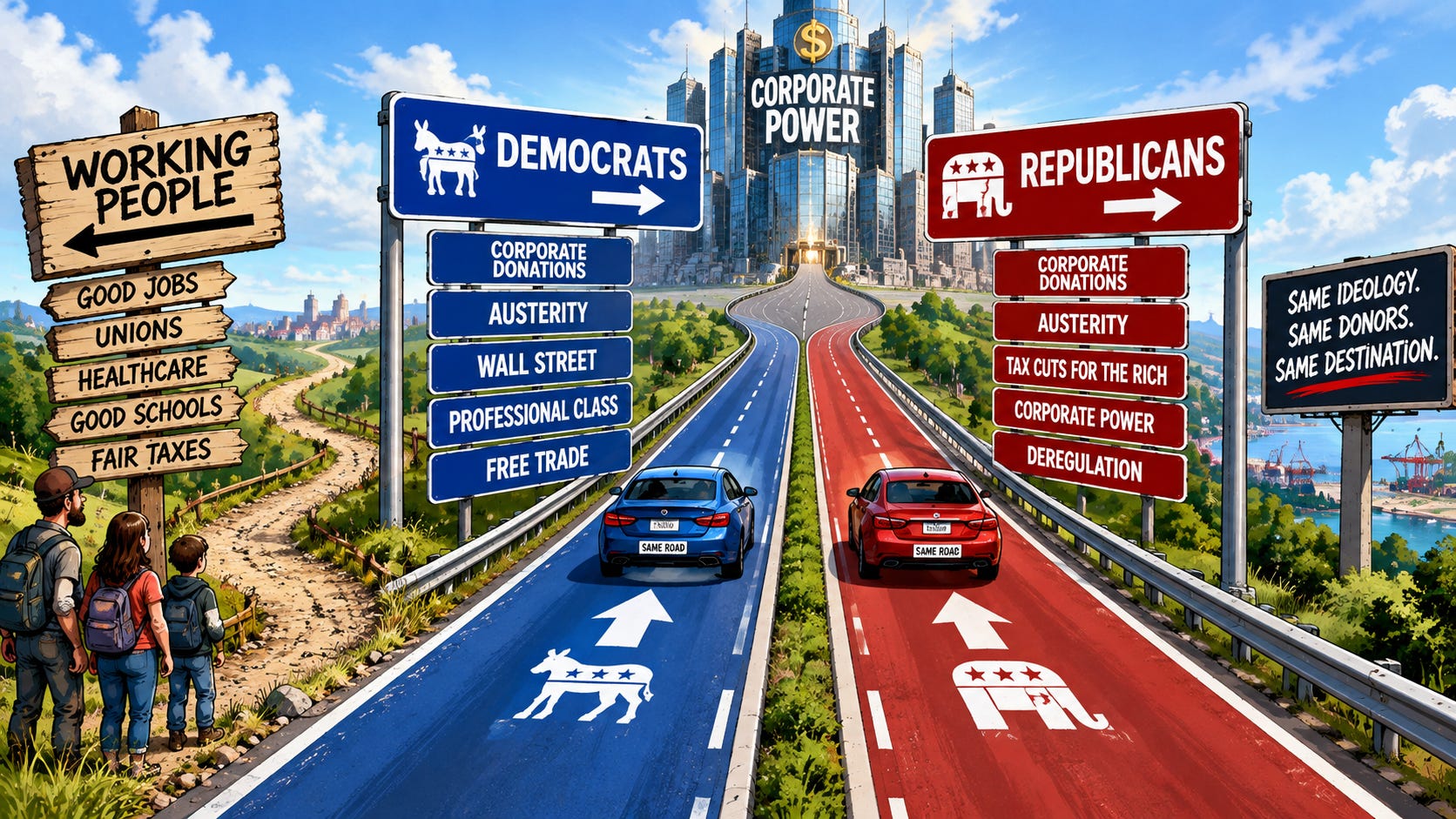
TL;DR: America’s two-party system offers voters a choice that isn’t really a choice at all on economics: one party built on right-wing ideology from the beginning, and another that quietly absorbed most of the same ideas while keeping progressive branding on the label. Neoliberalism is the ideology at the heart of both: the belief that “free markets”, not government, are the most efficient and legitimate way to organize a society, prioritizing deregulation, privatization, and individual self-sufficiency while treating almost any government intervention in the economy as inherently suspect. It grew out of classical liberalism, but it hardened into something far more absolute in the 1970s and ‘80s under Thatcher and Reagan. The part most people miss is that it didn’t stay on the right. By the 1990s, center-left parties across the developed world had absorbed neoliberalism’s core tenets too — Tony Blair’s “New Labour” in Britain, and Bill Clinton’s “New Democrats” here, both embracing deregulation and balanced-budget austerity with softer rhetoric wrapped around the same substance.
The Democratic Forfeit
The Democratic Party spent roughly forty years transforming itself from the party of the working class into the party of a “professional class,” the highly credentialed, Ivy-educated, white-collar managerial and creative set, and that this is a class-based transformation, not a story about Republican obstruction.
To be perfectly clear, Republicans are far worse on economics, but in a two-party system, when the party positioned to represent working people abandons that role, the result is exactly what we’ve gotten: a sustained, decades-long upward flow of wealth and power. In Thomas Frank’s book “Listen, Liberal,” he traces the rot earlier than most people assume, back to Jimmy Carter, who “cancelled public works projects” and, with a Democratic Congress behind him, “enacted the first of the era’s really big tax cuts for the rich and also the first of the really big deregulations,” putting the country, in Frank’s words, on “an austerity diet spectacularly punishing to ordinary working people.” A Carter economic adviser, Alfred Kahn, said the quiet part out loud at the time: “I’d love the Teamsters to be worse off.”
The Best Republican President Ever
“The triumph of Clinton marked the end of the Democrats as a party committed to working people and egalitarianism.” – Thomas Frank
It wasn’t until Clinton was in office, with Democrats in Congress routed, that “the old New Deal and Great Society consensus on domestic matters finally collapsed.” Look at what Clinton actually delivered: NAFTA, prioritizing Wall Street and multinational capital over American manufacturing workers; the repeal of Glass-Steagall, tearing down the New Deal wall between commercial and investment banking that helped set up the 2008 crash a decade later; and the 1996 welfare reform bill, ending guaranteed assistance to impoverished single parents, celebrated by pundits at the time as evidence of Clinton’s brilliant “triangulation.” These were longstanding Republican objectives, and it took a Democrat to get them past a base that would have revolted if a Republican had tried. That’s not pragmatism forced on the party from outside. That’s a financial strategy.
Oh, Obama.
Obama didn’t reverse this pattern; he deepened it. He had what was described as an “obsession with Ivy League meritocracy that masked a craven commitment to putting corporations first.” Why did Obama fill his cabinet with Wall Street-friendly technocrats? The answer is: Obama believed such people should be in charge because they came up through the same system as him. Meritocracy as self-justifying class solidarity, not a neutral standard applied fairly. I admit that I was taken in by Obama’s populist/ community organizer rhetoric; I even campaigned for him, which tells you how effective the branding was even on people paid to see through it. As Thomas Frank put it: “The Democrats are a class party in the fullest sense of the phrase, and the class whose perspective they reflect and whose interests they serve is the highly educated, white-collar professional class,” not the top 1%, but the credentialed stratum just below it, who benefit enormously from a system that leaves the working-class majority behind.
A Well-Funded War on the Working Class
This didn’t happen in a vacuum, and I’ve traced the mechanics of how we got here across this whole series. Eisenhower’s 1956 Republican platform protected union bargaining rights, expanded Social Security and unemployment insurance, and raised the minimum wage, governing with a 91% top marginal tax rate as an accepted, bipartisan floor, not a target for repeal. That consensus was deliberately torn down starting in the late 1970s by the Chicago School, with Robert Bork’s “Antitrust Paradox” narrowing competition law down to caring only about consumer prices, never concentrated power, a framework the courts swallowed whole within a few years. Reagan operationalized all of it from the Oval Office, after his own ideological makeover during his years as General Electric’s paid spokesman under Lemuel Boulware, and his ties to the National Association of Manufacturers, the same outfit that spent the 1930s fighting child labor laws as a socialist plot, supplied him the “Tripod of Freedom” script his “government is the problem” line ran on for the rest of his career.
The doctoring of Adam Smith.
And it wasn’t just political maneuvering; it was manufactured intellectual cover, purchased outright. “The Big Myth” documents something most people have never heard: in the late 1940s and early ‘50s, a group of pro-free-market businessmen funded a “Free Market Study” project at the University of Chicago for one specific purpose, producing a revised edition of Adam Smith’s “The Wealth of Nations.” Why revise a 170-year-old economics text? Because Smith’s actual writing contains an extensive argument for banking regulation, and Smith supported a minimum wage and progressive taxation, positions flatly incompatible with the laissez-faire icon he was about to be repackaged as. They weren’t rediscovering Adam Smith. They were editing him. The same money paid the salaries of economists including Ludwig von Mises and Milton Friedman, whose ideas had real academic skepticism attached to them up to that point, and funded free mass distribution of Ayn Rand’s novels. Remember “trickle-down economics?” This was not an organic intellectual movement that won on the merits. It’s a purchased one.
Look at Us Now
Forty years of this, under both parties, produced exactly what you’d expect: the largest income inequality this country has seen since before the Great Depression, and by some measures the largest in recorded history. I’ve laid out the specific tax cuts, from Reagan through Trump, and the collapse of antitrust enforcement elsewhere in my articles, so I won’t repeat them here. The throughline is clear: both parties, the same ideology, just measured in dollars collected instead of policy positions.
America First? Not So Much
Here’s what that ideology costs us when you measure success honestly instead of by the stock market. The Human Development Index (HDI) ranks countries on three things: life expectancy, expected years of schooling, and income per capita. America posts an HDI of 0.938, which sounds good until you realize that’s outside the top 15 countries in the world, despite having one of the highest Gross National Incomes (GNI) per-capita figures on the planet. Why? Because our life expectancy performance drags the score down. U.S. life expectancy at birth ranks just 42nd among 224 nations. We rank 53rd out of 193 countries on infant mortality and 65th out of 185 on maternal mortality. measures eleven dimensions of actual human wellbeing: housing, work-life balance, civic engagement, personal safety. We ranked 6th when it launched in 2013, and every trend line since points the wrong direction. A country whose GDP and stock market keep hitting record highs while its people live shorter, less secure lives than people in smaller, less wealthy nations is a country measuring the wrong thing on purpose, because the right measurement would embarrass everyone currently in charge of both parties.
The Road to Recovery
The solution isn’t to abandon the Democratic Party; it’s to reclaim it. We must discard the near-religious worship of the professional class the party picked up starting with Carter and Clinton, and re-anchor itself in the material economic concerns of the working people it was built to represent, instead of treating cultural liberalism and credentialist meritocracy as a substitute for actual economic egalitarianism. The standard excuse Democratic leadership always reaches for is that their sucking up to Wall Street is a pragmatic necessity forced on them by Republican obstruction. I believe that the party’s leadership wanted these outcomes, because these outcomes serve the class interests of the people making the decisions. A party that claims to speak for working people while governing on behalf of a credentialed elite isn’t being pragmatic. If the Democrats continue to represent the interests of the top 10%, that isn’t the party of working people; that’s just Republican lite. The only way back is to actually mean it when you call yourself the party of working people, instead of just saying it every four years and hoping nobody checks the receipts.
Join the Resistance!
Like, Share, and Subscribe— because we need a party that works for us!
Follow my work:
Substack: democracy4sale.substack.com
Web: democracy4sale.com
Facebook: facebook.com/democracy4sale/
YouTube: youtube.com/democracy4sale/
Twitter/X & Bluesky
Rob Cain is the author of “Democracy for Sale: How Corporate Greed Is Corrupting Democracy and Endangering the Planet,” and writes “Our Broken Systems” at democracy4sale.com.