By Rob C.
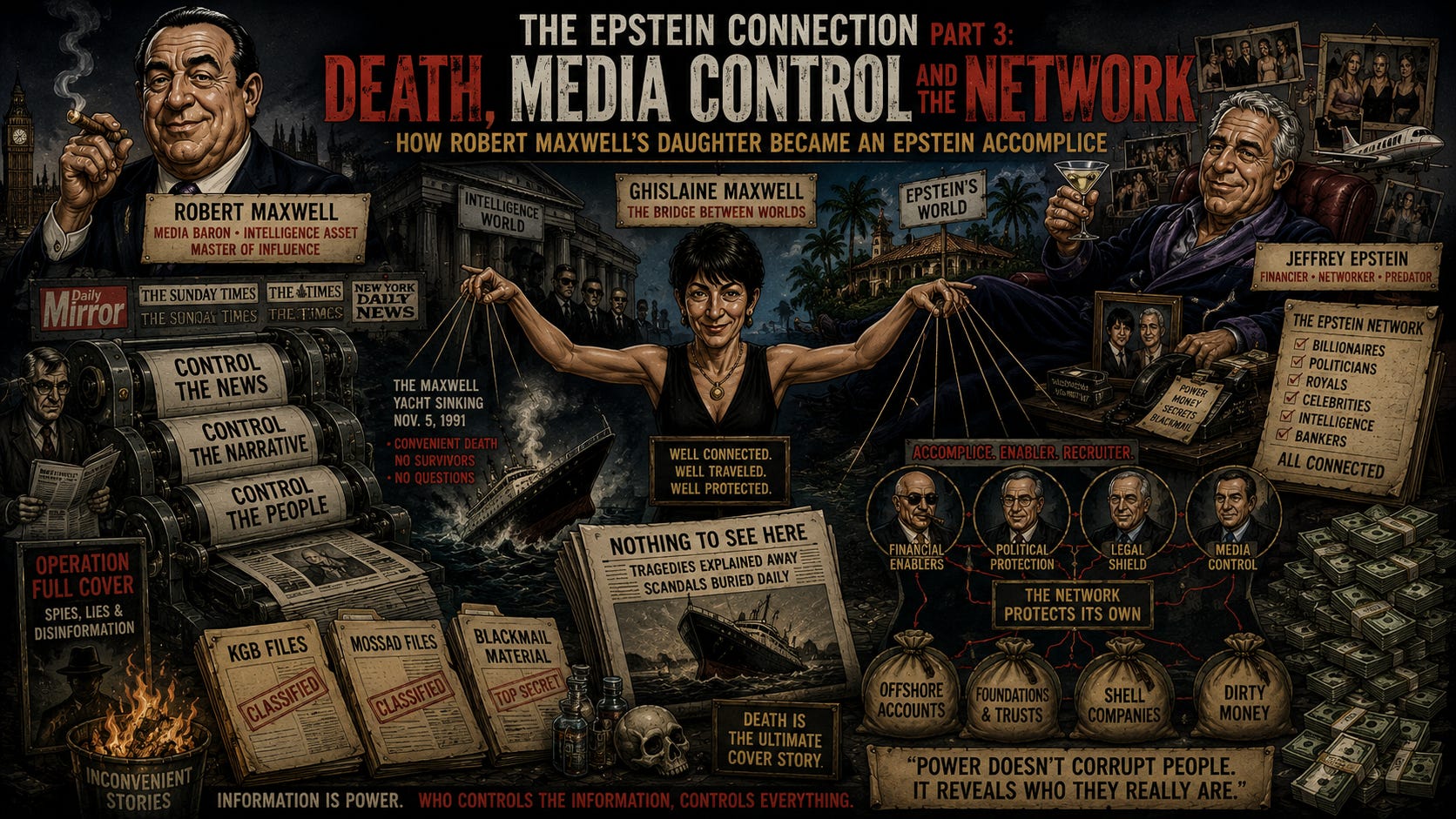
TL;DR: A media mogul steals $1.4 billion from workers’ pension funds, falls off his yacht under mysterious circumstances, and dies just as the fraud is about to explode into public view. His daughter then resurfaces alongside Jeffrey Epstein, becoming one of the central figures in one of the largest sex trafficking operations in modern history. The newspapers that should have been investigating the powerful were themselves controlled by the powerful. This isn’t just a crime story, it’s a case study in how money, media, intelligence services, and elite protection intersect, the Maxwell-Epstein story is about as close as you’ll find to a blueprint.
Good morning America. We’ve traced the money from Les Wexner’s billion-dollar heist to the looting of the Soviet Union. Now, we arrive at the third pillar of the Epstein class: The Control of Reality.
To build a criminal network that spans continents, you need two things: cash and cover. The cash, we know, came from systematically raiding the life savings of the working class. The cover? That came from the media moguls who were supposed to expose the rot but were, in fact, the ones holding the shovel.
One of the recurring themes in this series has been that the Epstein scandal was never really about Jeffrey Epstein.
Epstein was important, certainly. He was the front man. The smiling billionaire with the private jet, the mansion, the endless supply of young women, and the uncanny ability to make criminal investigations disappear. But if all roads somehow lead back to Epstein, it is worth asking where Epstein’s roads came from.
To answer that question, we have to talk about Robert Maxwell.
A Media Mogul’s “Convenient” Exit
And like so many stories involving the ultra-wealthy, it begins with a dead billionaire floating in the ocean.
In March of 1991, Robert Maxwell arrived triumphantly in New York aboard his luxury yacht, the Lady Ghislaine, named after his favorite daughter. Maxwell wasn’t just rich. He was one of the most powerful media figures in the world. He owned newspapers, publishing houses, printing operations, and vast media assets stretching across multiple countries. His flagship publication, the Daily Mirror, was Britain’s largest left-leaning tabloid. In the United States, he had just acquired the New York Daily News, one of the country’s most influential newspapers. He was also a member of Parliament, an intelligence darling with alleged ties to the Russians, and a man who projected the image of a titan.
Maxwell dreamed of building a media empire capable of rivaling Rupert Murdoch’s. He wanted power. He wanted influence. He wanted the ability to shape public opinion on both sides of the Atlantic.
And for a while, he had it.
Politicians courted him. Journalists feared him. Business leaders sought his approval. He was estimated to be worth well over a billion dollars and appeared untouchable.
Then, suddenly, he wasn’t.
On November 1, 1991, Maxwell departed aboard the same yacht that had carried him into New York months earlier. Four days later, on November 5, his body was discovered floating in the Atlantic Ocean near the Canary Islands.
The official story? Accidental drowning or a heart attack. The reality? He was found nude, reportedly with a “blow to the head,” floating in the middle of the Atlantic just as the world began to realize that his empire was a hollow shell.
The speculation only intensified because of Maxwell’s long-rumored connections to intelligence services. Over the years, journalists and investigators had linked him to allegations involving Mossad, MI6, and even Soviet intelligence. Former Israeli officials publicly praised Maxwell following his death in a manner that raised eyebrows among observers already familiar with those allegations.
Was he murdered? Did he jump? Did he accidentally fall? Thirty-five years later, nobody can say with certainty. What we do know is what happened next.
Within weeks of Maxwell’s death, investigators uncovered a financial catastrophe hidden beneath his media empire. Approximately $1.4 billion was missing.
Not misplaced – Missing – GONE!
The bulk of that money had been taken from employee pension funds associated with the Daily Mirror and other Maxwell-owned companies. Ordinary workers who had spent decades contributing to retirement accounts discovered that the money they had counted on for their futures had effectively been looted. He didn’t just steal their retirement; he leveraged their life savings to maintain the facade of a media empire while he played at being a global intelligence asset.
Imagine working your entire life, trusting your employer to safeguard your retirement, only to discover that the billionaire owner had been using your pension fund like his personal ATM.
The collapse of Maxwell’s empire was swift and brutal. Assets were frozen. Investigations began. His family suddenly found itself under intense scrutiny. Kevin Maxwell, Robert’s eldest son, became a focus of multiple investigations. The family fortune evaporated almost overnight.
And sitting at the center of the wreckage was Robert’s youngest daughter, Ghislaine.
From Asset to Accomplice
When her father died, Ghislaine Maxwell lost more than a parent. She lost access to the world that had protected and elevated her. The money was disappearing. The empire was collapsing. The family name had become synonymous with scandal.
Then, almost as if on cue, another billionaire entered the picture.
Jeffrey Epstein.
The timing is impossible to ignore.
Within roughly a year of Robert Maxwell’s death, Ghislaine Maxwell, fell upward, right into the orbit of a man who had his own $1.3 billion—also stolen, also unexplained, and also needing the kind of “special access” that only a woman with Maxwell’s intelligence pedigree could provide.. Over time, she would become far more than a social companion. Court records, witness testimony, and ultimately her criminal conviction established her role as a recruiter and facilitator within Epstein’s trafficking operation.
The partnership was mutually beneficial.
Epstein offered wealth, protection, connections, and an escape route from the wreckage of the Maxwell scandal. Ghislaine brought elite social access, international connections, credibility within upper-class circles, and potentially the kinds of relationships inherited from her father’s extensive network. Together, they formed a perfect, mutually reinforcing engine of exploitation, they built something far darker than either could have achieved alone.
One of the most disturbing aspects of the Maxwell-Epstein story is how effectively it remained hidden despite operating in plain sight.
Girls reported abuse. Victims came forward. Journalists pursued leads. Law enforcement received complaints. Yet somehow, again and again, the story stalled.
This is where media control becomes impossible to ignore.
Capturing of the Fourth Estate
The most dangerous part of this story isn’t the theft—it’s how the media handled it. Robert Maxwell spent decades building newspapers capable of shaping public perception. He understood something many billionaires understand instinctively: controlling information is often more valuable than controlling money.
Money can buy influence - Media creates reality!
The institutions that are supposed to investigate power frequently depend upon power for access, advertising revenue, ownership, or political protection. That dynamic did not begin with Maxwell, nor did it end with him.
In many ways, the collapse of independent journalism accelerated after his death.
The New York Daily News provides a striking example. Once one of America’s most influential newspapers, it has been hollowed out through years of cuts and corporate consolidation. A publication that once employed armies of investigative reporters now operates with a fraction of its former capacity. Maxwell’s papers were supposed to be the watchdogs, but they were the ones wearing the leashes. When he died, the papers that should have investigated the Epstein-class network were either shuttered, sold to his cronies, or systematically stripped of their power.
The journalist Kevin M. Kruse’s favorite media critique may be the most fitting summary of this phenomenon: Newspapers Did Not Kill Themselves. They were hollowed out by the very people they were supposed to hold accountable. The Epstein class doesn’t need to censor the news; they just buy the newspapers and fire the people who ask questions.
And that brings us back to Epstein.
Part one of this series examined the mysterious transfer of enormous wealth and influence surrounding Epstein’s rise.
Part two explored the looting of post-Soviet Russia and the creation of oligarchic fortunes that intersected with Epstein’s network.
Now we arrive at part three, where media power enters the equation.
Money, Sex, and Silence
Three pillars supporting the same structure.
Add intelligence connections hovering in the background, and the pattern becomes difficult to ignore.
Again and again, we encounter the same recurring themes: stolen money, compromised institutions, elite protection, and investigations that somehow stop short of the most powerful people involved.
The story is never just about one criminal.
It is about a system.
That system protects billionaires while workers lose pensions. It protects traffickers while victims are ignored. It protects powerful networks while journalists struggle to obtain basic answers.
The result is a society where ordinary people are expected to follow every rule while the wealthy operate under an entirely different set of assumptions.
If Robert Maxwell’s workers had stolen a billion dollars, they would have spent the rest of their lives in prison. If an ordinary citizen had trafficked children, they would have disappeared into a federal penitentiary.
If a local newspaper editor had concealed crimes committed by powerful friends, prosecutors would be lining up at the door.
Yet somehow, when enough money, influence, intelligence connections, and political power accumulate in one place, accountability becomes remarkably elusive.
Why This Matters
Robert Maxwell stole from his own employees to buy the media that hid his crimes. Epstein used that same playbook to build a global sex-trafficking machine that kept senators, princes, and economists in check. And in 2026, the elite are still doing it. They’ve just traded the printed newspaper for social media algorithms and the “yacht” for a private cloud server.
The depravity of the Epstein class isn’t a “glitch”—it’s the operating system. They thrive because they know that when you own the papers, steal the pensions, and blackmail the judges, you don’t have to obey the law. You are the law.
Democracy cannot function if information itself is controlled by the same people committing the crimes. If newspapers can be influenced, prosecutors pressured, witnesses intimidated, and investigations quietly redirected, then accountability becomes theater rather than reality. The Maxwell-Epstein network isn’t important because it’s unique. It’s important because it reveals how power actually works.
And once you see the pattern, you start noticing it everywhere.
Please like, share, and subscribe. The people who own newspapers, influence governments, and mysteriously fall off yachts would very much prefer that nobody connect the dots.
F*CK ICE. RELEASE ALL THE FILES!
Follow my work: Substack: democracy4sale.substack.com / Web: democracy4sale.com
Robert Cain, author of Democracy for Sale: How Corporate Greed Is Corrupting Democracy and Endangering the Planet. Available at Amazon, Barnes & Noble, and booksellers everywhere.