By Rob C.
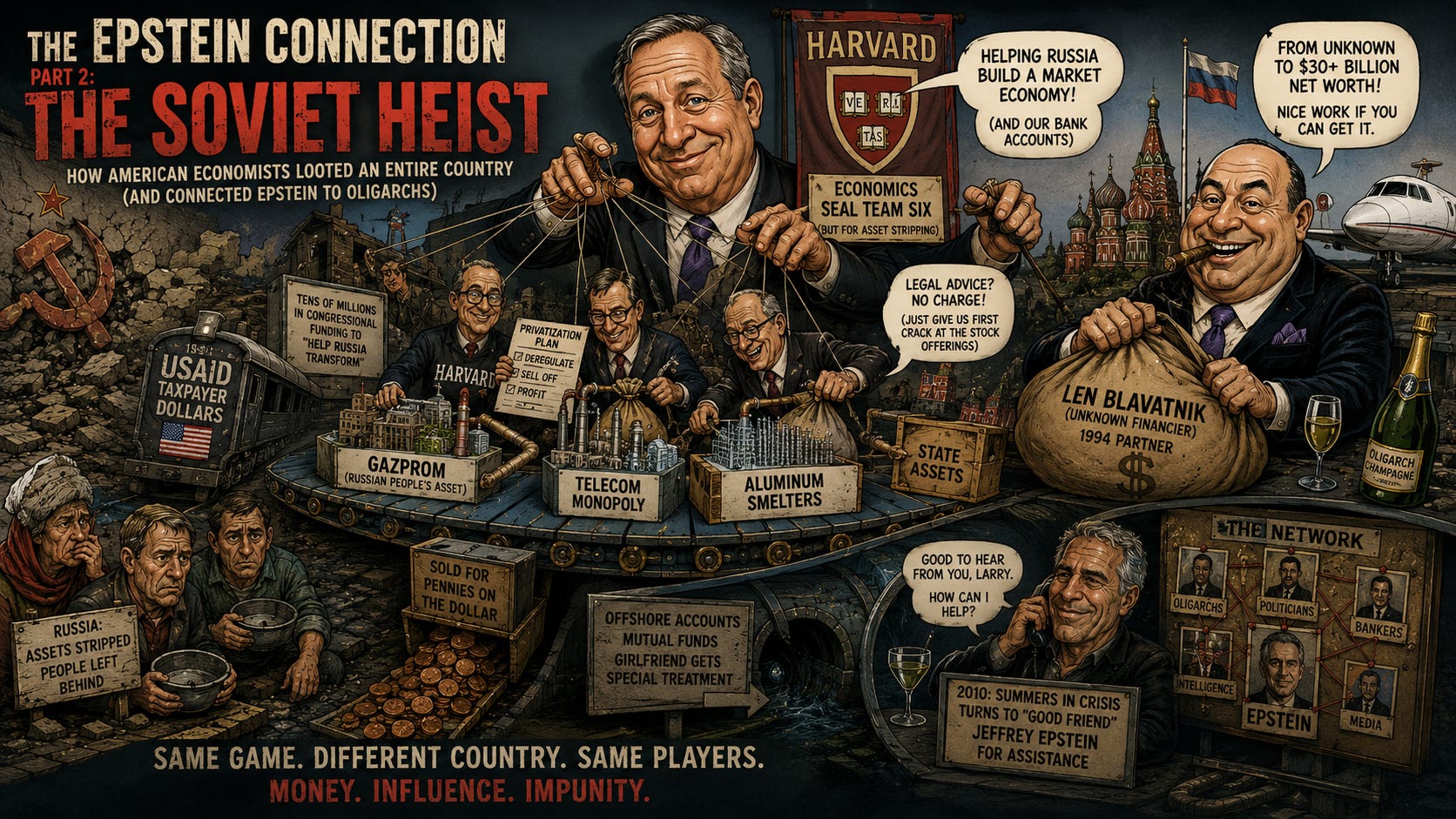
TL;DR: When the Soviet Union collapsed, it didn’t just fall; it was liquidated by a “Seal Team Six” of Western economists who treated a nation’s assets like a private shopping spree. Led by Larry Summers, this Harvard-backed “aid” program wasn’t about democracy; it was about auctioning off a continent at pennies on the dollar. The result? A new class of oligarchs like Len Blavatnik, who rose from obscurity to a $30+ billion fortune, and a playbook of corruption that would later become the standard operating procedure for the entire Epstein network. And your tax dollars funded the crime.
When an empire collapses, history tells us that vultures are never far behind. Sometimes they arrive in military uniforms. Sometimes they arrive carrying briefcases, PowerPoint presentations, and economic theories. When the Soviet Union fell apart in 1991, Americans were told that the West would help Russia transition to democracy and free markets. Congress authorized funding. Economists flew in. Consultants descended on Moscow. The rhetoric was noble, uplifting, and wrapped in the language of freedom.
Then something funny happened.
A small number of people became unimaginably rich, an entire nation was stripped for parts, and the Russian oligarchy was born. Officially, this was called privatization. In practice, many Russians experienced it as a fire sale of national wealth.
The Geopolitical Vultures
When the Soviet Union dissolved in 1991, the world’s largest pile of state-owned assets—was suddenly up for grabs. It created one of the largest transfers of assets in human history. State-owned industries, natural resources, telecommunications systems, factories, mines, energy infrastructure, and industrial monopolies that had belonged—at least in theory—to the Soviet people suddenly became available for purchase. Congress authorized tens of millions in USAID funding to “help Russia” transition, effectively handing American economists a blank check to write the rules of the new Russian economy.
The question was: who would own Russia’s future?
American policymakers argued that rapid privatization was necessary to prevent a return to communism. The theory was straightforward. Move assets into private hands as quickly as possible, create a capitalist class, and democracy would follow. What could possibly go wrong? As it turns out, quite a lot.
Enter Larry Summers, then-deputy secretary of the Treasury and the undisputed architect of U.S. policy toward Russia. Summers didn’t just offer advice; he deployed a “Seal Team Six” of Harvard economists, led by his protégé Andrei Shleifer, to rewrite the rules of Russian privatization. The mission was theoretically to create a “market economy,” but the mechanism was built on a foundation of “pro bono” corruption that would eventually blow up in the face of the U.S. government, Harvard University, and the Russian people themselves.
Millions of dollars in American aid flowed into programs designed to assist Russia’s transition. Universities, economists, consultants, and government advisers became deeply involved in shaping the process. At the time, Summers was emerging as one of the most powerful economic thinkers in Washington. His ideas carried enormous weight, and his network extended deep into both academia and government. Summers would later become Treasury Secretary under President Bill Clinton and the president of Harvard University.
The sales pitch was simple: America would teach Russia how markets work.
The reality was considerably messier.
Andrei Shleifer was deeply involved in advising on Russian privatization programs. Years later, controversy would erupt over conflicts of interest involving individuals connected to the Harvard project. Federal litigation alleged that advisers benefiting from privileged access to information engaged in activities that conflicted with their official responsibilities. Harvard eventually paid millions to settle the government’s lawsuit, though the institution did not admit wrongdoing.
Privatization as Plunder
What emerged from this period was a system in which assets that had once belonged to the state were acquired for fractions of their eventual value. Industries worth billions changed hands under conditions that critics described as chaotic, opaque, and ripe for abuse. Defenders argued that mistakes were inevitable in a transition of such enormous scale. Critics saw something else: a feeding frenzy.
The most important consequence wasn’t simply that wealth changed hands. It was who received it.
The “Insider” Edge: Shleifer and his team were advising the Russian government while simultaneously maneuvering to invest in Russia’s very first authorized mutual fund.
Out of this process emerged a new class of oligarchs whose fortunes would reshape Russia for decades. Among the most successful was Len Blavatnik, who participated in investments connected to the post-Soviet privatization era and eventually built a fortune worth tens of billions of dollars. Today he ranks among the wealthiest individuals in the world, with investments spanning energy, media, entertainment, and technology.
There is nothing inherently illegal about becoming wealthy through successful investments. But the broader question remains impossible to ignore. How did so much wealth become concentrated in so few hands so quickly? Why did the promised era of democratic capitalism instead produce a system dominated by oligarchs? And why did so many of the people who designed the process later act surprised by the outcome?
The answer may be that the outcome wasn’t entirely surprising.
When public assets are sold rapidly, oversight is weak, information is unevenly distributed, and political connections determine access, wealth tends to flow toward insiders. That’s not a bug in the system. That’s often the system functioning exactly as designed.
The Quid Pro Quo: In exchange for “free” legal work and advice, these Western economists and their inner circle gained the first “crack” at buying up state assets—often hidden in the names of family members or girlfriends to avoid detection.
Assets that belonged to the Russian public were auctioned off to a chosen few for pennies on the dollar. The DOJ would eventually uncover evidence of fraud, money laundering, and the “cavalier use” of U.S. taxpayer funds for everything from tennis lessons to vacation boondoggles for Harvard employees and their Russian pals.
The tragedy is that ordinary Russians paid the price. During the 1990s, life expectancy fell, savings evaporated, organized crime flourished, and economic insecurity exploded across the country. While Western economists celebrated market reforms, millions of people watched their standard of living collapse. Entire industries that had once been publicly owned became the property of a tiny elite. The result was not the flourishing democratic capitalism many promised. It was oligarchy.
Harvard and Shleifer eventually paid over $31 million to settle a lawsuit brought by the U.S. government for this “conspiracy to defraud”. But the damage was done. They had effectively created the Russian oligarch class, the very people who would go on to build the autocracy that Putin now commands.
And where oligarchy flourishes, politics soon follows.
The system that emerged from the chaos of the 1990s created conditions that ultimately enabled the rise of Vladimir Putin. Russians who had watched public assets disappear into private hands became increasingly skeptical of both democracy and market reforms. The very policies that were supposed to secure a Western future helped create the political conditions for a nationalist backlash.
The Epstein Connection
Fast forward to 2010. Larry Summers, by then a major figure in the Obama administration, was caught in the aftermath of the global financial crisis. But he wasn’t just talking to bankers. Newly released emails reveal a different set of advisors: his “good friend” Jeffrey Epstein.
Epstein wasn’t just a “socialite”; he was a node in the same global financial network that allowed the Russian oligarchs to move their money. Emails leaked to the press show Epstein and others coordinating on high-level financial policy, with Epstein’s circle acting as a shadow infrastructure for influence, blackmail, and asset management.
Summers’ relationship with Epstein wasn’t an “error in judgment”; it was a continuation of the same circles of power that he helped build in the 1990s. Whether it’s looting the Soviet Union or managing the fallout of a U.S. financial crash, the people are the same, the methods of hidden ownership are the same, and the goal—the concentration of wealth in the hands of the “untouchables”—is always the same.
Again and again, the same pattern emerges. Massive concentrations of money. Powerful men. Weak accountability. Elite networks that protect themselves. Whether we’re discussing billionaires, politicians, financiers, or academics, the machinery often looks remarkably similar.
The Soviet heist was just a rehearsal. The same mechanism—state-level looting, offshore laundering, and political cover-ups—was perfected in Moscow and later deployed globally by the Epstein network.
If you’re wondering why the system never changes, it’s because the people writing the rules are the same people who looted the country.
And somewhere in the overlapping networks of money, influence, and power, Jeffrey Epstein keeps appearing.
In Part Three, we’ll examine another figure whose shadow stretches across this story: Robert Maxwell. Media baron. Intelligence asset. Financial operator. And the father of Ghislaine Maxwell. Because before Epstein built his network, another man had already mastered the art of controlling information, cultivating influence, and operating in the space between wealth and intelligence.
If you enjoyed learning how American taxpayers helped fund economic experiments that somehow produced billionaires, oligarchs, and decades of instability - Please like, share, and subscribe. Apparently “nation building” is what they call it when the rich get richer on someone else’s dime.
F*CK ICE. RELEASE ALL THE FILES!
Follow my work:
Substack: democracy4sale.substack.com / Web: democracy4sale.com
Robert Cain, author of “Democracy for Sale: How Corporate Greed Is Corrupting Democracy and Endangering the Planet.” Available at Amazon, Barnes & Noble, and booksellers everywhere.