By Rob C.
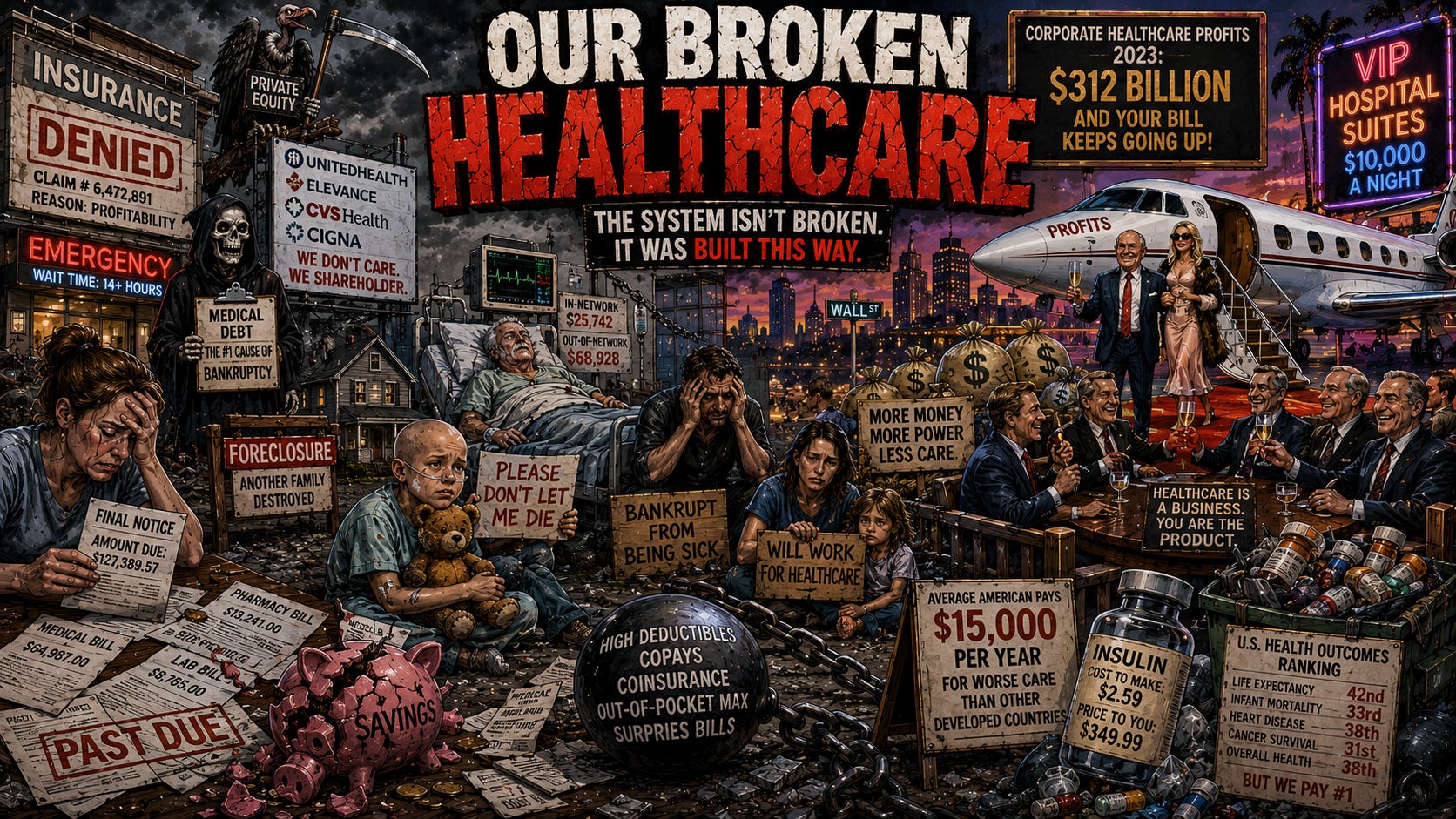
TLDR: If you’ve ever been seriously sick in this country, you know the real horror isn’t the illness. It’s the system that’s supposed to heal you but instead bleeds you dry. You survive the cancer but lose your house. You live through the heart attack but declare bankruptcy. You keep your kid alive but mortgage your future.
Welcome to American sick care—where profit matters more than your pulse.
What makes healthcare in America uniquely awful is that we’ve transformed illness into one of the most profitable industries on Earth. We spend nearly $15,000 per person every year on healthcare—more than double what many developed countries spend—and yet we rank near the bottom of the developed world on health outcomes. Nearly half of major healthcare markets are controlled by one or two hospital systems. Four giant pharmacy chains dominate prescription distribution. Insulin, a century-old drug that costs a few dollars to manufacture, can cost hundreds of dollars per vial. Meanwhile, medical debt remains one of the leading causes of bankruptcy in the richest nation on Earth.
This is the second Broken System in our series, and it might be the cruelest one. The food system poisons you slowly. The healthcare system bankrupts you while you’re trying not to die. And the math is so brutally simple it’s almost laughable: we spend more money on healthcare than the entire economies of most countries, yet we get worse results than nations spending half as much.
If America’s food system is a dumpster fire, healthcare is the dumpster fire after someone poured gasoline on it and then billed the fire department $300,000 for emergency services.
Americans are told constantly that we have “the greatest healthcare system in the world.”
That statement is technically true in the same way that saying a Ferrari is the world’s greatest commuter vehicle is technically true.
Not because our doctors are worse. Not because our nurses care less. Not because our hospitals lack technology. In fact, many of the world’s best doctors, researchers, and medical institutions are right here in the United States.
In 2024, America spent an estimated $14,885 per person on healthcare. That’s more than double what Australia spends ($4,700), three times what the UK spends ($4,200), and light-years beyond what most other nations spends ($7,500). If you added up what we spend on healthcare for our entire population, you’d get roughly $4.9 trillion annually. For context, that’s more than the entire GDP of Japan.
What do we get for this obscene spending? We rank last—dead last—among ten wealthy nations in health outcomes. We have higher mortality rates, shorter life expectancy, worse outcomes on chronic diseases, and the only developed nation where people regularly skip insulin to pay rent.
When I was writing Part 1 of this series on America’s food system, I kept running into the same pattern over and over again. A handful of giant corporations consolidated power. - Government regulators looked the other way. - Consumers paid more. - Quality got worse. - Corporate profits exploded.
The Hospital Monopoly
Start with the physical infrastructure of sickness: hospitals. When most Americans picture healthcare, they imagine doctors, nurses, emergency rooms, and life-saving surgeries. What they don’t picture is a handful of giant corporations quietly buying everything in sight.
In 1998, America had real competition in healthcare markets. Patients could choose between multiple hospitals. Doctors could negotiate independently. Prices reflected actual competition. Over the last few decades, hospital mergers have transformed local healthcare into something that increasingly resembles a monopoly board game.
Then consolidation began. By 2023, we’d seen over 2,000 hospital mergers. The result is the healthcare equivalent of what happened to the meat industry: a handful of massive systems controlling entire regions with no competition.
In Austin, Texas—a city of 2.6 million people with four major health systems—two corporations (HCA Healthcare and Ascension) control 89% of inpatient hospital care. Pittsburgh, which once had robust hospital competition, is now dominated by two systems. Walk through almost any major American city and you’ll find the same pattern: one or two hospital networks control the entire market.
What happens when hospitals have monopoly power? Prices explode. Research shows monopoly hospitals charge 12% more than hospitals in competitive markets. Some regions saw 30% to 50% price increases after mergers. These aren’t marginal bumps—they’re massive extractions of profit from patients already vulnerable by illness. Did the care improve by 50 percent? Of course not. Did patient outcomes improve dramatically? Not really. The only thing that reliably improved was executive compensation.
Your insurance premium rises to cover it. Your deductible rises. Your out-of-pocket maximum rises. And the hospital system’s profit soars. The consolidation also crushed physician independence. In 2012, 30% of doctors worked for hospital systems. By 2024, that number hit 47%. Doctors became employees, losing negotiating power, forced to follow corporate protocols that prioritize billing over patient outcomes.
The result is that 36% of American households have medical debt as of 2024. One-third have past-due medical bills. For the first time in American history, we’ve normalized the idea that getting sick makes you financially toxic.
The Pharmaceutical and PBM Cartel
Then we arrive at perhaps the most morally offensive part of the entire system. If hospital monopolies are the extractors, pharmaceutical companies are the architects. They’ve perfected the art of price gouging on life-sustaining medications.
Consider insulin. Frederick Banting invented it in 1921 and famously said it “belongs to the world.” He sold the patent for $1. A vial of Humalog insulin cost $21 in 1999. By 2019, the exact same insulin in the exact same vial cost $332. That’s a 1,500% price increase on a drug invented a century ago that the company didn’t even invent.
Why? Because after decades of price increases, people stopped asking why. The pharmaceutical industry consolidated from 60 major companies in 1995 down to 10 today. With that consolidation came pricing power. They set prices. Insurance companies negotiate rebates (which they often pocket instead of passing to you). Pharmacy Benefit Managers—the middlemen who decide what your insurance covers—extract their cut. You pay whatever’s left.
The result is catastrophic. One-point-three million Americans ration insulin. That means they skip doses. They take less than prescribed. They delay refills. They choose between food and medication. For Type 1 diabetics, who literally die without insulin, this isn’t an inconvenience—it’s a death sentence administered slowly through poverty.
A 2024 Yale study found that despite new laws capping insulin costs at $35 a month for Medicare beneficiaries, one in four insulin users still ration. Why? Because the insulin companies responded to cost caps by raising list prices, insurance companies raised deductibles, and the net effect for most people was unchanged suffering.
Insurance companies, meanwhile, have their own monopoly game going. The top four pharmacy chains control 50% of all prescriptions. UnitedHealth Group alone now employs or is affiliated with 10% of all U.S. physicians. They decide what gets covered. They deny claims after you’ve already had the procedure. And when they deny coverage, that’s when people lose everything.
The Body Count
The cruelty of this system is its abstraction. Numbers make it invisible. So let’s be specific: in 2024, 36% of American households had medical debt. That’s 47 million households carrying bills for staying alive. Twenty-one percent have past-due medical bills in collections. Fifteen percent have been contacted by debt collectors over medical debt.
Two-thirds of all personal bankruptcies in America are caused by medical bills. That’s not a healthcare problem—that’s a financial extinction event. Your house is foreclosed not because you made bad choices but because you got sick. The average person filing for medical bankruptcy is 44.9 years old—working age, presumably responsible, destroyed by illness. Statistics are useful. But numbers can sometimes hide suffering.
Seventy percent of people with medical bills report cutting food expenses to avoid bankruptcy. Let that sink in: people are choosing between eating and medical debt. We’ve created a system where healing yourself financially destroys your ability to survive.
Medical debt also triggers housing instability. Twenty-eight to 41% of home foreclosures cite medical debt as a contributing factor. Among people experiencing homelessness, nearly one-third blame medical debt. The cascade is simple: emergency → hospital bill → unpayable debt → lost house → homelessness → more medical emergencies → repeat.
This is not just a failure of capitalism or markets. It’s the intended outcome. Profit requires extracting maximum value from human suffering. The system works exactly as designed.
The Solution Everyone Else Uses
Here’s where it gets infuriating. We aren’t trying to solve some impossible mystery. We don’t have to guess whether there’s a better way. It exists. Right now. In Australia, Canada, the UK, Germany, France, and every other developed nation.
Australia ranks number one globally in healthcare outcomes. They spend $4,700 per person. Everyone is covered. Medical bankruptcies don’t exist. People don’t skip insulin doses.
Canada spends $7,500 per person. Americans literally drive to Canada to buy insulin for $35 a vial instead of $300. Same drug. Same people. Different system.
The UK spends $4,200 per person on the National Health Service. Free at point of service. No bankruptcies. Better outcomes on most measures, even though the NHS has been gutted by the Conservative government.
Germany, France, Netherlands—the same pattern repeats. They spend half what we spend. They cover everyone. They have better health outcomes. Medical debt is not a social category in these countries because it doesn’t exist.
The difference isn’t innovation, doctor quality, or medication effectiveness. It’s simple: they optimized their healthcare systems for health. We optimized ours for profit. They have government negotiate drug prices directly. We allow companies to set prices with no accountability. They have universal coverage. We have a fragmented system where profit depends on excluding sick people. They have no medical bankruptcies. We have 500,000 annually.
None of these countries are perfect. Every healthcare system has flaws. Every healthcare system has wait times. Every healthcare system has bureaucracy.
But none of them produce medical bankruptcies like America does.
Why This Keeps Happening
The answer is the same as it was for the food system: consolidation, regulatory capture, and the transformation of human need into corporate profit. Hospital systems donate to politicians. Pharmaceutical companies lobby Congress. Insurance companies fund think tanks. The system protects itself.
There’s $2 trillion in “excess spending” flowing to corporate profits in American healthcare compared to peer nations. That’s trillion with a T. No corporation voluntarily surrenders that. No politician funded by that money votes to eliminate it.
We know solutions exist because other countries are already using them.
But implementing those solutions would threaten concentrated wealth and power.
And that, apparently, is unacceptable.
The solution is the same as every broken system: demand universal healthcare, eliminate middlemen, regulate consolidation, price transparency, antitrust enforcement, and decide that health is a public good, not a commodity. But that requires political power greater than corporate power, and right now, corporate power is winning.
F*CK ICE. RELEASE ALL THE FILES!
Please like, share, and subscribe—because the only thing more expensive than American healthcare is explaining why we won’t adopt the system literally every other wealthy nation uses successfully.
Follow my work: Substack: democracy4sale.substack.com /Web: democracy4sale.com
Robert Cain, author of “Democracy for Sale: How Corporate Greed Is Corrupting Democracy and Endangering the Planet.” Available at Amazon, Barnes & Noble, and booksellers everywhere.