By Rob C.
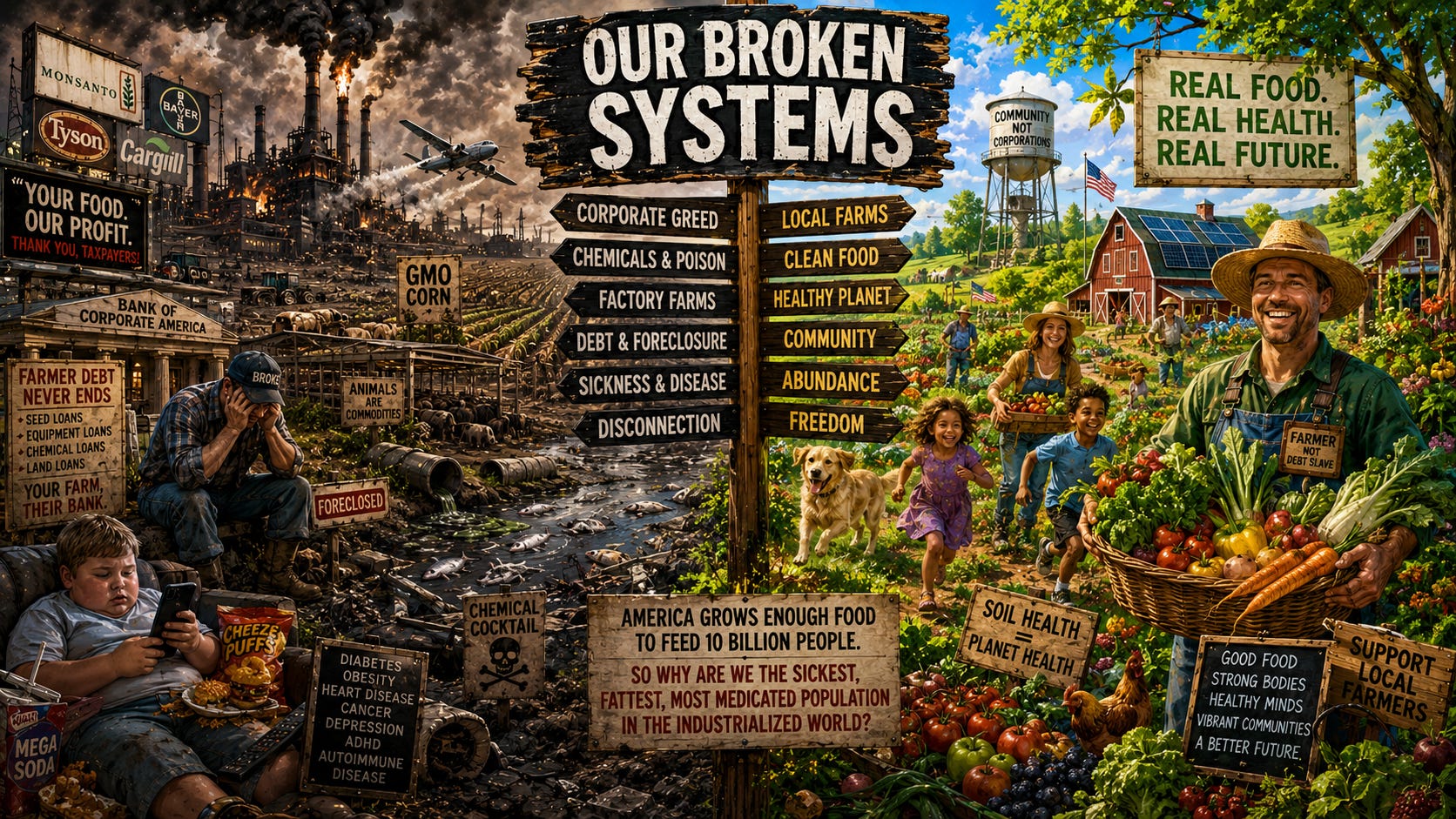
Good morning America, welcome to Our Broken Systems, my new series that explores and exposes the cracks in the foundational systems of our country. We will examine the structural systems that we all rely on and how they have been “Enshitified” by corporate greed and political corruption and what it will take to restore these vital functions and actually make America great again. I hope you’ll stay with me.
TL;DR: The American food system isn’t just expensive and corrupt — it’s actively making you sick, destroying the planet, and torturing billions of animals along the way, all while being subsidized by your tax dollars. America grows enough food to feed 10 billion people. So why are we the sickest, fattest, most medicated population in the industrialized world?
Your grandmother fed a family of six on $50 a week in 1980. You need $300 today — and your food is objectively worse for you. The farmers growing it are going broke. The land producing it is dying. And somewhere between the seed and your supermarket, an extraordinary amount of money is being made by people who had absolutely nothing to do with growing anything.
That’s not a coincidence. That’s a business model.
In America, four corporations control 85% of beef, three companies control all chicken production, and one Chinese company controls U.S. pork — while a cartel of four dominates 56% of global seeds and 61% of pesticides. They’ve weaponized tax subsidies to lock farmers into chemical dependency, poisoned your food with glyphosate (now found in 87% of American children), and manufactured an obesity and diabetes epidemic that’s only good for enriching Big Pharma. The solution exists, is already working.
We grow enough food to feed 10 billion people. We are 330 million. So where is it all going? Mostly to cattle. About 80% of the corn and soy grown in the United States — crops subsidized by $38 billion a year of your tax money — goes to feed livestock packed into industrial feedlots. Not pastures. Not farms. Feedlots. Concrete and dirt holding pens where tens of thousands of animals stand in their own waste, pumped full of antibiotics just to survive the conditions, until they’re heavy enough to slaughter.
We’ll get to what that does to the animals. And to you. And to the atmosphere.
But first, let’s back up and look at how we got here — because this didn’t happen by accident.
A Food System Gone Wrong
America has been down this road before. In the 1930s, a decade of aggressive plowing, single-crop farming, and stripping the plains of native grasses that held the soil together turned the American heartland into a wasteland. The Dust Bowl didn’t just destroy farms — it destroyed communities, displaced 3.5 million people, and buried livestock and children alive in walls of black dirt. FDR understood something our current government has apparently forgotten: you cannot feed a nation on dead soil. The New Deal’s soil conservation programs weren’t charity — they were survival. We learned that lesson in the hardest way possible. Then we forgot it.
But then, After World War II, the U.S. had two things in surplus: industrial infrastructure and a chemical industry that had just spent five years making weapons. The solution was elegant, in a horrifying way. Repurpose the chemistry. Nerve agents became pesticides. Munitions plants became fertilizer factories. And American agriculture — which had fed a nation through a depression and a world war using relatively sane farming practices — got “modernized.”
Yields went up. Costs went down. Consolidation began.
Over the next 50 years, the number of farms in America dropped from 6.8 million to under 2 million. The farms that survived got enormous. The ones that didn’t, sold their land to the ones that did. By the 1990s, a handful of corporations had figured out that controlling the food supply — all of it, from the seed in the ground to the package on the shelf — was the most reliable business model ever invented. People have to eat. Every single day.
So they bought the seed companies. They bought the slaughterhouses. They bought the processing plants and the distributors and, where they could, the politicians. Then they lobbied to make sure the government subsidized the crops that fed their operations and penalized the farming practices that didn’t.
What we have now isn’t a food system. It’s an extraction machine dressed up as farming.
Four Companies Own Your Dinner
Let’s start with beef, because nothing says “free market” like four corporations controlling 85% of America’s meat supply. Tyson Foods (Arkansas-based multinational and the largest U.S. meat company by overall sales), JBS S.A. (Headquartered in Brazil, this is the world’s largest meatpacker and controls a massive share of the American beef market), Cargill, (A massive, Minnesota-based global commodity trader and food corporation), and National Beef (Controlled by the Brazilian beef producer Marfrig Global Foods), have quietly consolidated an entire industry while everyone was distracted by woke avocado toast. In 1980, there were over 1,000 independent slaughterhouses. Today there are about 600 — all controlled by the same four companies. They set the prices. Farmers take what they’re offered or find another career. Consumers pay record-high prices while record amounts of beef are being imported. Everyone wins! Except, you know, farmers and consumers.
How about those chicken wings? TysonFoods, Perdue, Pilgrim’s Pride (also owned by J.B.S S.A.), Kock Foods, and Sanderson Farms control roughly 60% of the market. In the 1970s, 40 companies shared that space. Today, the farmers raising your chicken don’t even own their chickens. They’re contract workers. The corporations control the breeding, the feed, the processing, and the pricing. And in case you thought maybe these companies at least competed on wages — in 2021, Tyson and Perdue settled a lawsuit for $35.8 million after sharing wage data to suppress what they paid farmers. The kleptocracy is working exactly as designed.
Then there’s pork. Smithfield Foods controls 25% of U.S. pork production. Smithfield is owned by WH Group — a Hong Kong-based company that paid $7.1 billion for it in 2013. That’s right: a significant chunk of American pork is owned by China, a fact that triggers absolute silence from the “America First” crowd that loses its mind over TikTok. Smithfield, for its part, settled for $75 million in 2023 for price-fixing allegations dating back to 2009, and $42 million more for doing the same thing to restaurants. Apparently price-fixing is just a cost of doing business when you own 25% of the market.
Picture the farmer in the middle of all this. Can’t sell to anyone else. Can’t set their own prices. Can’t survive without taking on massive debt to buy the equipment the corporations require. They’re not farmers anymore — they’re serfs with tractors. A recent study found that farming had the highest suicide rate of any industry.
The Chemical Cartel: Locked-In
In 1974, Monsanto created Roundup — a glyphosate-based herbicide that kills weeds efficiently and, as it turns out, the plants too. In 1996, they invented Roundup Ready crops: genetically modified (GMO) seeds engineered to survive Roundup while everything around them dies. Genius, right? Now farmers had to buy Monsanto chemicals AND Monsanto seeds, every single year, forever. No opting out. The seeds are patented. You can’t save them. You can’t replant them. You write Monsanto a check or you don’t farm.
In 2018, Bayer acquired Monsanto for $63 billion and inherited what has become the most expensive legal time bomb in agricultural history. Over 192,000 lawsuits have been filed alleging Roundup caused non-Hodgkin’s lymphoma. Bayer has already paid over $10 billion in settlements. In March 2025, a jury handed down a $2.1 billion verdict after finding that Bayer knowingly sold a carcinogenic product. In May 2025, a $611 million verdict was upheld on appeal. There are 65,000+ cases still pending, and Bayer has set aside $16 billion more to pay them.
Here’s the part that should genuinely make your blood boil: the key study used to convince the EPA that Roundup was safe was retracted in 2025 because the authors had undisclosed financial ties to Monsanto — and Monsanto employees had secretly helped write it. The EPA relied on a fraudulent, industry-ghostwritten study to approve a chemical that is now in the bodies of 87% of American children.
That’s not regulatory failure. That’s regulatory capture. There’s a difference.
The CDC has tested urine samples from Americans across the country. Glyphosate — the active ingredient in Roundup — shows up in 81 to 87% of us. The primary exposure route for children isn’t playing in the yard. It’s food.
And Monsanto/Bayer doesn’t operate alone. Bayer, Corteva, Syngenta, and BASF — the Big 4 seed companies — control 56% of the global seed market and 61% of pesticides. In corn and soybeans alone, Bayer and Corteva control 71.6% of corn seed and 65.9% of soybean seed. These companies don’t just sell seeds. They sell the seeds AND the chemicals the seeds require. Captive market. Guaranteed revenue. Poisoning as a subscription service.
The Feedlot: Where Food Becomes a Crime Scene
Before we talk numbers, let’s talk about what industrial livestock production actually looks like — because most people have a vague sense that it’s “not great” without fully reckoning with what’s happening at scale.
A commercial feedlot holds anywhere from 10,000 to 100,000 cattle on a plot of land with no grass, no pasture, and no pretense of anything resembling the animal’s natural life. They stand. They eat subsidized corn and soy — food their digestive systems weren’t designed for — which makes them gain weight fast and makes them sick enough to require constant low-dose antibiotics. The waste from a single large feedlot can exceed the waste output of a mid-sized American city. Unlike cities, feedlots don’t have sewage treatment plants. The waste sits in lagoons. It runs off into rivers and groundwater. It evaporates into the air as methane and ammonia.
Speaking of methane: animal agriculture is responsible for roughly 14.5% of global greenhouse gas emissions — more than the entire global transportation sector. The feedlot model, specifically, is a climate disaster wrapped in a styrofoam tray. Cows on a natural grass diet produce significantly less methane than cows forced to digest grain. The feedlot doesn’t just concentrate animals; it concentrates environmental damage.
The land underneath and around feedlots is essentially sacrificed. Topsoil compacts. Groundwater contaminates. The surrounding communities — disproportionately low-income and rural — breathe the air and drink the water and have the cancer rates to prove it.
On top of the elevated risk to our health because of the unsanitary conditions, there have been dozens of documented cases of animal abuse. People who were working in some of these lots, videotaped the cruelty, and the result was so shocking it caused a political ground swell for change. There was change alright. Big-Ag lobbied to make it illegal to film inside these factory farms. So much for transparency if it affects profits.
Your Tax Dollars at Work (Against You)
The federal government sends $38 billion a year to American agriculture in subsidies. Eighty percent goes to five crops: corn, soy, wheat, cotton, and rice. Eighty percent of that goes to the top 20% of farms — the massive industrial operations feeding the feedlots. The top 10% of farms collect 75% of everything.
Trace the subsidy and you trace the poison. Cheap subsidized corn flows into feedlots, keeping meat company costs low. The same cheap corn becomes high-fructose corn syrup, which goes into processed food, which is cheaper than real food, which is why the communities with the least money eat the most of it, which is why obesity and diabetes track so precisely with income.
In 1980, 15% of American adults were obese. Today it’s 40.3%. In 1980, roughly 3 million Americans had diabetes. Today it’s 40.1 million, with another 115 million in prediabetes. Type 2 diabetes in children was nearly unheard of before the 1990s. Now it accounts for 15% of new childhood diabetes diagnoses.
Something changed in our food supply. We can argue about what, but the timing aligns perfectly with the rise of ultra-processed food, high-fructose corn syrup, and chemical-dependent industrial agriculture. Obesity and diabetes cluster in low-income communities — the same communities where cheap, processed, corporate food is the only financially accessible option. We call it a “health disparity.” It’s actually a food system disparity. The disease is downstream of the policy.
You paid for this as a taxpayer. You paid for it again at the grocery store. You’re paying for it now in healthcare costs. The system isn’t failing — it’s succeeding at exactly what it was designed to do, which is move money from your pocket into theirs at every possible point of contact.
The Human Cost: What “Efficient” Agriculture Actually Costs
America’s farm crisis is equally devastating and almost entirely invisible to urban media. In 1935, there were 6.8 million farms in America. In 2024: 1.865 million — a 73% decline. Between 2017 and 2022 alone, 142,000 farms were lost. In 2025, another 15,000 closed or consolidated. The average farmer is now 58.1 years old because young people can’t afford to enter a system designed to extract everything from them. Calls to farmer suicide hotlines have surged 109% in recent years. The mental health crisis in rural America has a direct cause, and its name is consolidation.
The land itself is paying the price. Topsoil is being depleted ten times faster than it can be replenished. It takes 500 years to naturally create one inch of topsoil; the U.S. is losing inches per decade. Pesticides are contaminating groundwater. Fertilizer runoff is creating dead zones in rivers. Pollinators such as bees and butterflies are collapsing. And antibiotic overuse in industrial livestock is generating resistant bacteria that will eventually kill people who’ve never been near a farm.
The Heroes Already Doing This Better
Here’s what the agricultural industry and its media allies don’t want you to know: it doesn’t have to be this way. Not theoretically, not in the future. Right now.
Examples: Joel Salatin runs Polyface Farm on 550 acres in Virginia’s Shenandoah Valley. He serves 5,000 families and 50 restaurants. His family has farmed the same land for four generations. He doesn’t use chemicals. He doesn’t collect subsidies. He rotates cattle through fresh pasture, then follows them with chickens in mobile pens that scratch through manure, eat pest larvae, and fertilize the soil with their own droppings. He’s restored 14 inches of topsoil in 40 years — while industrial farming depletes it. His farm is highly profitable with a growing waiting list of customers. His summary: “We didn’t use chemicals. We mimicked nature.”
Gabe Brown farms 5,000 acres in North Dakota. He started conventionally, nearly went bankrupt in the 1990s from crop failures, and pivoted to regenerative agriculture out of desperation. Today his farm is carbon-negative. His corn costs $1.44 per bushel to produce, all costs included. His soil absorbs rainfall that would have caused flooding before his transformation. He doesn’t use synthetic pesticides or fertilizers. He’s featured in Netflix’s “Kiss the Ground” and won the Heinz Award for the Environment. His philosophy: “97% of any plant is carbon, oxygen, nitrogen and hydrogen — four elements found in the atmosphere. Why would farmers write checks for chemical fertilizers when the same nutrients are free?”
Regenerative agriculture isn’t a fantasy. It’s a proven model that increases soil health, reduces input costs by 40-60%, improves crop nutrition, and restores profitability to farmers. The transition takes 3-5 years. The only thing stopping widespread adoption is that it would destroy the chemical companies’ captive market, and those companies have spent decades creating a system of government subsidizes that benefits them.
The Solution Is Staring Us In The Face
The American food system is not accidentally broken. It is operating precisely as it was intentionally designed to operate: as a highly efficient, closed-loop corporate extraction engine designed to systematically poison the population for maximum profit. Every single phase of the process—from the patented seed to the supermarket shelf—has been meticulously optimized to extract capital from independent communities and concentrate it into the hands of a ruling corporate monopoly.
The path forward out of this systemic trap does not require the invention of unproven, hyper-complex new technologies. The operational blueprints have already been thoroughly written, tested, and validated by the likes of Joel Salatin, Gabe Brown, and thousands of independent regenerative farmers worldwide.
What is required is a complete, aggressive political overhaul of our national priorities:
1. Redirect the Subsidies: We must immediately strip the $38 billion in annual federal farm subsidies away from the chemical-industrial monopolies and reallocate those funds to directly support farmers during their critical 3-year operational transition to regenerative practices.
2. Reward Soil Health: Federal agricultural incentives must be entirely restructured to pay farmers based on verifiable metrics of soil health, topsoil creation, and water retention, rather than rewarding the raw volume of chemical commodity crops.
3. Break the Monopolies: The Department of Justice must aggressively enforce long-dormant antitrust laws to completely break up the Big Four meat packing and chemical cartels, forcibly restoring a competitive, decentralized open market.
4. Transparent Labeling: We must mandate clear, unambiguous consumer labeling that clearly distinguishes between chemical-industrial products and genuinely pasture-raised, regenerative, chemical-free food, allowing consumers to vote accurately with their dollars.
We must also make it possible for young farmers to enter regenerative agriculture without taking on crushing debt to buy Monsanto seeds and John Deere equipment.
None of this is technologically difficult. All of it is politically obstructed by industries that profit from the current arrangement.
The current state of our food supply is the ultimate, textbook manifestation of the broader pattern defining all of Our Broken Systems. An industry consolidates into a multi-billion-dollar corporate monopoly; that monopoly systematically captures the federal regulatory agencies tasked with policing it; and highly viable, decentralized solutions are aggressively suppressed because they threaten corporate profit margins.
We see this exact same destructive narrative play out across modern healthcare, housing, defense, and finance. But the food system remains the most urgent battleground—because you cannot build a free, conscious, or democratic society if you are actively funding the system that is poisoning your children for profit.
F*CK ICE. RELEASE ALL THE FILES!
Please like, share, and subscribe — because your food is killing you and the planet.
Substack: democracy4sale.substack.com /Web: democracy4sale.com
Robert Cain, author of “Democracy for Sale: How Corporate Greed Is Corrupting Democracy and Endangering the Planet.” Available at Amazon, Barnes & Noble, and booksellers everywhere.