By Rob C
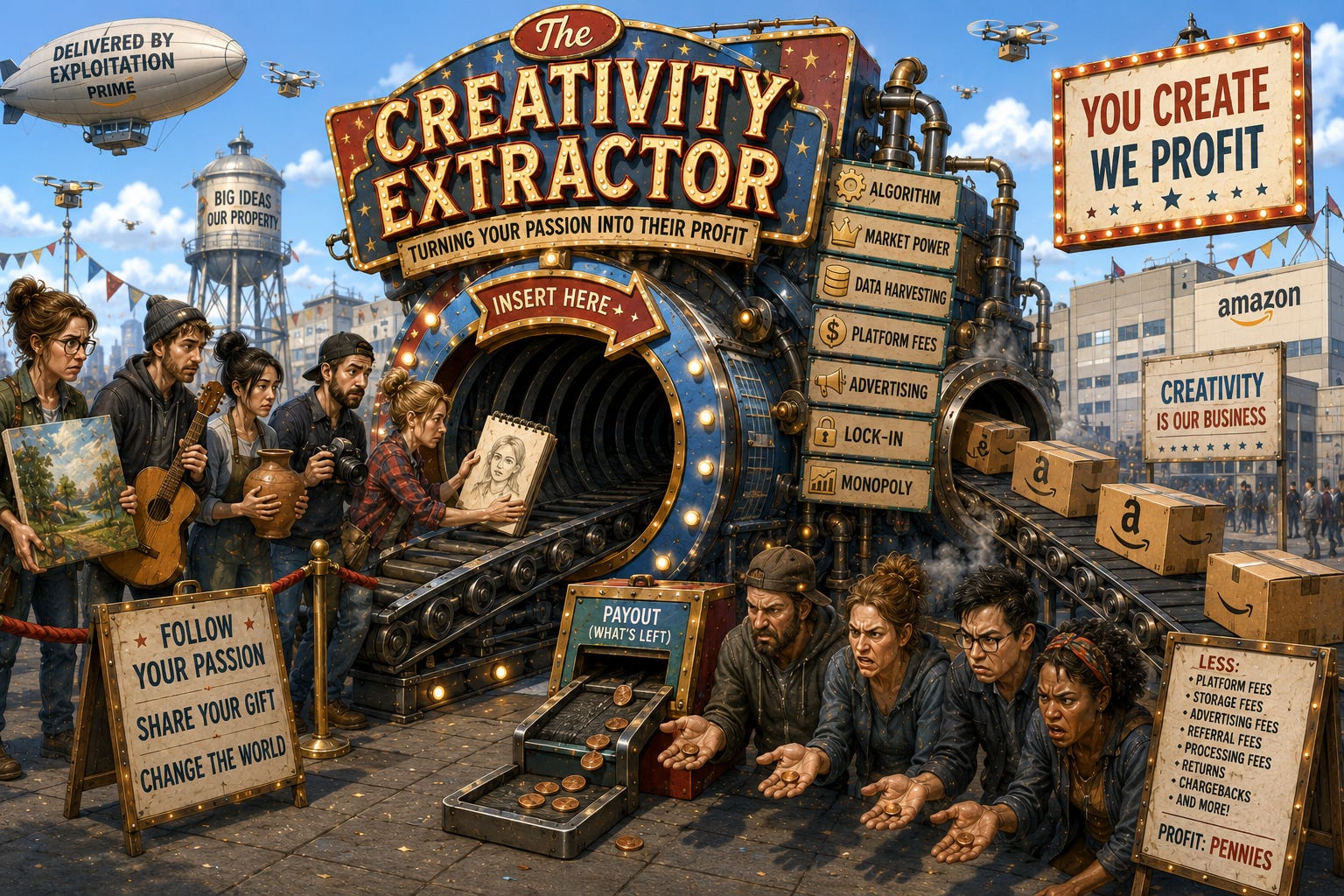
TL;DR: You think Amazon is just a really convenient place to buy stuff? Think again. It’s actually a trap door. The entire platform is a meticulously engineered trapdoor built specifically to lock in customers, strip small businesses of their agency, and squeeze independent creative professionals until they bleed. Warren Buffett calls this a “moat,” like he’s defending a castle. He’s not. He’s running a toll booth on your own work and calling it strategy.
Drawing on the foundational analysis of Cory Doctorow and Rebecca Giblin’s Chokepoint Capitalism, we rip the mask off the modern corporate monopoly. From the systemic cloning of independent bestsellers to the unchecked rise of predatory “monopsonies,” the corporate elite are turning the world into a highly managed command economy. Worse yet, this is the exact same chokehold architecture currently suffocating our housing, our healthcare, and our global geopolitics.
The Toll Booth at the Edge of the World
Sarah spent three years of her life hunched over a sewing machine and a laptop, risking her life savings to launch an independent, sustainable clothing line. After a grueling first year, her signature organic cotton hoodie found its audience. Orders started pouring in, her small brand finally crossed into profitability, and for a fleeting moment, the American dream of entrepreneurial independence felt real. Because 2026 demands it, she sold her inventory through Amazon, paying her dues to the platform because that’s where the eyeballs are.
Then, on a Tuesday morning, Sarah noticed a sudden, unexplained 60% cratering in her daily sales.
Confused, she searched for her own brand name on the platform. There, occupying the absolute top “Sponsored” slot on the search page, was a near-identical replica of her signature hoodie. It featured the exact same cut, the exact same stitching pattern, and an identical color palette, but it was listed for half her retail price. The seller? An obscure Amazon house-brand entity. Amazon’s algorithms had quietly monitored Sarah’s proprietary sales velocity, scraped her design specifications, used its infinite supply chain leverage to manufacture a cheap knockoff, and then buried her original listing on page three of the search results. In a matter of weeks, Sarah’s independent business was effectively wiped out by the very platform she trusted to host it.
This is not an isolated malfunction of the digital marketplace. This is a cold, calculated, and perfectly legal corporate heist. We have been conditioned to look at the massive tech conglomerates as benevolent architects of convenience, providing us with endless choices at the click of a button. In reality, the modern corporate state has spent the last two decades building an elaborate web of digital chokepoints designed specifically to strip writers, musicians, artists, and independent entrepreneurs of their intellectual property, their revenue, and their creative autonomy.
This is the story I want to tell you today, because it’s not really about clothes, or books, or music. It’s about the machine underneath all of it — and once you see it, you can’t unsee it.
The Moat Is a Trap, Not a Castle
Warren Buffett has spent decades telling investors to look for companies with a “moat” — a competitive advantage that protects the business from rivals. It sounds almost noble, doesn’t it? Defensive. Prudent. Like a castle keeping out marauders.
Here’s the problem: a moat doesn’t just keep competitors out. It keeps you in. When a company builds a “moat,” what it’s really building is a wall around its customers and suppliers so they can’t leave, even when they want to. That’s not defense. That’s a trap with better PR.
And in case you thought this was subtext, Peter Thiel said the quiet part out loud back in 2014: “competition is for losers.” Business schools took the hint. They now actively teach the next generation of executives to avoid competitive markets entirely — to find an industry, dominate it, and if a competitor still manages to show up, buy them before they become a problem. This has become the quiet, unifying doctrine of the modern corporate boardroom. The goal is to completely eradicate the possibility of competition altogether. They want to control the entire infrastructure of a market so thoroughly that no buyer can purchase a good, and no creator can sell a product, without passing through their corporate toll booth and paying an exorbitant, life-stifling tax. Somewhere corporate America went from, “compete fairly and win” to “eliminate the competition and call it winning.”
The Amazon Playbook, By the Numbers
Back to that clothing brand. This isn’t a one-off horror story — it’s a documented pattern. Researchers who studied hundreds of third-party clothing products sold on Amazon found the company had cloned roughly a quarter of sellers’ bestselling items within just twelve weeks of the original listing going up. Twelve weeks. That’s not competition. That’s corporate espionage with a shipping label.
And here’s the part that makes it inescapable: most shoppers don’t even use Google anymore to find products. They go straight to Amazon’s search bar — somewhere around two-thirds of all online shoppers, and closer to three-quarters when they already know what they want. Which means even if a seller gets burned, they can’t just leave and set up shop elsewhere. The customers aren’t anywhere else. The moat isn’t keeping competitors out — it’s keeping sellers in, whether they like the terms or not. Imagine your landlord tripling your rent, except you also can’t move, because he owns every other apartment in the city too.
Once a platform achieves this total, inescapable lock-in over the consumer base, it turns its sights on the helpless suppliers. Over the last decade, the effective cut extracted from independent third-party sellers has virtually tripled, skyrocketing to roughly 40% of every single transaction. Merchants are forced to pay mandatory storage fees, fulfillment surcharges, and astronomical advertising costs just to ensure their own products are visible to the customers searching for them by name. You provide the labor, you take the financial risk, and the corporate platform pockets nearly half the revenue simply for owning the digital gate.
Monopoly’s Quieter, Meaner Cousin: Monopsony
To fully understand this crisis, we have to upgrade our political vocabulary. Most of us learned the word “monopoly” in school, usually right before someone landed on Boardwalk and bankrupted the family. Monopoly is when a seller has too much power over buyers — think one company controlling all the electricity, charging whatever it wants, giving a single corporation the absolute power to gouge buyers on prices.
But there’s a lesser-known, arguably nastier cousin: monopsony. That’s when a buyer has too much power over sellers. No board game for this one, which is a shame, because it deserves the humiliation. Amazon isn’t just a powerful seller to customers — it’s a powerful buyer from the small businesses and creators who depend on it to reach anyone at all. Same with Google, which dominates search, advertising, and video, giving it enormous leverage over musicians, journalists, and publishers who have nowhere else to go.
While a monopolist uses their leverage to screw over consumers on the way out, a monopsonist uses their leverage to completely crush workers, creators, and suppliers on the way in.
This dual-chokehold is actively destroying the fabric of human creativity. Writers, musicians, indie game developers, and journalists are all independent sellers trying to bring their labor to market. But because of corporate consolidation, they are forced to sell into a landscape where there is effectively only one game in town.
If you are an author, you must bow to Audible and Kindle. If you are a musician, you must accept the fractional, insultingly small streaming royalties dictated by Spotify. If you are a journalist, your livelihood depends on the opaque traffic algorithms of Meta and Google. When a single boardroom controls the only digital storefront on the planet, they don’t have to bargain with creators; they dictate terms, slash compensation, and capture the entirety of the cultural value for their own shareholders.
The “Disruptor” Myth
The tech-bros of Silicon Valley loves to tell itself a story: we’re scrappy outsiders, we disrupted a broken industry, we won because we built something better. It’s a great story. It’s also mostly fiction. They paint themselves as leather-jacketed geniuses who won the market because their code was cleaner, their vision was bolder, and their technology was superior.
It is an absolute myth. These firms did not win through technological innovation; they won through aggressive legal engineering, predatory pricing funded by endless pools of venture capital, regulatory capture, and the sheer, old-fashioned corporate bullying of smaller players. They bought out potential rivals before they could grow, weaponized digital rights management (DRM) to lock users into proprietary hardware, and deployed armies of Washington lobbyists to ensure antitrust laws remained completely toothless.
Doctorow and Giblin land the sharpest, most devastating critique of this modern arrangement: when a corporation successfully eliminates all meaningful competition and locks both buyers and sellers into an inescapable loop, you are no longer participating in capitalism. You do not have a free market. What you have is a highly centralized command economy—except instead of being run by a government politburo for some semblance of the public good, it is run out of a private corporate boardroom for the sole enrichment of an elite kleptocracy. Same top-down control. Slightly better catering.
The Geopolitical Chokepoint
This systematic enclosure of creativity is not happening in a vacuum; it is the exact same blueprint that dictates the brutal realities of modern geopolitics and international conflict. When we step back and look at trump’s war against Iran, we are witnessing the macro-evolution of chokepoint capitalism.
Just as a tech conglomerate seizes a digital marketplace to extract tolls from independent creators, Iran is using military might to seize control of a maritime chokepoint—like the critical shipping lanes of the Straits of Hormuz—to control the global flow of energy and resources.
The strategy is completely identical. You find the structural bottleneck where humanity must pass to survive—whether it is an oil pipeline, a deep-water shipping strait, or a digital bookstore—you station your mercenary forces or your proprietary software at the gate, and you threaten anyone who attempts to route around your authority with absolute economic or physical annihilation. The drone strikes over the Persian Gulf and the algorithmic destruction of an independent author’s livelihood are two branches of the very same tree: an unyielding, insatiable global system that views human life and creative expression as mere resources to be enclosed, policed, and milked for private capital.
Connecting the Broken Systems
We must stop treating the structural decline of the creative industries as an isolated tragedy affecting only artists and intellectuals. The exact same predatory playbook running underneath Amazon and Spotify is currently operating inside every single foundational sector of American life.
It is running inside our housing market, where private equity giants use algorithmic pricing software to buy up single-family homes, create artificial scarcity, and lock a generation of working-class families into a permanent cycle of skyrocketing rent.
It is running inside our healthcare system, where corporate hospital monopolies and consolidated insurance conglomerates create administrative chokepoints that systematically deny lifesaving care to sick children while extracting multi-million-dollar bonuses for executive directors.
It is running inside our agriculture, where a tiny cartel of agro-chemical monopolies forces independent farmers to use proprietary, single-use seeds and legally prohibits them from repairing their own tractors.
The system isn’t experiencing a temporary glitch, and it isn’t waiting for a new technological upgrade. From the digital shelves of the Kindle store to the physical infrastructure of our cities to the military contractors controlling our foreign policy, the corporate capture is absolute. They have financialized our survival, automated our exploitation, and called it progress. It’s time to stop looking for a trapdoor out of their ecosystem and start building the collective power necessary to tear down the toll booths once and for all.
F*CK ICE. RELEASE ALL THE FILES!
Please like, share, and subscribe. If you believe that a corporate boardroom running a centralized command economy over human culture sounds less like technological innovation and more like a high-tech feudal fiefdom. Forward this article to an independent creator currently being squeezed by the algorithms. Let’s keep this truth-seeking machine loud, independent, and hazardous to the billionaire class.
Follow my work: Substack: democracy4sale.substack.com / Web: democracy4sale.com
Robert Cain is the author of “Democracy for Sale: How Corporate Greed Is Corrupting Democracy and Endangering the Planet.” Available at Amazon, Barnes & Noble, and independent booksellers everywhere.