By Rob C.
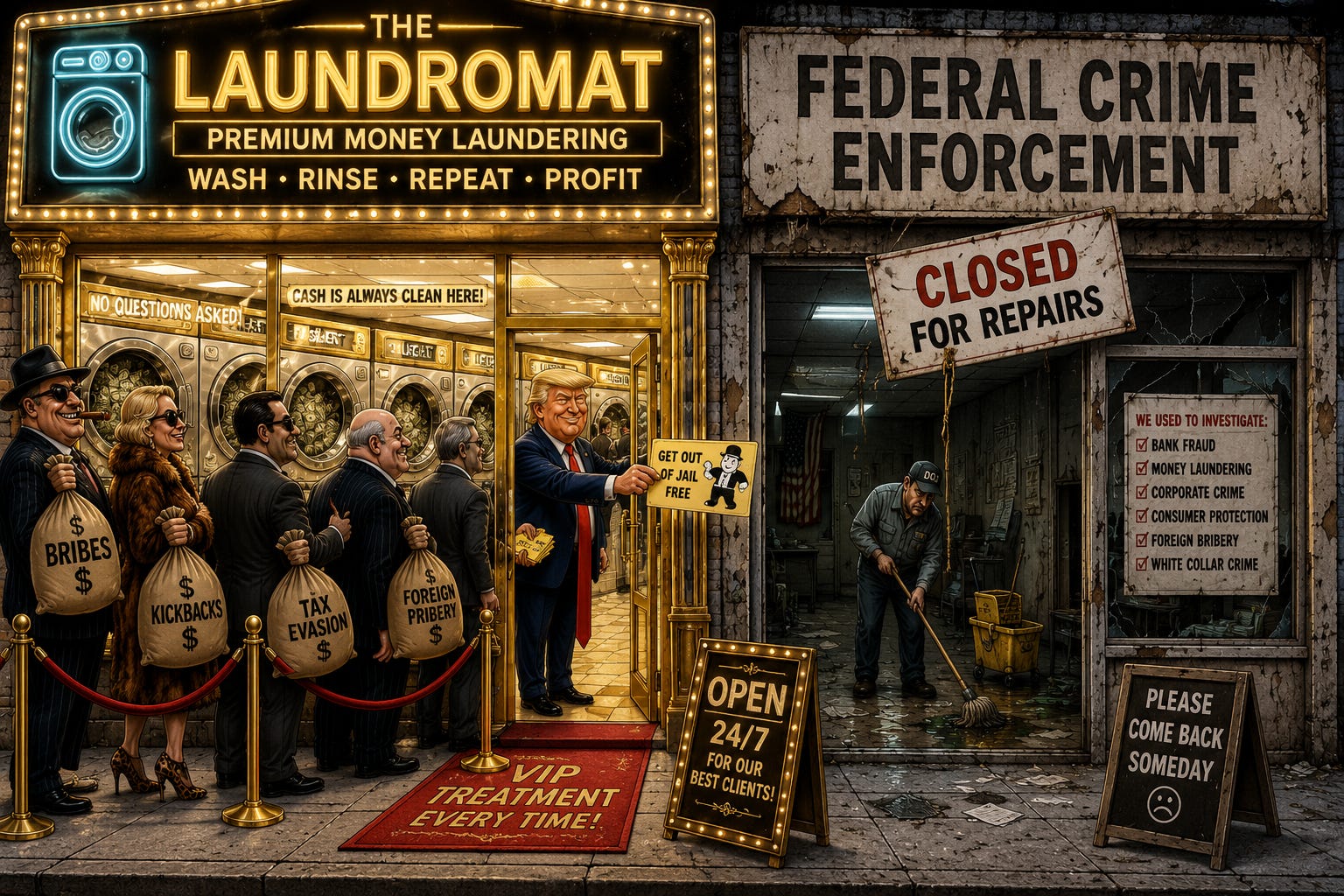
TL;DR: The Trump administration didn’t magically “forget” how to prosecute bank fraud, white-collar crime, or corporate money laundering. They fired the federal investigators, gutted the Consumer Financial Protection Bureau (CFPB), paused foreign bribery enforcement, and then held a glossy press conference about “eliminating fraud.” Meanwhile, Capital One is in federal court explaining why it closed over 300 Trump Organization accounts because its own internal compliance department flagged them for money laundering.
Good morning. Grab your coffee and let’s check in on the latest episode of government hypocrisies.
They didn’t forget how to catch bank fraud and money laundering. They just fired the people who could, gutted the one federal agency built specifically to protect working people from financial predators, paused the law that stops foreign bribery, and then had the audacity to hold a press conference about “eliminating fraud.”
Cool story.
Meanwhile, Capital One is literally sitting in federal court right now explaining why it shut down over 300 Trump Organization bank accounts back in 2021. The bank’s defense isn’t a political excuse; it’s that its own anti-money-laundering division flagged those accounts as a massive red flag.
Call me crazy, but “the guy in charge of investigating financial crime is also the guy whose accounts keep getting flagged for financial crime” feels like a teensy-tiny conflict of interest.
The Numbers Don’t Lie (They Just Get Buried)
This administration isn’t shy about what it cares about. It’s border theater, cartels, and whatever generates a rage-bait chyron on Fox News. Everything else? It just quietly stops.
An investigation by ProPublica laid bare the unglamorous numbers, and they are staggering:
23,000 criminal investigations were abruptly dropped as DOJ resources were redirected to immigration enforcement.
5,000 federal drug and money laundering cases were declined for prosecution—a rate 45% higher than the average of the prior three administrations combined.
These weren’t baseless hunches; these were solid cases ready for trial. An investigation into patient abuse at a Virginia nursing home? Gone. Fraud probes into union embezzlement in New Jersey? Paperwork in a drawer. Cryptocurrency scams that fleeced everyday investors? Poof.
Attorney General Todd Blanche decided the DOJ’s real job is chasing imaginary cartel threats while real financial predators walk free. It’s awfully convenient how “we’re too busy” always applies when the target has a lobbyist, a fat bank account, and a golf membership.
The Bribery Law Gets Shelved
If you want the single cleanest example of this administration telling on itself, look no further than the Foreign Corrupt Practices Act (FCPA)—the law that spent nearly fifty years prosecuting corporations for bribing foreign officials to grease business deals.
Just twenty-one days into his second term, Trump signed an executive order pausing all new FCPA investigations for 180 days. The official excuse? FCPA enforcement had become “overexpansive and unpredictable” for American businesses.
Translation: It’s really annoying when the law applies to campaign donors.
While the pause technically “lifted,” former DOJ FCPA prosecutors admit enforcement has been decimated. The unit that once brought massive cases against financial giants like Goldman Sachs, Siemens, and Airbus has been stripped of staff, with crypto and bribery enforcement explicitly demoted. You don’t pause a law you plan on using; you pause a law you intend to dismantle.
The CFPB Assassination
This is the one that should make your blood boil, because the Consumer Financial Protection Bureau was actually working for you.
The CFPB exists for one reason: to catch banks, mortgage servicers, credit bureaus, and predatory lenders who prey on working-class families. It goes after overdraft fee scams and illegal interest rates. Which is, of course, exactly why Russell Vought—Trump’s acting director whose entire playbook involves burning regulatory agencies to the ground—ordered a complete halt to all agency work within weeks of taking over.
When courts blocked mass layoffs, the administration tried a back-door trick: starving it of cash. The CFPB draws its funding from the Federal Reserve to prevent political strangulation, so the administration simply declared that funding structure “unlawful” and refused to request money.
Look at the numbers:
Staffing: Slashed from 1,750 employees down to around 1,174, with the administration asking courts to gut it further to just 556.
Enforcement & Supervision: Enforcement staff cut by 80%, supervision staff by 85%.
Bank Exams: Routine bank inspections cut nearly in half, from 107 a year down to 64.
Even the federal judge overseeing the case called out the scam, noting the administration was “actively and unabashedly trying to shut the agency down again, through different means.” When a federal judge uses “unabashedly” in a ruling, she’s telling you she sees the grift crystal clear.
“But We Have a Fraud Task Force!” — Sure, JD
To cover their tracks, the White House rolled out a shiny new “Task Force to Eliminate Fraud,” chaired by JD Vance.
It makes for great press conferences—chasing online scam centers, sextortion rings, and healthcare fraud. But take a close look at what isn’t on their radar: Bank fraud committed by actual banks? Corporate bribery? Money laundering through real estate? Crickets.
This isn’t an anti-fraud administration; it’s a selective-fraud administration. They are tough as nails on the crimes that make for good TV, and mysteriously allergic to the white-collar theft involving people with the president’s cell phone number.
The Bottom Line
Connect the dots. Capital One is currently in court defending its decision to shut down 300-plus Trump Organization accounts following an internal anti-money-laundering review. Those weren’t partisan operatives; those were bank compliance officers raising the alarm on suspicious financial activity.
With this administration - every accusation is a confession. You don’t pause foreign bribery enforcement, gut the consumer watchdog, and starve the DOJ’s white-collar crime division by accident. Incompetence is random; this level of protection for the rich and powerful is a feature, not a bug.
They didn’t forget how to catch financial criminals. They just made sure nobody was left in the building who had the power to stop them.
F*CK ICE. RELEASE ALL THE FILES!
If you made it this far, congratulations—you now know more about federal white-collar enforcement policy than most of Congress. Please like, share, and subscribe so I can keep ruining your morning coffee with facts!
Follow my work: Substack: democracy4sale.substack.com / Web: democracy4sale.com/ FaceBook.com/democracy4sale/ youtube.com/democracy4sale + Twitter-X + Bluesky
Robert Cain is the author of “Democracy for Sale: How Corporate Greed Is Corrupting Democracy and Endangering the Planet,” and writes “Our Broken Systems” at democracy4sale.substack.com.