By Rob C.
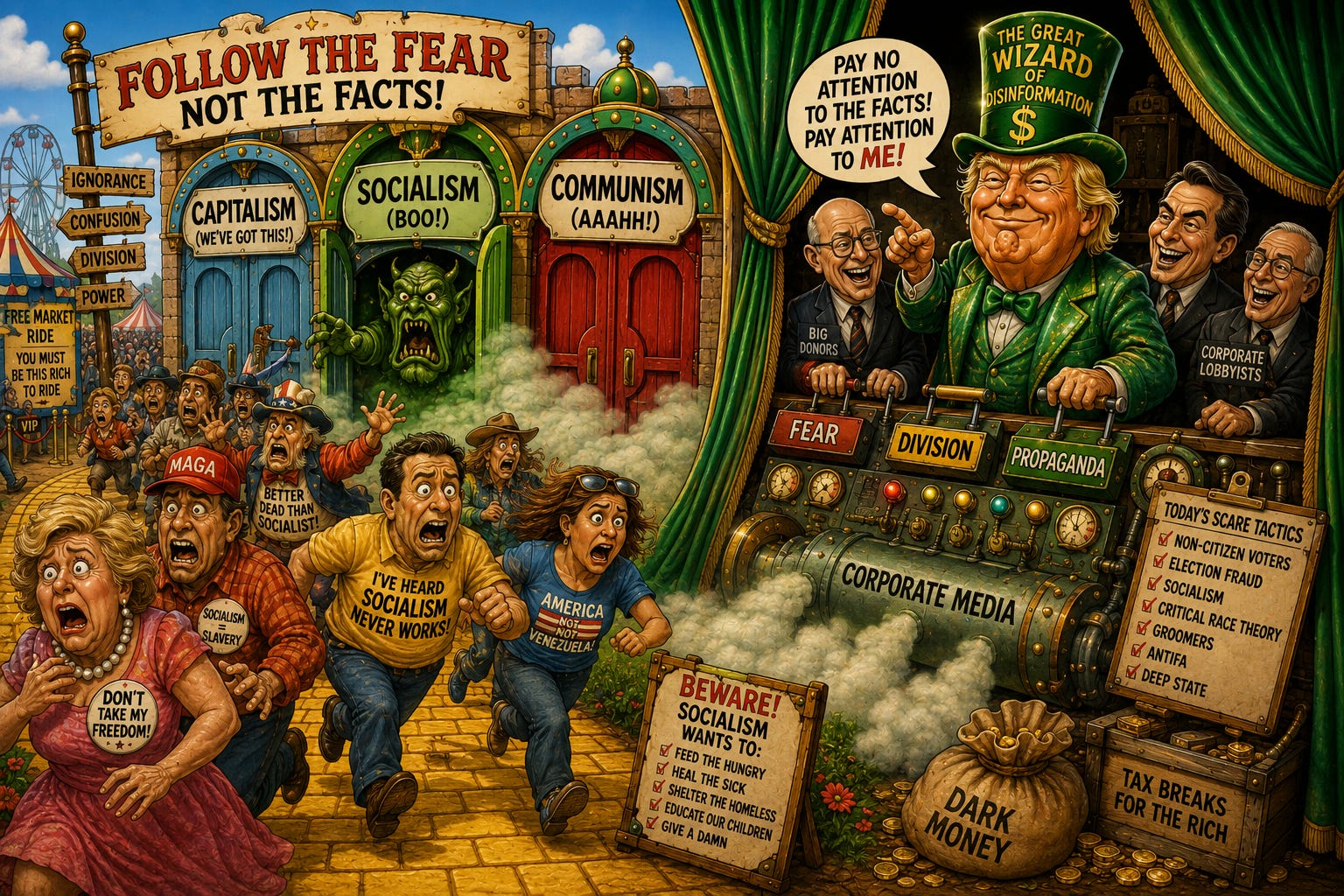
TL;DR: Every time a politician says the word “socialism,” half the country clutches its pearls and the other half starts drafting a five-year plan, and almost nobody involved could actually define the term if you put a gun to their head. Much of the panic is built on pure historical ignorance and calculated corporate propaganda. This confusion isn’t an accident — it’s been useful, for a very long time, to a very specific set of people. So let’s do what nobody in Washington seems interested in doing: actually define our terms. Pulled from a chapter of my book, here’s the demystified version of capitalism, socialism, and communism — what they are, what they aren’t, and why the United States has been quietly running a socialist playbook for longer than the people screaming about it would like to admit.
Good morning. Today’s post is a bit different — it’s adapted from a chapter of my own book, because democratic socialism has been getting a lot of attention lately, and not much of it accurate. And I don’t just mean from Republicans, who’ve used “communism” and “socialism” as a boogeyman since roughly the invention of boogeymen. I mean from corporate Democrats too, who are often just as ignorant, just as arrogant, and just as invested in keeping the confusion alive. Let’s demystify the terms, debunk the myths, and get back to what actually matters: holding the oligarchs accountable.
The Great -Isms Confusion - Economics vs. Government Structure
Here’s the mistake almost everyone makes, on every side of the aisle: Communism, Socialism, and Capitalism are economic systems, not forms of government. But if you listen to cable news or a speech from a panicked corporate lobbyist, you’d think these words were ancient curses designed to summon the Four Horsemen of the Economic Apocalypse. They describe how a society produces and distributes resources. They say nothing, by themselves, about who’s allowed to vote, who holds power, or how leaders get chosen.
Because political talking heads love to mash them together to score cheap points, the public naturally conflates economic engines with political structures, which is how you end up with people insisting a country can’t be a “democracy” and “socialist” at the same time. Just to keep our cards on the table, here is what actual governance looks like, completely separate from how a country buys and sells shoes:
Democracy: A government voted for by the people.
Dictatorship: Rule by a single leader or small group with absolute power.
Oligarchy: Rule by a few, often the wealthy elite (sound familiar?).
Parliamentary System: The legislature selects the government.
Republic: A state where power is held by the people and their elected representatives, typically with a president instead of a monarch.
Theocracy: Rule based on religious authority.
Totalitarianism: Centralized control by an autocratic leader or ruling hierarchy.
Monarchy: Rule by a single sovereign (e.g., king or queen), absolute or constitutional.
Anarchy: The absolute absence of government.
When we hear the word “Communism,” our brains instantly flash back to Cold War images of Russia or China. When we hear “Socialism,” the corporate media immediately drags out Cuba and Venezuela—conveniently ignoring Scandinavian powerhouses like Denmark and Sweden. And what about the good old U.S. of A.? Most Americans blindly assume we are pure, ruggedly individualistic capitalists, which is, frankly, adorable.
The U.S. is structured as a Constitutionally Governed Democratic Republic — that’s the government system. Russia and China claim to be democracies while operating as brutal authoritarian regimes—though when you look strictly under the hood of their economic engines, their structural reliance on state-backed corporate power isn’t all that different from our own. Government type and economic system are two separate animals, and most political arguments in this country are people angrily insisting they’re talking about the same thing.
Debunking the Definitions
The confusion surrounding these terms isn’t accidental. Historically, conflating communism and socialism was a deliberate PR strategy cooked up to promote pro-business, anti-labor policies and protect corporate profit margins from pesky things like worker safety and fair wages.
Part of the muddle comes from how definitions evolve. Originally, “Communism” referred to an idealistic economic theory advocating for the communal sharing of all resources equally among a group of people. In practice, that pure vision has only ever existed in small-scale indigenous communities. By that definition, neither the Soviet Union nor modern China were ever truly communist.
Similarly, socialism is constantly portrayed by right-wing fearmongers (and their corporate Democrat enablers) as heavy-handed, centralized government planning reminiscent of the old USSR. This deliberate lie completely overlooks how democratic socialism actually functions in the modern world: as a mechanism to provide essential, life-saving public services without a predatory profit motive.
Here’s the simplified version, no ideology required:
Communism — the government controls most resources and distributes them equally. This has never actually been achieved at scale, most likely because of structural challenges and, let’s be honest, human greed.
Capitalism — Most resources are privately owned and operated for profit. But here’s the dirty little secret the free-market fundamentalists leave out: pure capitalism has never existed. Why? Because large-scale infrastructure—roads, bridges, power grids, and basic legal frameworks—requires massive public investment. Furthermore, unchecked capitalism naturally tends toward extreme wealth concentration and anti-democratic power structures. Our own Founding Fathers were deeply skeptical of concentrated wealth because they understood a basic mathematical truth: the more money an individual or corporation accumulates, the more political power they wield over everyone else.
Socialism — exists in varying degrees between the two extremes, expressed through the level of social spending a society devotes to its citizens’ needs. Nearly every advanced nation on earth runs on some version of this blend, including — whether its loudest critics want to admit it or not — the United States.
The American Hypocrisy: Socialism for Me, Rugged Individualism for You
When you look past the partisan soundbites, the U.S. actually leans toward the capitalist end of the spectrum, but it routinely incorporates massive, undeniable socialist policies to keep society from collapsing into a Mad Max wasteland.
Consider the foundational pillars of American life:
The National Military (our largest federal jobs and manufacturing program)
Social Security and Medicare
Local and Federal Fire and Police Departments
Public Schools and Food Assistance Programs
And, of course, Corporate Welfare Subsidies (billions of taxpayer dollars handed out annually to prop up oil giants, agribusiness, and Wall Street banks) and, notably, somehow these never get denounced with the same fervor as school lunches.
By comparison, our democratic peers take these collective concepts and actually fund them properly:
Canada: Similar to the U.S., but includes universal healthcare.
Britain & Japan: Stronger, more comprehensive public service networks.
Germany, Sweden, Finland, and Denmark: Extensive social programs that guarantee healthcare, education, and elder care—which is precisely why these nations consistently rank among the happiest, healthiest places on Earth. Which should probably tell us something, though I understand admitting that requires stepping outside a few decades of conditioning.
Here’s the definition that ties this whole thing together: a society is a large group of people living together in an organized way, sharing responsibilities and making collective decisions. By that standard, the United States has already been a democratic socialist country for a long time — we just provide meaningfully fewer social benefits than most of our wealthy peers, while paying plenty into the system that’s supposed to provide them.
The Billionaire Protection Racket and the Economy of Scale
Let’s talk about the math that the corporate media refuses to touch.
In advanced nations where tax rates range between 38% and 55%, citizens aren’t being squeezed by a tyrannical government; they are utilizing collective cooperation and the power of economies of scale to buy universal healthcare, affordable higher education, robust maternity care, and secure elder care.
Meanwhile, in the U.S., billionaires and mega-corporations routinely pay little to nothing in federal income taxes while happily feeding at the public trough, extracting trillions in infrastructure benefits and government subsidies.
So when political pundits screech that universal healthcare, affordable college, or a living wage would mark the “end of America as we know it,” ask yourself who is really talking. They are either tragic victims of a decades-long propaganda machine, or they are the exact parasites benefiting from an uneven, rigged financial system.
Every private business on Earth utilizes the “economy of scale” to drive down operating costs and maximize efficiency. Yet, our corporate-owned Congress has explicitly forbidden the federal government from using that exact same economic principle. They have legally barred Medicare from negotiating drug prices and blocked public options, forcing American taxpayers to pay vastly more for medicine, healthcare, transportation, and education than any other industrialized population.
It begs a couple of obvious questions: If corporate billionaires can truly provide a better quality of life for hardworking Americans while saving money, why do they continually demand government bailouts and tax subsidies? And if unbridled capitalism is so ruthlessly efficient, why do we constantly have to rescue corporations from crises entirely of their own making?
Maybe it’s time to rethink what we’ve been trained to fear and start demanding the kind of society we actually deserve.
F*CK ICE. RELEASE ALL THE FILES!
Please like, share, and subscribe — because the first step to fixing a rigged system is refusing to be scared of a name.
Follow my work: Facebook.com/Democracy4sale1 / Web: democracy4sale.com
Robert Cain is the author of “Democracy for Sale: How Corporate Greed Is Corrupting Democracy and Endangering the Planet.” Available at Amazon, Barnes & Noble, and independent booksellers everywhere.