Democracy
Part of: AuthoritarianismBuilding the Police State
By Rob C.
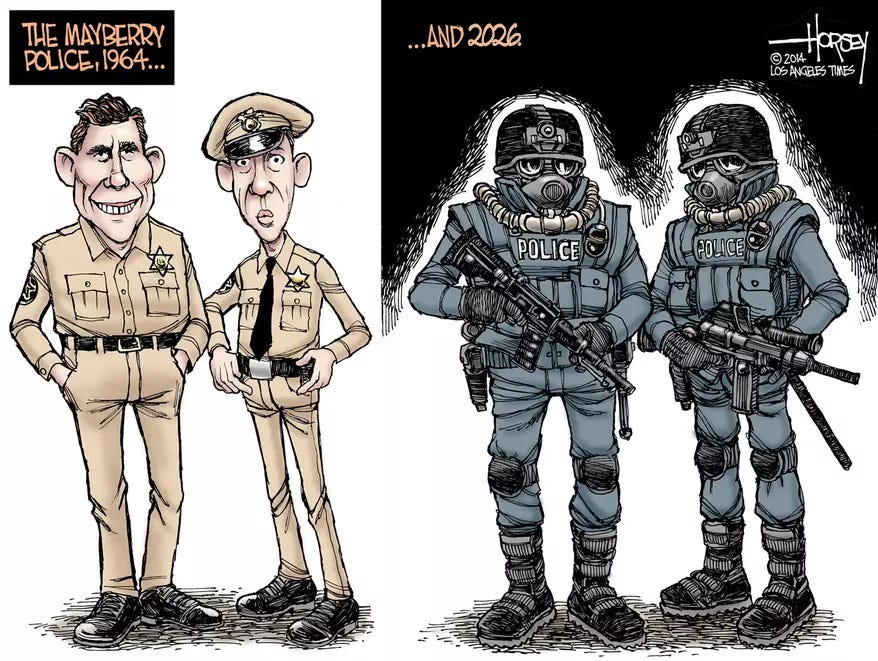
Art by David Horsey
TL;DR: The violent, militarized response we’re seeing in Minnesota and nationwide didn’t happen overnight. While the killings of Renee Nicole Good and Alex Pretti in Minnesota have finally sparked outrage among the demographic that usually considers the police to be God’s own customer service department, it’s important to remember that Trump didn’t invent this system. He simply inherited a well-oiled machine of repression and decided to remove the “safety” switch. The architecture of repression was built over centuries, by both major parties, and now it’s come home to roost.
The killings of U.S. citizens in Minnesota by agents of ICE and Customs and Border Protection have ignited justified outrage. Across the country, protests have erupted not because the public loves crime, but because they’re witnessing ordinary people gunned down by armed agents whose first instinct is force, not restraint. Yet for all the modern horror, what we’re seeing today is not an anomaly — it’s the long arc of America’s relationship with policing bending toward brutality.
To understand how we got here, you have to look at the roots. Before there were municipal police departments, there were slave patrols — organized, armed groups in the antebellum South whose explicit mission was to chase down escaped enslaved people, terrorize Black communities, and enforce a racial caste system by brute force. These patrols could enter homes, drag people off the streets, and administer punishment without guilt or oversight. They were the earliest publicly funded force tasked with “keeping order” on behalf of the powerful.
Those patrols dissolved after the Civil War, but their logic didn’t vanish. During Reconstruction, new state and local forces enforced Black Codes — laws criminalizing the freed formerly enslaved — and later enforced the terrifying machinery of Jim Crow. Policing became a tool for suppressing freedom, not protecting it.
By the late 19th and early 20th centuries, modern municipal police departments arose in cities like Boston, Philadelphia, and Chicago — largely to control urban populations, protect property, and break labor movements, not to protect human rights. The idea that police were neutral guardians of public safety is a myth that takes careful historical erasure to maintain.
Jump ahead a century, and we see the formal and informal choices that hardened this system. Programs like Operation Pipeline in the 1980s taught law enforcement to conduct aggressive stops in the guise of drug interdiction, disproportionately targeting communities of color and normalizing confrontations that could — and often did — turn violent.
A lot of Americans have been fed a propaganda soup — from major newspapers to cable news — about “crime waves” and “lawlessness,” not because data supports it, but because fear sells and fear pacifies. Real violent crime, by most measured indicators, is not surging across the country. But the perception of crime — a perception shaped by politicians and media — convinces people that only more policing, more force, more authority will keep them safe. Once fear becomes currency, militarization is the ATM.
For decades, this drive toward authoritarian policing happened under both Democratic and Republican administrations. It didn’t suddenly spring forth with Trump — it metastasized. What Trump has done, however, is exploit the ready-made architecture of coercion for political ends. The deployment of thousands of federal agents to Minneapolis — against the will of state and local officials — was not about safety. Minnesota isn’t a top destination for undocumented immigrants and wasn’t experiencing a crime surge that required military deployments. It was, according to critics and analysts, retaliation for political nonconformity.
What’s more telling is the rhetoric that accompanies these operations. Federal officials claimed they faced “violent threats,” even as video evidence showed peaceful protesters and unarmed bystanders gunned down. When local officials and communities objected, the response was not accountability — it was escalation. The tools of a militarized police state were deployed not against criminals, but against citizens and residents demanding their Constitutional rights be respected.
And yes, some people genuinely believe police are divine protectors — that any criticism of force equals chaos. That belief has been crafted over generations by politicians and media alike. But the truth is hard to escape: police kill thousands of citizens each year and a militarized approach often makes communities less safe, not more secure. De-escalation, community engagement, and non-violent conflict resolution have, time and time again, shown they are more effective at reducing harm than armored vehicles and chemical agents.
The rise of the police state wasn’t inevitable. It was chosen — choice by choice, law by law, narrative by narrative.
Our founding father Benjamin Franklin put it plainly: “Anyone who would trade essential Liberty, to purchase a little temporary Safety, deserves neither Liberty nor Safety.”
So the warning is not just about Minnesota. It’s about the entire country — because when a government uses force against peaceful dissent and disguises repression as protection, it erodes the very liberties it claims to defend.
End ICE,
RELEASE THE FILES!
Please like, share, and subscribe — and remember: you don’t need militarized men in black to keep peace. You need accountable institutions that protect ALL people.
—
Robert Cain
Author of Democracy for Sale: How Corporate Greed Is Corrupting Democracy and Endangering the Planet
Politics
Change the Face, Keep the Evil:Politics
Our Nazi NeighborsDemocracy
American GestapoPolitics
Violence Abroad - Violence at Home: