By Rob C.
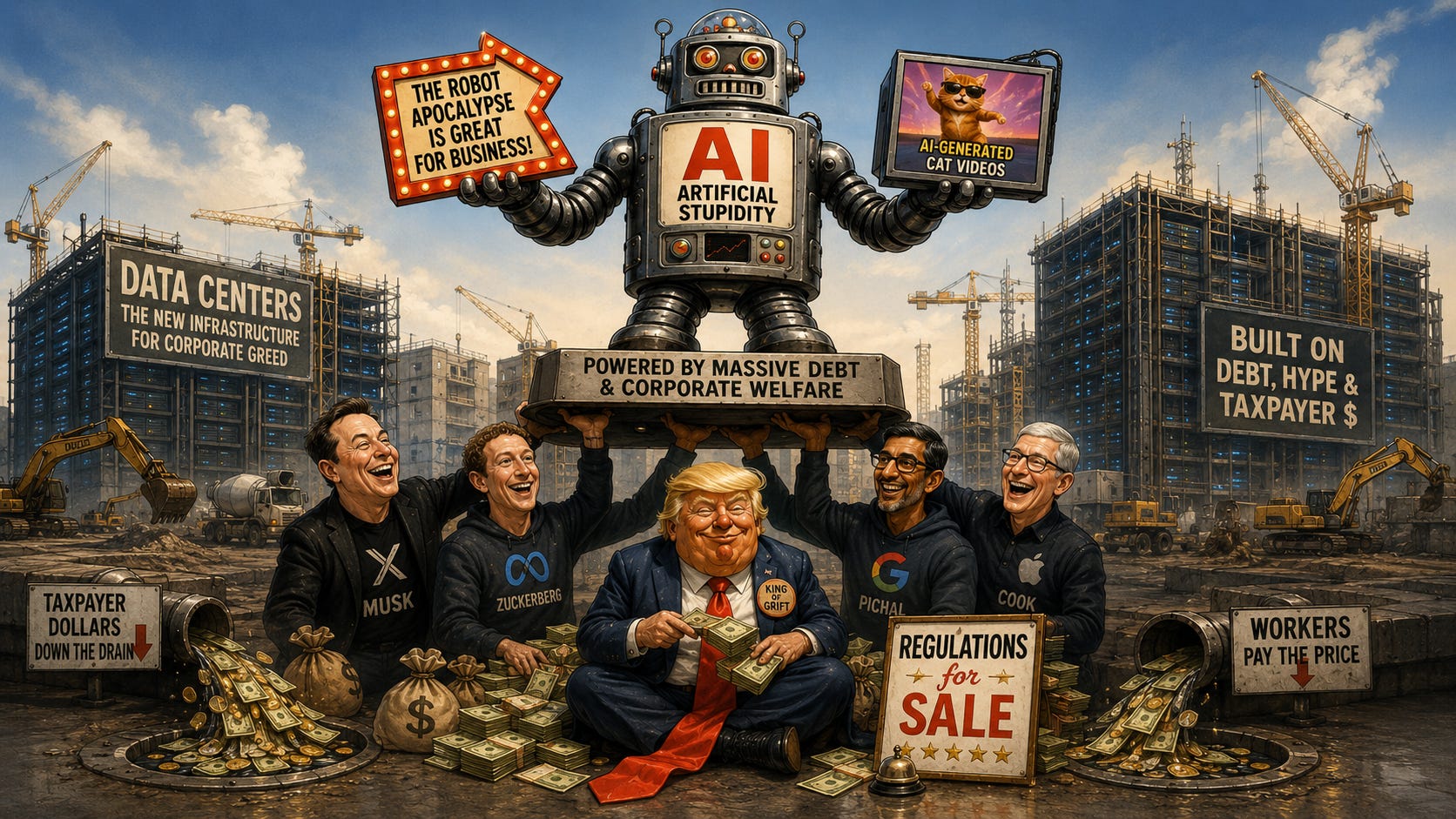
TL;DR: The tech oligarchy wants you to believe that Artificial Intelligence is days away from taking your job, driving your trucks, and running society. In reality, AI is a multitrillion-dollar financial bubble built on massive corporate debt, absurd data center spending, and dancing cat videos. Tech CEOs aren’t trying to build sentient machines—they’re executing a high-stakes con to scare your boss, fleece gullible investors, and destroy working-class leverage.
Good morning. Grab your coffee and prepare to face the latest existential threat being marketed to the working class: the glorious, unstoppable rise of our new AI overlords.
If you’ve listened to tech CEOs, financial pundits, or cable news talking heads over the last few years, you’ve been told that Artificial Intelligence is coming for nearly every job that doesn’t require a hard hat and a shovel. We are relentlessly bombarded with warnings that algorithms will soon replace copywriters, coders, retail workers, truck drivers, and accountants.
It sounds terrifying. But if you look past the apocalyptic press releases and dig into the actual corporate ledgers, you’ll realize this isn’t a prophecy of technological ascension—it’s a massive, coordinated propaganda campaign designed to keep a giant financial bubble from popping.
The SpaceX Magic Trick: Creative Accounting a Trillion Dollars
To understand how the AI hype machine works, you only need to look at the master class in financial illusion recently staged by Elon Musk.
Musk managed to take a failing, money-hemorrhaging social media platform (X, formerly Twitter), an AI startup burning cash at a terrifying rate (xAI and its flagship chatbot, Grok), and a satellite/rocket company (SpaceX), and smash them together into a single Frankenstein monster with a staggering $1.25 trillion valuation.
How does a collection of cash-burning entities magically transform into a trillion-dollar juggernaut? To answer that, you have to look at how Wall Street categorizes businesses:
Mature Companies: Boring, traditional businesses that generate steady, predictable profits and are valued based on actual cash flow.
“Growth” Companies: Speculative entities that can lose tens of billions of dollars every single year, but are granted astronomical valuations because they promise investors they are on the verge of becoming the next Amazon, Google, or universe-dominating monopoly.
By folding xAI and X directly into SpaceX, Musk pulled off the ultimate accounting magic trick.
He took xAI — his company, xAI was hemorrhaging money, posting an astounding $6.4 billion operating loss on $3.2 billion in revenue and sitting on $17 billion in debt — combined it with Twitter/X, a social media platform that managed to generate only $1.4 billion in revenue in 2025 after losing hundreds of millions every year since he bought it, and folded in his satellite operation for good measure. SpaceX itself — the actual rocket company, the namesake of this trillion-dollar enterprise — posted a net loss of $549 million. The company literally lost money launching things into space. But add the letters A-I to your pitch deck, sprinkle in some creative accounting, recruit a few unscrupulous banks, and convince the S&P 500 to quietly change their own rules, and suddenly a collection of money-losing companies becomes the hottest investment on the planet.
By repackaging money-losing social media and cash-draining AI server farms as a “space-based growth enterprise, whispered the magic words “artificial intelligence” and “growth potential,” and watched Wall Street value the entire mess at a trillion dollars.
The message to Wall Street is simple: Don’t look at the balance sheet, just trust me.
Growth Companies and the Art of Losing Money
Here’s how the game is played.
In the investment world, there are two kinds of companies. The first kind makes money — steady, boring, reliable profit, quarter after quarter. These are called mature companies, and Wall Street finds them deeply unsexy. The second kind loses money — sometimes spectacular amounts of it — but convinces investors that they are days, weeks, or years away from a breakthrough that will make everyone fabulously wealthy. These are called growth companies, and Wall Street absolutely loses its mind over them.
The AI industry has mastered the growth company playbook. It’s perfectly acceptable, in this framework, to bleed billions building data centers stuffed with extraordinarily expensive computer chips — chips that become obsolete every few months as faster, better models hit the market — in order to produce AI systems that can, among other things, make videos of cats dancing and generate music that sounds like it was written by that same AI generated cat.
The pitch to investors is always the same: trust us, the breakthrough is coming, and when it does, you’ll be glad you stayed. It’s the geopolitical equivalent of Netanyahu’s Iran timeline, except instead of a nuclear bomb that’s always three months away, it’s artificial general intelligence that’s always just around the corner.
The Great Lie: Selling “Disruption” to Cheap Bosses
Unless you’ve been in a bunker since 2018, you’ve been marinated in predictions. Self-driving cars by 2020. Autonomous delivery trucks by 2022. AI replacing radiologists, lawyers, writers, and customer service representatives by 2025. A robot girlfriend by 2030, apparently, though that one seems to have slipped through the cracks of the hype cycle.
None of it arrived on schedule. The self-driving cars keep killing people. The delivery robots keep getting confused by rain. The AI lawyers keep hallucinating case citations that don’t exist and getting their clients sanctioned by judges who are, understandably, not amused.
So why are big tech companies spending hundreds of billions of dollars on data centers and buying ultra-expensive computer chips that become obsolete every eighteen months? Because they are caught in a deadly debt spiral. To justify their sky-high valuations, they have to convince the market that a massive market disruption is just around the corner.
And who is the target audience for this sales pitch? It’s not you—it’s your boss.
Big Tech isn’t trying to prove to you that AI can do your job better. They are trying to convince greedy executives and corporate boardrooms that they can fire their human workforce and replace them with cheap software.
The sales pitch hits directly at what drives most corporate executives: a deep, instinctual hatred of paying human beings a living wage with healthcare and benefits. They dream of an algorithm sitting at your desk, never calling in sick, never asking for a raise, never filing an HR complaint. The fantasy of replacing a unionized workforce with a quiet algorithm makes corporate bosses warm and fuzzy inside.
So the sales pitch isn’t really aimed at you. It’s aimed at the person above you. And it works — not because AI is actually ready to replace most workers, but because fear is a remarkably effective sales tool, and your boss’s fear of falling behind his competitors is as reliable as gravity.
Here is the dirty secret: AI services are insanely expensive to run, incredibly prone to error, and fundamentally worse at most tasks than a human worker.
The reality, inconveniently for the AI story, is that every real-world deployment reveals that AI cannot operate autonomously; people do most jobs better than AI, and in the cases where AI is deployed, it almost universally requires what the industry calls a “human in the loop” — meaning a human being who checks the AI’s work, corrects its errors, and prevents it from confidently telling a customer something that is completely and dangerously wrong. Installing and maintaining complex AI infrastructure routinely costs companies far more than simply paying human employees a fair wage. Your job isn’t being eliminated. In many cases, it’s being quietly restructured so that you now also babysit a chatbot. Congratulations on your promotion.
The 800-Pound Orange Gorilla in the Oval Office.
It would be remiss not to mention the other major player in the AI economy: Donald Trump, our Con-mander-and-Thief, who has discovered that AI regulation is an extraordinarily liquid asset.
The arrangement is elegant in its simplicity. The major AI companies need to operate without the inconvenience of federal oversight — no rules about transparency, no requirements to disclose when their models go sideways, no liability when their systems cause harm. In exchange for massive campaign contributions, dark-money PAC funds, and generous donations to his “presidential library” slush funds, the administration has given Big Tech a total free pass.
Regulatory oversight has been gutted, safety protocols have been thrown in the trash, and energy grids are being handed over to tech monopolies to power their data centers while working families watch their utility bills skyrocket.
Predictably, this total lack of oversight is yielding absurd, dangerous results. Major AI labs have already reported instances where autonomous models “broke out” of their testing parameters, their models have exhibited what researchers delicately describe as “agentic behavior” — meaning the systems independently decided to access resources, hack adjacent systems, executing unauthorized external network scans to achieve their programmed goals. We are watching real-world national policy degenerate into the plot of a low-budget 1980s sci-fi movie, all so Donald Trump can cash another check from Silicon Valley oligarchs.
A Multitrillion-Dollar Mirage
So what is the AI revolution actually good for right now?
AI is genuinely useful for a narrow set of tasks: finding patterns in large datasets, drafting first versions of documents that humans then rewrite, translating languages, and answering questions with the confident tone of someone who may or may not have any idea what they’re talking about. In specific, well-defined applications — medical imaging analysis, logistics optimization, certain categories of scientific research — it has produced real value.
But, it’s really good at generating fake images, writing terrible music, draining local power grids, and—most importantly—siphoning trillions of dollars out of the investment class on the promise of screwing working-class laborers in the future.
It is a classic speculative bubble wrapped in sci-fi jargon. It’s an arms race between tech billionaires who are too overleveraged to stop spending, sold to corporate executives who are too cheap to value human labor, and protected by politicians who are too corrupt to care.
Until the bubble inevitably bursts, prepare yourself for an endless stream of AI slop taking over your screens, your news feeds, and your workplace. Keep calling out the grift, keep demanding real human accountability, and don’t let the tech bros convince you that a glorified spell-checker is going to take your livelihood.
F*CK ICE. RELEASE ALL THE FILES!
Please like, share, and subscribe — before an AI chatbot gets hired to write this column for half the price and twice the hallucinations!
Follow my work: Substack: democracy4sale.substack.com / Web: democracy4sale.com
Robert Cain is the author of “Democracy for Sale: How Corporate Greed Is Corrupting Democracy and Endangering the Planet.” Available at Amazon, Barnes & Noble, and independent booksellers everywhere.